Carex, Genus, densa, Species,
- Genus & species
dense sedge
Western North America from British Columbia to Baja California
Overview
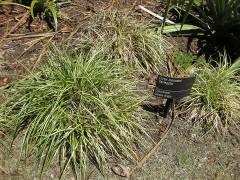
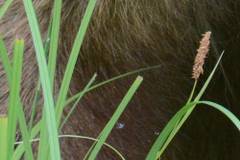
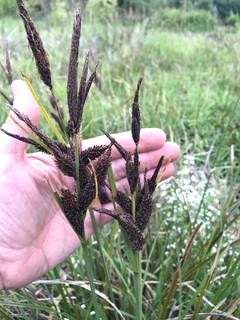
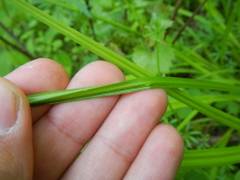
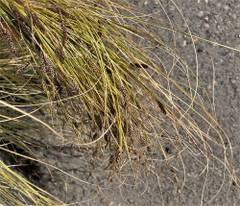
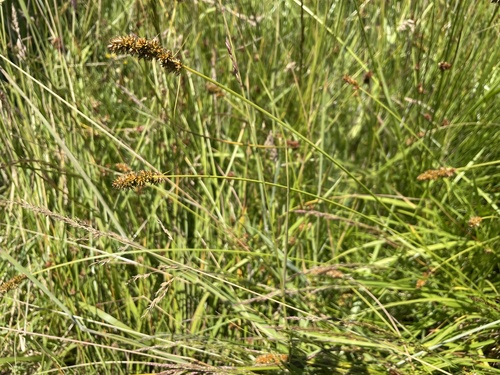
Carex densa is a deciduous clumping perennial sedge reaching 12-30 inches (30-75 cm) tall and 12-24 inches (30-60 cm) wide, forming a tight bunch of upright to arching foliage. Leaves are flat, bright green to medium green, 0.1-0.2 inch (3-5 mm) wide and 8-20 inches (20-50 cm) long. Flowering stems are stiffly upright, triangular in cross-section, and bear a single dense head of 8-25 short spikes packed into a head 0.6-1.5 inches (1.5-4 cm) long; the head is brown to tawny at maturity. Bloom occurs from March through June depending on elevation. Plants form a discrete clump that expands by 1-2 inches (2.5-5 cm) per year without rhizomatous spread; mature clumps reach 18-24 inches (45-60 cm) wide within 4-5 years. Foliage yellows after bloom in dry summers but recovers with fall rain. Self-seeds modestly in open moist soil; volunteer seedlings can be transplanted or removed.
Native Range
Native to western North America from British Columbia through Washington, Oregon, and California to northern Baja California. Grows in seasonally wet sites: vernal pool margins, swales, low-gradient stream banks, and moist meadows at elevations from sea level to 4,000 feet (1,200 m). Persists on heavy clay soils that are flooded in winter and dry in summer.Suggested Uses
Used in rain gardens, vernal pool plantings, native meadows, and streamside restorations, spaced 15-18 inches (38-45 cm) apart in moist sites. Plantings combine with Juncus patens, Sisyrinchium bellum, and Achillea millefolium in seasonally wet California meadows. Compatible with full sun in moist soils or part shade in drier conditions; tolerates clay and brief winter inundation.How to Identify
Appearance
Size & Dimensions
Height1' - 2'6"
Width/Spread1' - 2'
Bloom Information
Blooms March through June, with peak inflorescence development in April at low elevations and May to early June in foothill populations. Each clump produces flowering culms over a 3-4 week window. Spikes hold their form for 6-8 weeks before perigynia disperse.
Detailed Descriptions
Flower Description
brown to tawnyFoliage Description
bright green to medium greenGrowing Conditions
Sun Requirements
Requires 4-9 hours of direct sunlight daily
• Full Sun: 6+ hours of direct sunlight
• Partial Shade: 3-6 hours of direct sunlight
• Full Shade: Less than 3 hours of direct sunlight
Care & Maintenance
Care Guide
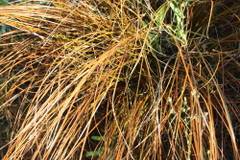
Water at planting and through the first growing season; established plants in seasonally wet sites tolerate summer drought once dormant. Foliage browns in dry summers and rebounds with fall and winter rain. Few pest or disease problems occur. Old foliage can be cut to 3 inches (7.5 cm) in late winter before new growth emerges; cutting reveals a clean clump for spring. Self-seeding is light to moderate in open soil and can be controlled by removing seedheads before perigynia ripen. Fertilization is not required.Pruning
Foliage is cut to 3-4 inches (7.5-10 cm) above the crown in late February or early March before new growth begins. Spent flowering stems can be removed in early summer to limit self-seeding, or left to mature for habitat value. No mid-season grooming is required.Pruning Schedule
Prune: February–March
winterearly spring
Container Growing
Suitable for container growing
Minimum container size: 3 gallons