Calophyllum, Genus, inophyllum, Species,
- Genus & species
Kamani
Coasts of East Africa, South and Southeast Asia, northern Australia, and the Pacific islands
Overview
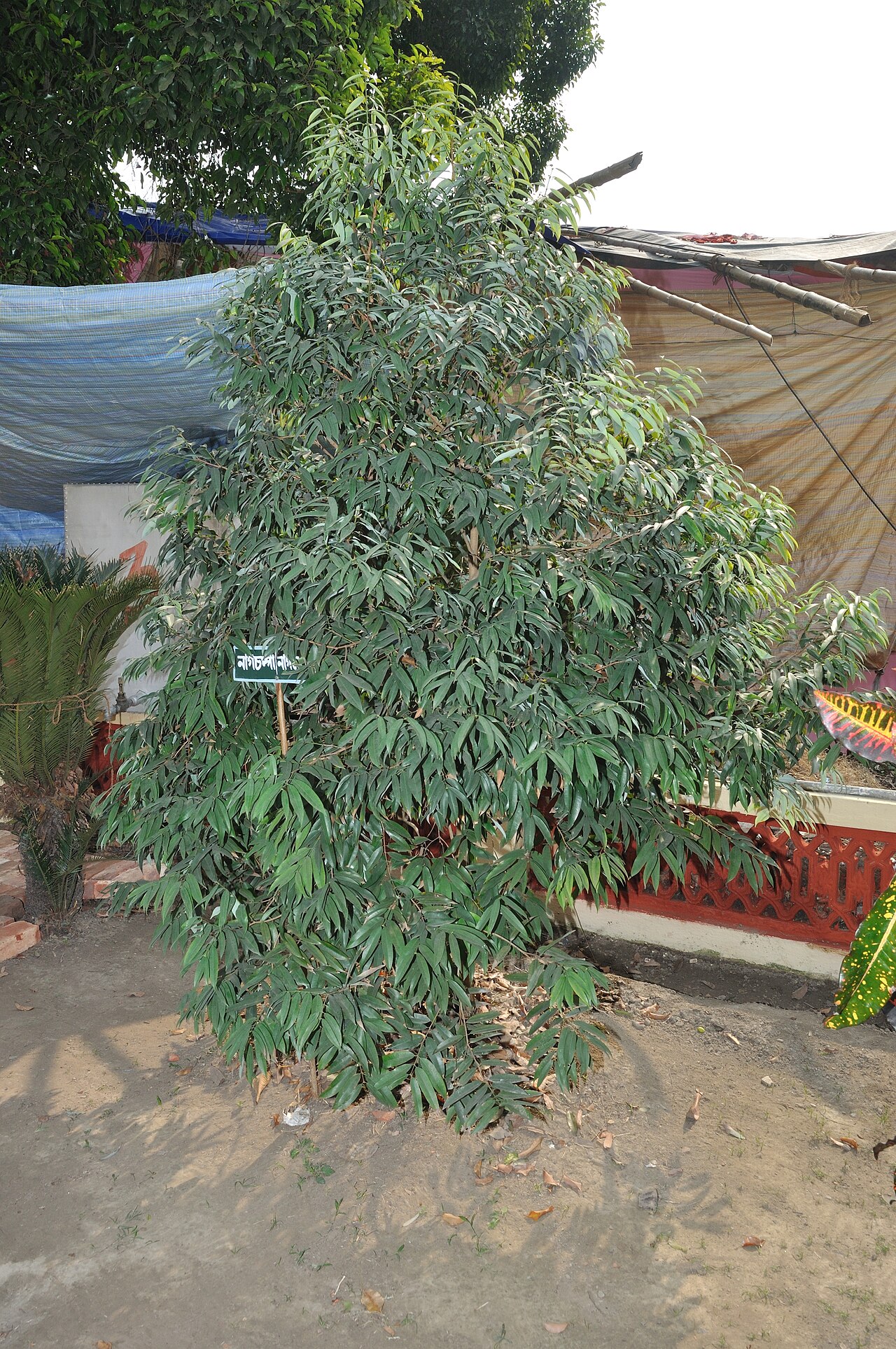
Calophyllum inophyllum is an evergreen coastal tree 25-65 feet (8-20 m) tall with a broad low crown 25-50 feet (7.5-15 m) across, often leaning seaward over sand or water on exposed shorelines. Bark is gray-brown with shallow diamond-shaped fissures and exudes sticky yellow-green latex when cut. Leaves are opposite, thick and leathery, glossy dark green, 4-8 inches (10-20 cm) long, and marked by many closely spaced parallel lateral veins running at right angles to the midrib. Flowers are white, about 1 inch (2.5 cm) across, borne in axillary racemes of 5-15, with a central boss of yellow stamens and a strong sweet scent. Fruit is a round green drupe 1-1.5 inches (2.5-4 cm) across ripening to yellow-brown, holding a single large seed whose kernel yields the dark green tamanu oil used in skin preparations. The seed kernel is not edible. The trunk is often short and crooked, growth slows after the first decade, and the crown drops hard fruit through much of the year onto whatever lies beneath. It withstands salt spray, partial sand burial, and sustained coastal wind, and re-establishes quickly on cyclone-scoured strand.
Native Range
Calophyllum inophyllum is native to coastal habitats from East Africa and Madagascar through South and Southeast Asia to northern Australia and the Pacific islands as far east as the Marquesas. Its seeds float in seawater for months, which accounts for the continuous shoreline distribution across two oceans. In Hawaii it was introduced by Polynesian settlers and grows on lowland coasts and in valley bottoms below 1,000 feet (300 m).Suggested Uses
Planted as a shade and windbreak tree in coastal parks, beachfront properties, and shoreline restoration at spacings of 25-35 feet (7.5-10.5 m). The dense interlocked timber is worked into canoe hulls, bowls, and furniture across the Pacific, and the seed kernel is pressed for tamanu oil used in cosmetics and skin preparations. Roots bind loose sand and the canopy filters salt-laden wind from plantings behind it.How to Identify
Appearance
Size & Dimensions
Height25' - 65'
Width/Spread25' - 50'
Bloom Information
Flowering occurs in two flushes across most of the range, March to May and September to November, and continues year-round near the equator. Racemes carry 5-15 flowers that open a few at a time over 2-3 weeks, and the scent is strongest in the morning. Fruit takes 8-12 months to ripen from green to yellow-brown, so flowers and mature fruit occur on the tree together. Trees begin flowering at 5-8 years old.
Detailed Descriptions
Flower Description
White with a boss of yellow stamensFoliage Description
Glossy dark greenGrowing Conditions
Sun Requirements
Requires 6-12 hours of direct sunlight daily
• Full Sun: 6+ hours of direct sunlight
• Partial Shade: 3-6 hours of direct sunlight
• Full Shade: Less than 3 hours of direct sunlight
Care & Maintenance
Care Guide
Calophyllum inophyllum grows in full sun on free-draining sand, coral rubble, or rocky loam at pH 6.0-8.5 and tolerates direct salt spray and brackish groundwater. Established trees withstand 4-6 dry months, and rainfall of 40-100 inches (1,000-2,500 mm) a year sustains steady growth. Hardiness is limited to USDA zones 10-12, with damage below 34F (1C). Young trees are staked at exposed coastal sites for the first 2-3 years, after which the low crown and deep taproot hold them against wind. Fertilizer is seldom required on coastal sand beyond an annual balanced application while young. Kamani leaf blotch fungus and black twig borer damage foliage and shoot tips in Hawaii, and sooty mould follows scale infestations in still, humid sites.Pruning
Pruning is carried out in summer, raising the crown on young trees to clear paths and taking out crossing limbs before they graft together. The wood is dense and cuts seal slowly, so branches over 4 inches (10 cm) in diameter are reduced to a lateral instead of removed whole. Latex flows heavily from fresh cuts for several hours and stains clothing and paving. Storm-damaged limbs are cut back to the branch collar.Pruning Schedule
Prune: June–July
summer