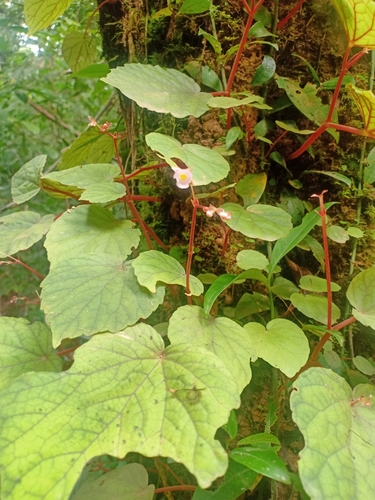
Begonia grandis ssp.
hardy begonia
Overview
Begonia grandis ssp. is a tuberous, clump-forming herbaceous perennial reaching 18–24 inches (45–60 cm) tall with a spread of 12–18 inches (30–45 cm). This is the hardiest begonia subspecies, persisting in zones 6–9 where other begonias are treated as annuals. Stems are succulent, upright to slightly arching, red-tinted. Leaves are asymmetrical, broadly ovate, 4–6 inches (10–15 cm) long, olive-green on the upper surface with prominent red veining on the underside. The red leaf undersides flash with movement and are visible from below in raised plantings. Pendant clusters of soft pink, 4-petaled flowers 1–1.5 inches (2.5–4 cm) across appear in August–October, later than most garden perennials. The plant produces small bulbils in the leaf axils in late summer and fall; these drop to the ground and establish new plants, creating colonies over 3–5 years. The colonizing habit can become aggressive in moist, sheltered shade gardens. The tuberous rootstock goes fully dormant in winter and emerges late in spring (May–June), leaving the ground bare until early summer.
Native Range
Begonia grandis is native to China, Japan, and the Malay Peninsula. Ssp. evansiana spp. occurs in moist, shaded mountain forests and stream banks at elevations of 1,000–5,000 feet (300–1,500 m) in central and southern China and Japan.Suggested Uses
Planted in woodland gardens, shaded borders, and along north-facing foundations at 12–18 inch (30–45 cm) spacing. The late emergence (May–June) pairs with spring ephemerals that go dormant by early summer. The pendant pink flowers provide late-season color in shade when few other perennials are blooming. The red leaf undersides are visible in raised beds and slopes. Grows in containers of at least 3 gallons (11 L) in humus-rich mix; store containers frost-free in zones 5–6.How to Identify
Appearance
Size & Dimensions
Height1'6" - 2'
Width/Spread1' - 1'6"
Reaches mature size in approximately 2 years
Bloom Information
Pendant clusters of soft pink flowers appear in August–October. Individual flowers are 4-petaled, 1–1.5 inches (2.5–4 cm) across. Female flowers have a winged ovary below the petals; male flowers have a central cluster of yellow stamens. Bloom continues until frost. Bulbils form in the leaf axils from September onward, dropping to the ground after the first frost.
Detailed Descriptions
Foliage Description
Olive-green upper surface with bright red veining beneathGrowing Conditions
Sun Requirements
Requires 1-4 hours of direct sunlight daily
• Full Sun: 6+ hours of direct sunlight
• Partial Shade: 3-6 hours of direct sunlight
• Full Shade: Less than 3 hours of direct sunlight
Care & Maintenance
Care Guide
Plant in humus-rich, consistently moist soil in partial to full shade. The tubers emerge late in spring (May–June); do not disturb the planting area in early spring while the ground appears bare. Consistent moisture is essential during the growing season; drought causes leaf curling and premature dormancy. The bulbil production creates colonies that can crowd out smaller companions in sheltered, moist sites; remove unwanted bulbils before they establish if spread is undesirable. Mulch with 3–4 inches (8–10 cm) of leaf mold over the dormant tubers in zones 6–7 for winter protection. Slugs and snails feed on the succulent stems and leaves.Pruning
Remove spent flower clusters if desired, though they drop cleanly after frost. After the first hard frost blackens the foliage, cut all stems to ground level or allow them to collapse naturally. The dormant tubers require no attention until emergence in late spring. Remove unwanted bulbil-grown plants in spring or fall to control colony expansion.Pruning Schedule
J
F
M
A
M
J
J
A
S
O
N
D
fall
Container Growing
✓ Suitable for container growing
Minimum container size: 3 gallons