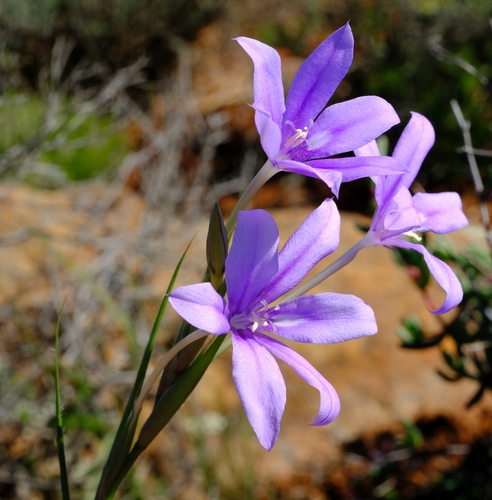
Babiana, Genus, spp., Multiple species,
- Genus
- Multiple species
baboon root
Overview
Babiana is a genus of about 90 cormous perennials in the iris family (Iridaceae), native mostly to the winter-rainfall regions of western South Africa and Namibia, with one species on Socotra. The common names baboon root and bobbejaantjie come from the baboons that dig up and eat the corms. Plants grow 10-40 cm (4-16 in) tall from a fibre-coated corm and bear lance-shaped, strongly pleated, usually hairy leaves that are often held stiffly upright like a fan. In spring they raise spikes of funnel-shaped, freesia-like flowers in blue, mauve, purple, violet, crimson, cream, and yellow, frequently marked with contrasting blotches; the flowers of several species carry a sweet scent. Pollination is by bees and long-tongued flies, while the bird-pollinated B. ringens produces a sterile side branch that perching sunbirds use as a stand. After flowering the leaves die back and the corm rests through the dry summer. The genus is frost-tender and adapted to mild, dry-summer climates with a wet winter growing season.
Native Range
Babiana is native chiefly to the western and southern Cape of South Africa and to Namibia, where most species grow in sandy, seasonally dry, winter-rainfall country. A single outlying species occurs on the island of Socotra.Suggested Uses
Babiana species are grown in rock gardens, raised beds, and gravel gardens in mild, dry-summer climates, and widely in pots and bulb frames elsewhere. They suit the front of sunny borders and naturalise in sandy ground where summers are dry. The spring flowers draw bees and, in some species, nectar-feeding birds.How to Identify
Appearance
Size & Dimensions
Height4" - 1'4"
Width/Spread3" - 6"
Bloom Information
Flowering is in spring, mainly from late winter to mid-spring in the native range, with each corm sending up one or more short flower spikes. Bloom lasts several weeks, and the flowers of scented species are strongly scented in warm sun. Plants then die back for their summer rest.
Detailed Descriptions
Flower Description
blue, purple, violet, red, cream, or yellowFoliage Description
greenGrowing Conditions
Sun Requirements
Requires 6-10 hours of direct sunlight daily
• Full Sun: 6+ hours of direct sunlight
• Partial Shade: 3-6 hours of direct sunlight
• Full Shade: Less than 3 hours of direct sunlight
Care & Maintenance
Care Guide
Plants grow in full sun on sandy, sharply drained soil at a pH of 5.5-7.0. Corms are planted in autumn, watered through the cool growing season, and kept dry once the leaves yellow and die back in late spring. They are frost-tender, hardy to about USDA zone 8, and are grown in pots or lifted where winters are cold and wet. Summer wet during dormancy rots the corms. Plants are set 8-10 cm (3-4 in) deep on lean soil with little feeding.Pruning
No pruning is needed beyond cutting off spent flower spikes if seed is not wanted. Yellowing leaves are left to die down so the corm can build reserves, then cleared. Crowded clumps are lifted and divided during summer dormancy.Container Growing
Suitable for container growing
Minimum container size: 1 gallons