Overview
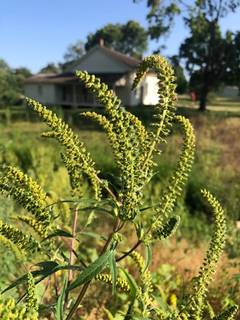
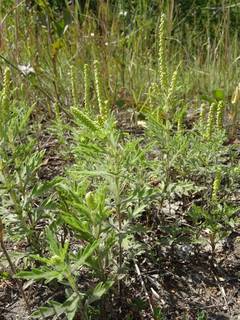
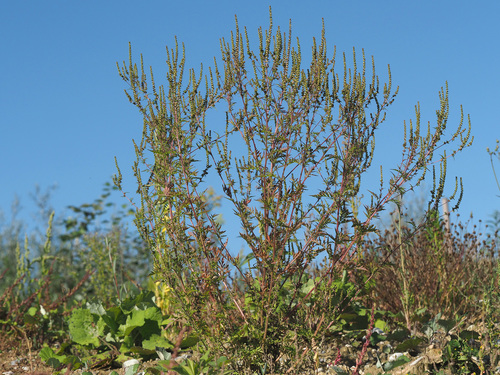
Ambrosia artemisiifolia, common ragweed, is an erect annual in the aster family, growing 1-6 feet (30-180 cm) tall on branched, hairy, often reddish stems. The leaves are 2-4 inches (5-10 cm) long, deeply twice-divided into narrow lobes, fern-like, and grey-green, set opposite low on the stem and alternate above. From late summer into autumn it produces slender upright spikes of small greenish male flower heads at the stem tips, with inconspicuous female heads clustered below in the leaf axils. It is wind-pollinated and releases large amounts of light pollen, a leading cause of late-summer hay fever across its range. The flowers are followed by small, woody, spiny seeds that can stay viable in soil for many years. The plant grows quickly on cultivated and disturbed ground, completing its cycle in one season and dying with the first hard frost. It is native to North America but has become a widespread weed of farmland and roadsides on several continents. It self-sows heavily and forms dense stands on bare ground.
Native Range
Native to North America, where it occurs across most of the United States, southern Canada, and into Mexico. It grows in fields, roadsides, riverbanks, and other disturbed open ground. It has spread as an invasive weed to Europe, Asia, and Australia, where its pollen is also a major allergen.Suggested Uses
It is treated as a weed rather than a cultivated plant and has no ornamental use. Its seeds are eaten by birds and small mammals in autumn and winter. Where it grows, it is usually controlled to limit pollen and seed.How to Identify
Appearance
Size & Dimensions
Height1' - 6'
Width/Spread1' - 2'
Bloom Information
Flowers from midsummer into autumn, mainly August and September, timed with shortening days. The greenish male spikes shed wind-borne pollen rather than attracting insects, so the flowers have no scent or showy color. Pollen release peaks in late summer mornings and is a major hay-fever trigger.
Detailed Descriptions
Foliage Description
grey-greenGrowing Conditions
Sun Requirements
Requires 6-12 hours of direct sunlight daily
• Full Sun: 6+ hours of direct sunlight
• Partial Shade: 3-6 hours of direct sunlight
• Full Shade: Less than 3 hours of direct sunlight
Water & Climate
Water Needs
Drought Tolerance
Drought tolerant when established
Care & Maintenance
Care Guide
Grows in full sun on a wide range of soils, including poor, dry, compacted, and disturbed ground. It needs no care and germinates readily on bare soil, growing fast through summer. Because it self-sows heavily and its pollen causes allergies, removing plants before flowering limits both spread and pollen. Pulling or hoeing young plants before the spikes form reduces the next generation. It dies with the first hard frost and relies on seed for the next year. It has few pests and competes strongly on open ground.Pruning
No ornamental pruning is needed. Cutting or mowing before the flower spikes shed pollen reduces both seed set and airborne pollen. Plants do not regrow after they die back at frost.Pruning Schedule
Prune: July–August
summer