Allium, Genus, proliferum, Species,
- Genus & species
tree onion
Of cultivated origin as a hybrid between Allium cepa (common onion, native to Central Asia) and Allium fistulosum (Welsh onion, native to China); cultivated for centuries in Europe and North America with historical records from at least the 18th century; no wild populations known
Overview
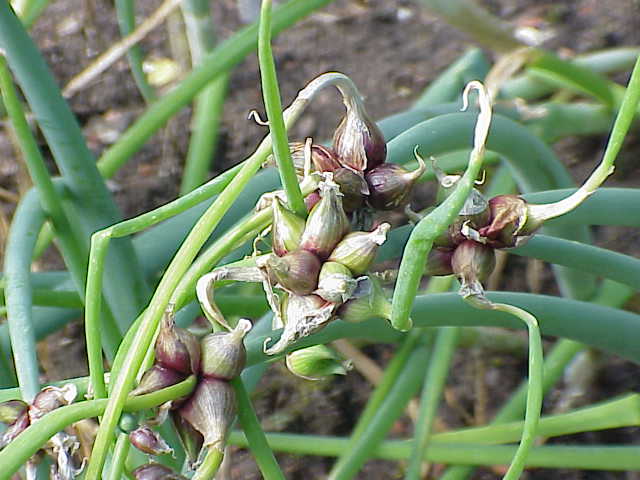
Allium proliferum (synonyms Allium × proliferum, Allium cepa var. proliferum) is a perennial onion in the family Amaryllidaceae reaching 24–48 inches (60–120 cm) tall and 8–12 inches (20–30 cm) wide. The species produces clusters of small bulbils (topsets) at the top of the flower stalk in place of — or in addition to — flowers. These aerial bulbils run 0.25–0.75 inch (6–18 mm) in diameter and develop at the stalk apex in a cluster of 5–20, sometimes sprouting green shoots while still attached to the parent plant. As the bulbil cluster gains weight, the stalk bends and touches the ground, where the bulbils root and establish new plants — the 'walking' behavior that gives the species the common name 'walking onion.' Botanically, the species is a hybrid between Allium cepa (common onion) and Allium fistulosum (Welsh onion) and is maintained vegetatively rather than by true seed. The basal bulb runs 1–2 inches (2.5–5 cm) in diameter, elongated, with a mild onion flavor; the hollow tubular leaves are 12–24 inches (30–60 cm) long and 0.5–0.75 inch (12–18 mm) wide, used as scallions in fresh culinary applications. All parts are edible: topsets, green leaves, and basal bulbs. Hardy to approximately -30°F (-34°C) once established. The species is essentially maintenance-free as an edible perennial — historical records document plantings persisting for decades in abandoned farmsteads without human intervention. Like all Allium species, it is harmful to cats and dogs if eaten, with cats especially susceptible; people eat it widely as a vegetable.
Native Range
Allium proliferum is of cultivated origin and arose as a hybrid between Allium cepa (common onion, native to Central Asia) and Allium fistulosum (Welsh onion, native to China). The species has been cultivated for centuries in Europe and North America, with historical records from at least the 18th century. No wild populations are known — the species exists only in cultivation and as escaped feral populations descended from cultivated stock.Suggested Uses
Grown in vegetable gardens, herb gardens, and edible perennial borders as a permanent scallion and onion source — a single planting yields scallion-grade green leaves from early spring through late autumn, topset bulbils from July through September, and basal bulbs at the end of the growing season. The topsets are planted as starts for new colonies, used as pearl-onion-sized cooking onions in pickled or sautéed preparations, or pickled whole in vinegar brines. Green leaves are harvested as needed for scallion use across the growing season — the perennial habit produces leaves continuously rather than the single-harvest cycle of annual scallion cultivars. The species runs essentially self-perpetuating — historical records document plantings persisting for decades in abandoned farmsteads without human intervention, which makes the species a teaching example in low-input edible perennial design and in the comparison of perennial versus annual vegetable cultivation systems. The walking habit of bulbil-rooting at the stalk-bending point can spread the colony into adjacent garden positions if topsets are not harvested before they root; harvesting before bend-down maintains the planting in the original position.How to Identify
Appearance
Size & Dimensions
Height2' - 4'
Width/Spread8" - 1'
Bloom Information
Flower stalks emerge from June through July, typically producing bulbils rather than true flowers. When flowers do appear, they run small greenish-white interspersed among the developing bulbils at the stalk apex. Topsets mature from July through September, growing larger and heavier until the stalk bends to the ground under the cumulative weight. Topsets can be harvested at any point along this maturation curve or left to root and self-plant for colony expansion. Plants are wind-pollinated when true flowers do open; insect activity at the flowers runs minimal due to the small flower size and the prevalence of vegetative bulbil production over sexual reproduction.
Detailed Descriptions
Flower Description
Greenish-white (rare flowers); topset bulbils green to brown 0.25-0.75 inch in diameter in clusters of 5-20 at stalk apexFoliage Description
Medium green; hollow tubular 12-24 inches long and 0.5-0.75 inch wideGrowing Conditions
Sun Requirements
Requires 6-10 hours of direct sunlight daily
• Full Sun: 6+ hours of direct sunlight
• Partial Shade: 3-6 hours of direct sunlight
• Full Shade: Less than 3 hours of direct sunlight
Care & Maintenance
Care Guide
Plant topsets or basal divisions 1 inch (2.5 cm) deep and 6–8 inches (15–20 cm) apart in spring or autumn in full sun in fertile well-drained soil at pH 6.0–7.0. Water regularly during the first growing season for root establishment; once established, the deep root system tolerates moderate drought. Feed with compost or a balanced fertilizer in early spring at the start of new growth. The species runs essentially self-maintaining — topsets that root will establish new plants without human intervention. To contain spread, harvest topsets before they root and bend the stalk to the ground. Divide congested clumps every 3–4 years to maintain vigor and to prevent the central crown from dying out as the colony ages. Hardy to USDA zone 3 without winter protection; foliage dies back to the basal bulb in autumn and resprouts from the bulb in early spring. Unlike annual onions, A. proliferum does not require lifting and replanting each year — a single planting yields scallions and topsets indefinitely.Pruning
Remove dead stalks at the base in late autumn after topsets have been harvested or have rooted into the soil. Cut back any damaged or yellowing foliage at any time across the growing season. No other pruning is required. In spring, remove weak or overcrowded shoots from divided clumps to maintain adequate spacing for the remaining plants.Pruning Schedule
Prune: November
fall
Container Growing
Suitable for container growing
Minimum container size: 5 gallons