Allium, Genus, moly, Species,
- Genus & species
golden garlic
Overview
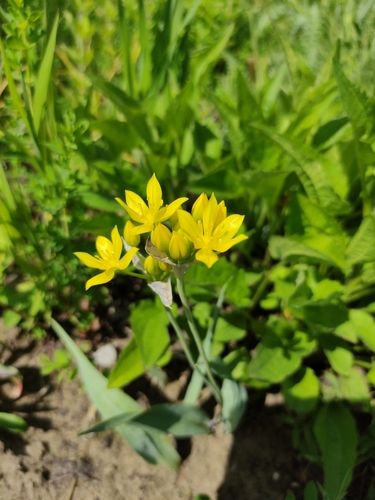
Allium moly is a compact bulbous perennial reaching 8–14 inches (20–35 cm) tall and 6–10 inches (15–25 cm) wide, growing from small ovoid bulbs 0.5–1 inch (1.3–2.5 cm) in diameter. Leaves are basal, broad and lance-shaped, 1–2 inches (2.5–5 cm) wide and 6–10 inches (15–25 cm) long, blue-gray to gray-green. Foliage emerges in early spring and persists through bloom before yellowing by midsummer. Flower umbels are loose and hemispherical, 2–3 inches (5–8 cm) across, composed of 15–30 star-shaped bright yellow flowers on slender stalks. Bloom occurs May through June, with individual umbels lasting 2–3 weeks. Yellow flower color sets this species apart from most cultivated Allium, which produce purple, pink, or white blooms. Plants self-seed prolifically in open, well-drained soils and spread through both bulb offsets and seed, forming dense colonies within 3–5 years. In parts of the Pacific Northwest and other mild-winter regions, A. moly has naturalized beyond garden boundaries. Bulbs are dormant by midsummer and require dry conditions from July through September. Foliage gap appears from late June onward.
Native Range
Native to southwestern Europe, found in Spain and southern France. Grows in rocky, open woodland, scrub, and dry grassland habitats at 1,000–5,000 feet (300–1,500 m) elevation in areas with Mediterranean-climate dry summers.Suggested Uses
Commonly planted in rock gardens, woodland edges, and naturalized plantings at 4–6 inch (10–15 cm) spacing in groups of 15–25. Partial shade tolerance suits planting under deciduous trees. Prolific self-seeding and offset production make this species unsuited to formal or contained plantings without regular management to control spread.How to Identify
Appearance
Size & Dimensions
Height8" - 1'2"
Width/Spread6" - 10"
Bloom Information
Flowers May through June in zones 3–9. Individual umbels last 2–3 weeks. In zones 8–9, bloom begins in late April. Bloom timing overlaps with late tulips and early alliums such as A. karataviense.
Detailed Descriptions
Foliage Description
Blue-gray to gray-green, broad, lance-shaped, basalGrowing Conditions
Sun Requirements
Requires 4-8 hours of direct sunlight daily
• Full Sun: 6+ hours of direct sunlight
• Partial Shade: 3-6 hours of direct sunlight
• Full Shade: Less than 3 hours of direct sunlight
Care & Maintenance
Care Guide
Plant bulbs 3–4 inches (8–10 cm) deep in fall in well-drained soil. Bulbs tolerate a range of conditions but require dry summer dormancy for long-term persistence. Self-seeding is prolific; removing spent flowers before seed set reduces aggressive spread. Bulb offsets also increase colony size. No fertilization is needed. Tolerates partial shade, suiting woodland edge conditions. Slugs may feed on emerging foliage in spring.Pruning
Allow foliage to die back naturally after bloom; remove yellowed leaves in July once fully brown. Deadhead promptly after bloom if self-seeding control is needed. No other pruning required.Pruning Schedule
Prune: July
summer
Container Growing
Suitable for container growing
Minimum container size: 2 gallons