Aleurites, Genus, moluccanus, Species,
- Genus & species
Kukui (candlenut)
Indo-Malaysia and the western Pacific
Overview
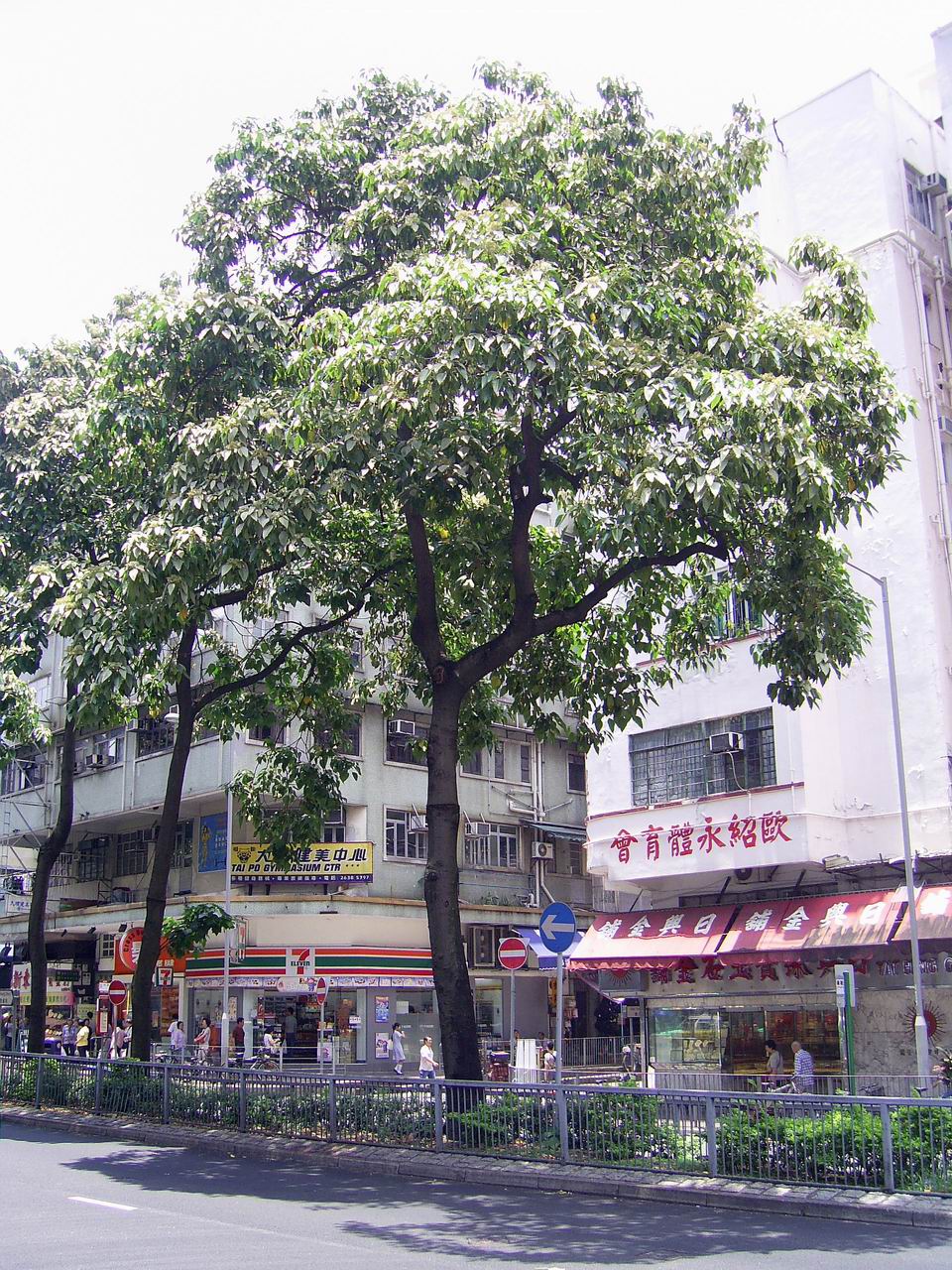
Aleurites moluccanus is a broad-crowned evergreen tree 50-80 feet (15-25 m) tall and 40-70 feet (12-21 m) wide, with a short trunk 2-4 feet (0.6-1.2 m) in diameter and low, wide-angled branching. New growth, petioles, and leaf undersides are coated in dense white stellate hairs, giving the canopy a pale silvery-green cast that separates it from surrounding forest at a distance. Leaves are 4-8 inches (10-20 cm) long, ovate on mature wood and shallowly three- to five-lobed on juvenile shoots and coppice growth, with two raised glands where the blade meets the 3-6 inch (8-15 cm) petiole. Creamy white flowers 0.25 inch (6 mm) across are borne in terminal panicles 4-6 inches (10-15 cm) long, carrying male and female flowers on the same panicle. Fruit is a green drupe 2-2.5 inches (5-6 cm) across containing one or two hard, rough-shelled nuts whose seeds run about 50 percent oil by weight. The wood is soft and brittle and limbs break in storms; fallen fruit and leaves generate heavy litter under the canopy. Raw seeds contain purgative toxins and cause severe gastrointestinal illness when eaten.
Native Range
Aleurites moluccanus is native to Indo-Malaysia and the islands of the western Pacific, with a natural range running from southern India and Southeast Asia through Malesia to Melanesia. Polynesian voyagers carried it across the Pacific, and the trees covering Hawaiian valley slopes descend from those introductions rather than from an endemic population. It has naturalized across the wet and mesic tropics, including parts of the Caribbean and northern Australia.Suggested Uses
Planted as a shade tree in large parks, valley plantings, and watershed restoration at spacings of 30-40 feet (9-12 m). Seed oil is pressed for lamp fuel, wood finishes, and soap, and roasted kernels are ground with salt into the Hawaiian condiment inamona. Bark, husks, and roots yield brown and black dyes used on kapa cloth and fishing nets.How to Identify
Appearance
Size & Dimensions
Height50' - 80'
Width/Spread40' - 70'
Bloom Information
Terminal panicles of creamy white flowers open from March through August, with scattered flowering at other times in continuously wet sites. Individual panicles stay in flower for 2-3 weeks and a tree carries overlapping panicles across a 20-week season. Green drupes follow within 3-4 months and drop through late summer and autumn. Trees begin flowering at 4-6 years old.
Detailed Descriptions
Foliage Description
Pale silvery greenGrowing Conditions
Sun Requirements
Requires 6-12 hours of direct sunlight daily
• Full Sun: 6+ hours of direct sunlight
• Partial Shade: 3-6 hours of direct sunlight
• Full Shade: Less than 3 hours of direct sunlight
Care & Maintenance
Care Guide
Aleurites moluccanus grows in full sun on deep, free-draining soils at pH 5.5-7.5 and tolerates rocky volcanic substrate. Annual rainfall of 25-100 inches (640-2,500 mm) supports full growth, and established trees withstand 2-3 dry months without leaf loss. Hardiness runs to USDA zones 10-11; temperatures below 30F (-1C) kill young shoots. The wood is brittle, so trees are set 25-30 feet (7.5-9 m) back from structures and paths where falling limbs and 2 inch (5 cm) fruit would otherwise land. Seedlings self-sow densely beneath the canopy and form thickets where they are not cleared. Routine fertilizer is unnecessary on volcanic soils, and chlorosis on alkaline substrate responds to chelated iron.Pruning
Structural pruning in the first 5 years removes narrow-angled forks, which split under storm loading in brittle wood. Cuts are made in dry weather between June and September and kept under 4 inches (10 cm) in diameter, since larger wounds decay rather than compartmentalize. Storm-broken limbs are cut back to the branch collar. Sap flow from fresh cuts is heavy in spring and stains paving beneath.Pruning Schedule
Prune: June–September
summer