Abies, Genus, magnifica, Species,
- Genus & species
California red fir
Sierra Nevada (California, Nevada), southern Cascade Range (California, Oregon)
Overview
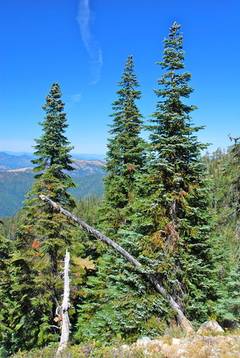
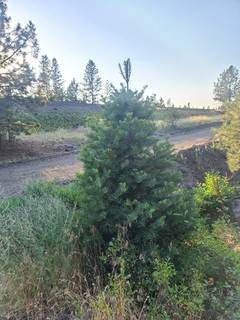
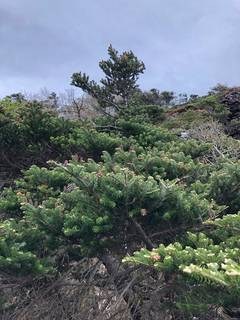
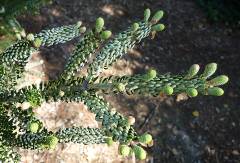
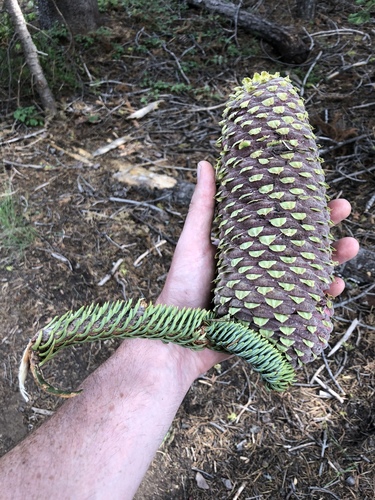
Abies magnifica is a large evergreen conifer native to western North America, reaching 60–150 feet (18–46 m) tall with a spread of 15–30 feet (4.5–9 m) at maturity. The crown is narrowly spire-like. Bark on young trees is smooth, gray, and resinous; on mature trees it becomes thick, deeply furrowed, and reddish-brown — the source of the common name. Needles are 1–1.5 inches (2.5–4 cm) long, four-sided in cross-section, blue-green to glaucous blue, and curve upward around the shoot. Cones are cylindrical, 5–9 inches (13–23 cm) long and 2–3.5 inches (5–9 cm) wide, purplish-green maturing to brown, held upright and disintegrating on the tree in August–September. The species performs poorly below 3,000 feet (900 m) elevation in cultivation and does not tolerate hot, humid lowland climates, air pollution, or heavy soils. Balsam woolly adelgid poses a significant pest threat in parts of its range.
Native Range
Abies magnifica is native to the Sierra Nevada of California and Nevada and the southern Cascade Range of California and Oregon, occurring at elevations of 5,000–10,000 feet (1,500–3,050 m). It grows in montane to subalpine coniferous forests, often in pure stands or mixed with Pinus contorta, Pinus jeffreyi, and Tsuga mertensiana.Suggested Uses
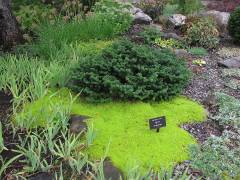
Planted as a specimen or forest tree in large-scale landscapes, parks, and mountain gardens at elevations of 3,000 feet (900 m) or above in the Pacific states. Requires minimum 20–25 feet (6–7.5 m) clearance from structures at planting. Not suitable for lowland urban or suburban gardens, climates with hot and humid summers, or sites east of the Rocky Mountains except at equivalent high elevations.How to Identify
Appearance
Size & Dimensions
Height60' - 150'
Width/Spread15' - 30'
Colors
Bloom Information
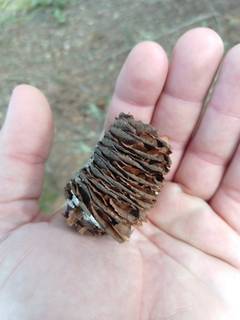
Male strobili are reddish-purple, 0.5–0.75 inch (1.3–2 cm) long, releasing pollen in May–June at high-elevation sites. Female cones form upright, purplish-green at pollination, maturing to 5–9 inches (13–23 cm) long by July–August. Cones disintegrate in place in August–September, releasing winged seeds and leaving a persistent central rachis spike.
Detailed Descriptions
Flower Description
reddish-purple (male strobili); purplish-green to brown (cones)Foliage Description
blue-green to glaucous blueGrowing Conditions
Sun Requirements
Requires 6-12 hours of direct sunlight daily
• Full Sun: 6+ hours of direct sunlight
• Partial Shade: 3-6 hours of direct sunlight
• Full Shade: Less than 3 hours of direct sunlight
Care & Maintenance
Care Guide
Plant in well-drained, deep soil with a pH of 5.0–6.5 at elevations of 3,000 feet (900 m) or above in western North America. Water weekly during the first 2–3 growing seasons in the absence of snowmelt or rainfall. Established trees tolerate seasonal dry periods in Sierra Nevada conditions but decline in chronically dry lowland sites. Summer temperatures above 90°F (32°C) combined with low humidity cause progressive decline; this species does not perform well at low elevations in hot or humid regions. Balsam woolly adelgid causes branch dieback and can be lethal; inspect annually in regions where the pest is established. No routine fertilization is required in native soils.Pruning
No routine pruning is required. The natural spire form is self-maintaining. Remove dead or damaged branches in late spring. The central leader should not be cut; its loss results in a forked top that does not regenerate. This species is not suitable for size control by pruning.Pruning Schedule
Prune: May–June
late spring