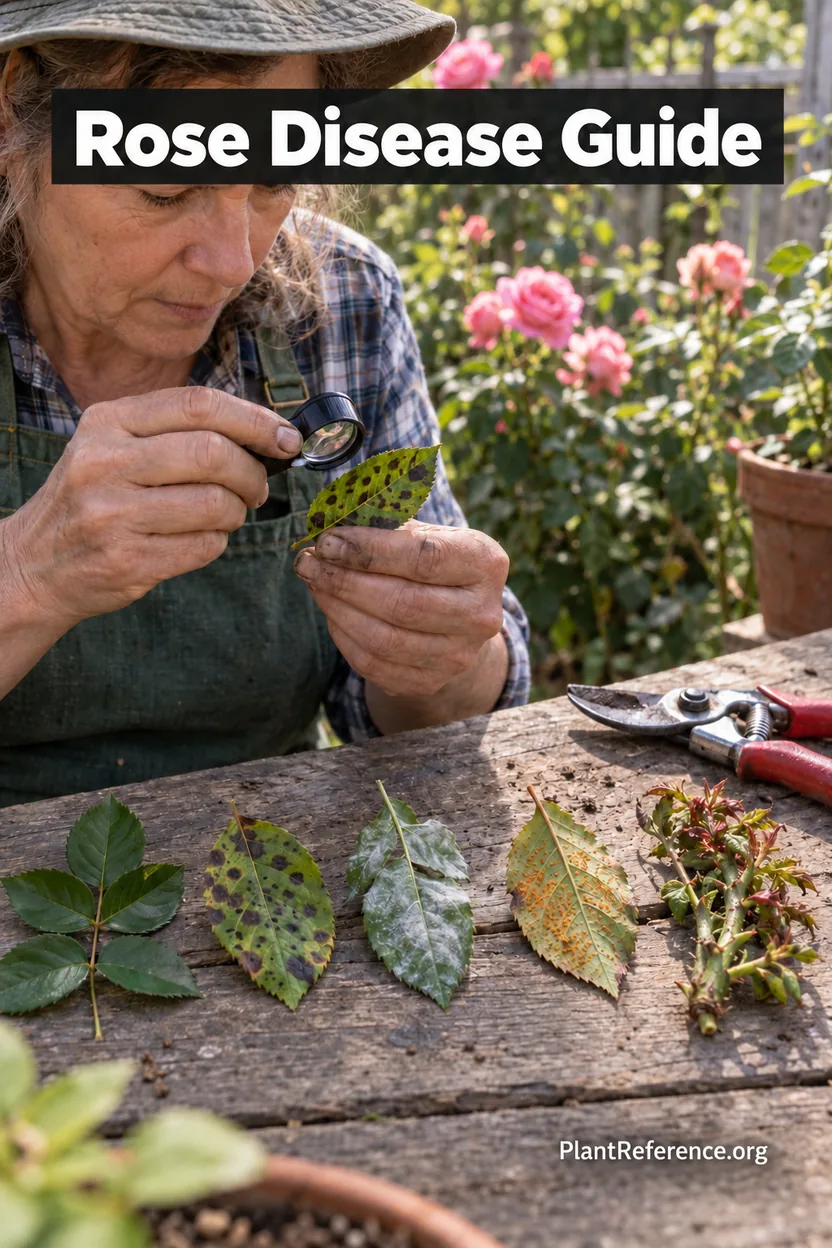
Rose Diseases: Identification, Prevention, and Treatment
— Image © PlantReference.org 2026
Pets & Toxicity
Recorded toxicity for plants linked in this guide. An unknown status is not a safety assessment.
No linked plant is recorded as toxicDetailsHide
Rose diseases often look alike after the plant has been stressed for weeks. Yellow leaves can follow black spot, saturated roots, mites, nutrient imbalance, or normal autumn aging; a red shoot may be healthy new growth or one feature of rose rosette disease. Good diagnosis starts before treatment: identify the first affected tissue, map how symptoms spread, examine both leaf surfaces, and connect the pattern to recent weather.
That process prevents two costly mistakes. The first is spraying a fungus product on a viral or environmental problem. The second is removing a rose for an alarming but normal feature. This guide organizes the common diseases by their most useful distinguishing signs and explains which cultural changes interrupt each disease cycle.
Diagnose Before You Treat
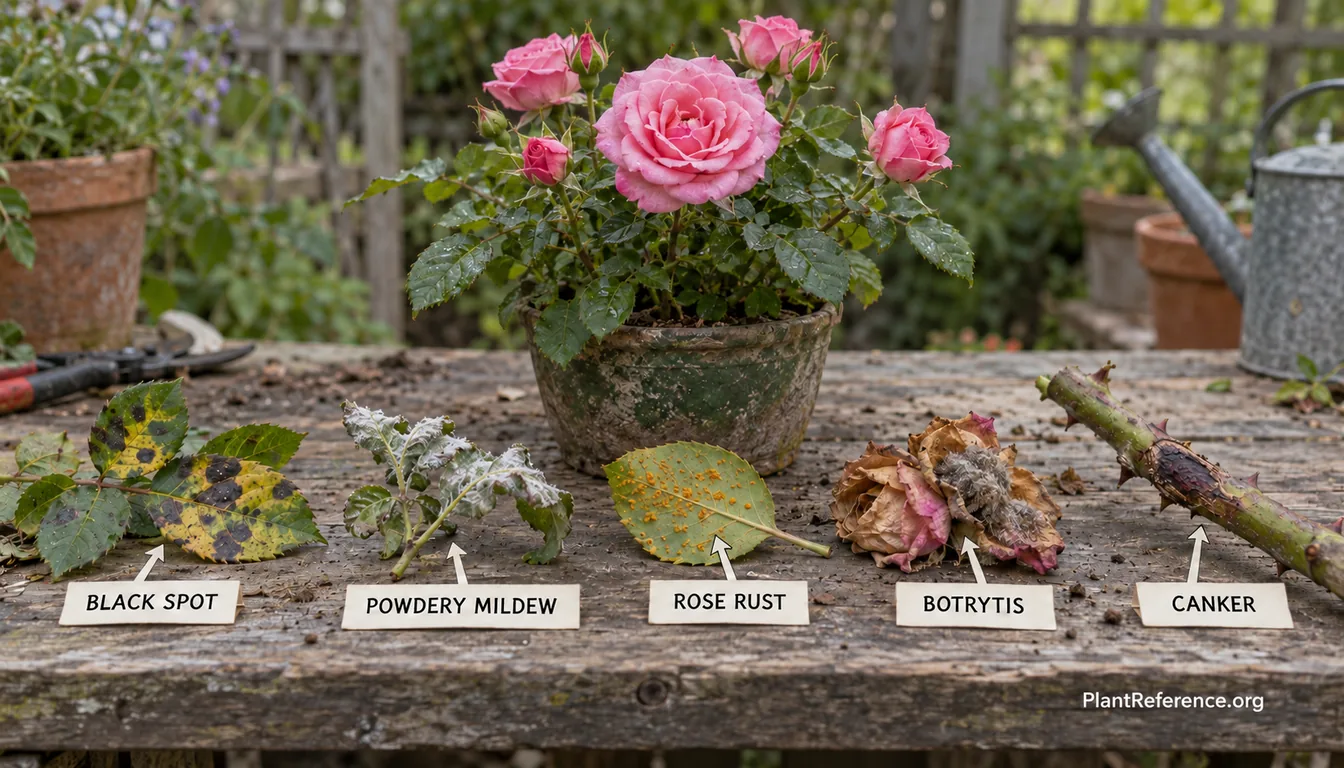
Begin with location. Black spot and rust first announce themselves on leaves. Powdery mildew often covers tender leaves, buds, and shoots. Botrytis blight is most obvious on petals and unopened flowers. Cankers occupy a defined section of cane, while rose rosette disease changes the architecture of new growth across an expanding part of the plant.
Next, examine the surface and margin. A true black spot lesion is dark with a feathery or radiating edge, often surrounded by yellow tissue. Rust leaves powdery orange pustules on the underside. Powdery mildew looks like a superficial white coating rather than bleached tissue. Canker creates discolored, sunken, or cracked bark and a sharp boundary between living and dead cane.
Finally, record timing. Seven or more hours of free water on rose foliage can allow black spot infection under suitable temperatures. Powdery mildew can thrive without liquid water, particularly during warm days, cool nights, and high humidity. Botrytis accelerates in cool, damp, crowded flowers. Those environmental clues help separate pathogens that look similar by the time leaves yellow and drop.
Problem | Most distinctive sign | Favored conditions | First action |
|---|---|---|---|
Black spot | Feathery black leaf spots with yellowing | Prolonged leaf wetness | Remove debris; shorten leaf-wetness period |
Powdery mildew | White coating on tender surfaces | Warm days, cool humid nights | Improve airflow; reduce excess soft growth |
Rose rust | Orange powder beneath leaves | Cool, moist periods | Remove affected leaves; clean fallen debris |
Botrytis blight | Spotted, brown, collapsing flowers | Cool, damp weather | Remove infected blooms before sporulation |
Cane canker | Sunken or discolored dead cane section | Wounds and stressed tissue | Cut below damage into healthy wood |
Rose rosette disease | Witches' brooms with distorted persistent red growth | Eriophyid mite transmission | Remove the entire infected plant, including roots |
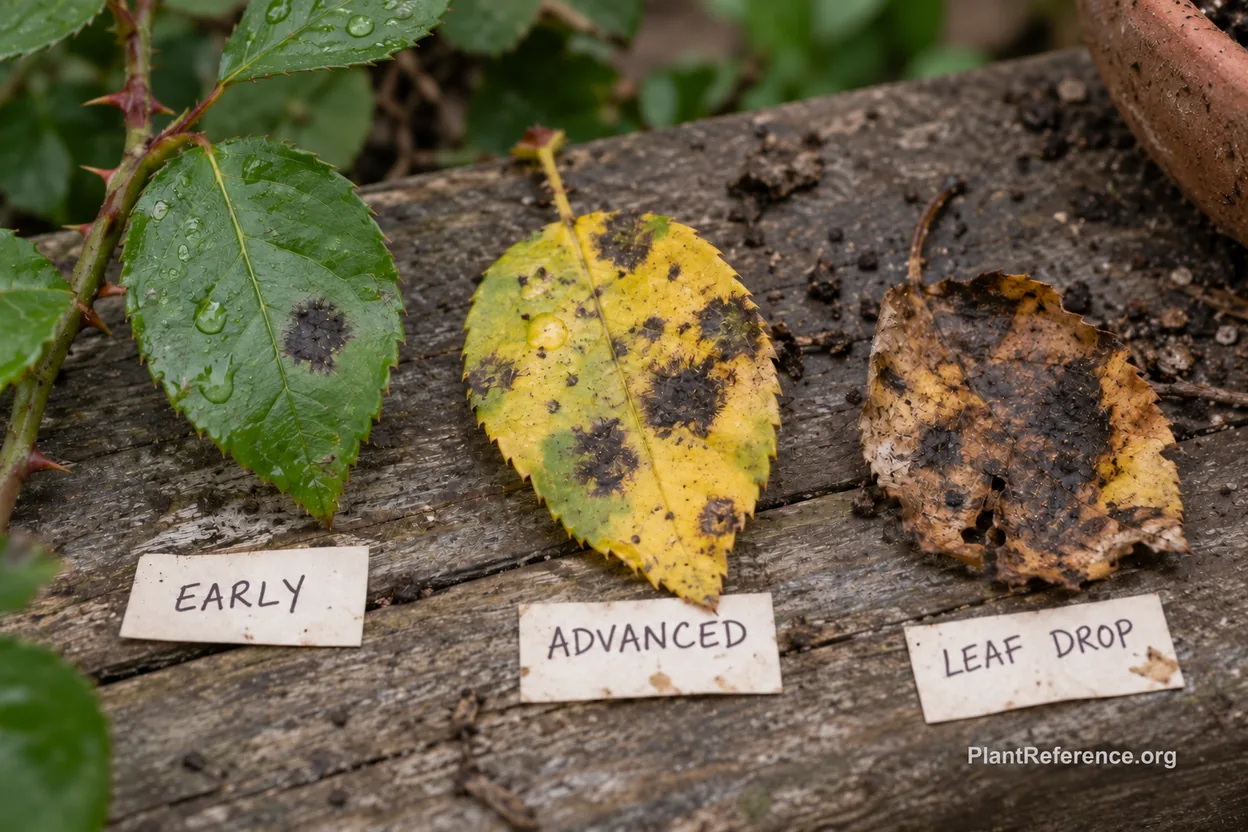
Photograph the plant before removing tissue. Include the entire rose, a branch, both sides of an affected leaf, and a close view of the margin. A sequence taken several days apart often shows whether the problem moves upward from lower leaves, spreads from one cane, or remains confined to weather-damaged flowers.
Black Spot
Black spot, caused by Diplocarpon rosae, is the most widespread rose fungal disease in humid regions. Circular black lesions with fringed margins appear on upper leaf surfaces; surrounding tissue yellows, and affected leaves drop. Severe repeated defoliation weakens the root-cane system because the plant loses photosynthetic surface and must spend stored energy replacing it.
The fungus depends on free water. Spores splash from infected leaves and debris, then germinate when foliage remains wet long enough. Prevention therefore targets the wet period: water at soil level, water early when overhead irrigation is unavoidable, space plants for moving air, and keep weeds or dense groundcover from trapping humidity. Renew mulch to reduce soil-to-leaf splash.
At first symptoms, remove heavily infected leaves without stripping the plant bare. Collect fallen debris and thin crossing growth if the canopy is crowded. A fungicide may protect uninfected tissue but will not heal an existing lesion. Black Spot on Roses: Seattle Treatment Guide describes an intensive wet-climate approach; adapt timing to local rain and the current label rather than copying calendar dates blindly.
Disease resistance lowers risk but does not create immunity. A resistant shrub can spot under extreme pressure, and pathogen populations vary. Best Disease-Resistant Roses for the Pacific Northwest offers cultivar-selection principles that remain useful wherever leaf wetness is a recurring problem.
Powdery Mildew and Rose Rust
Powdery mildew, caused primarily by Podosphaera pannosa, forms white to gray fungal growth on young leaves, buds, and stems. New leaves may curl or distort before the coating becomes obvious. Unlike black spot, powdery mildew does not require free water. Dense soft growth, warm days, cool nights, and high humidity create an ideal boundary layer around the foliage.
Increase spacing and sunlight, remove severely distorted tips, and avoid pushing excessive nitrogen. Irrigate the root zone consistently because drought stress weakens the plant, but do not assume that washing leaves every evening is treatment. Powdery Mildew on Roses: Treatment and Prevention gives a detailed prevention sequence, while Powdery Mildew vs Downy Mildew: Diagnose and Treat helps separate superficial white growth from angular downy-mildew lesions.
Rose rust produces orange, yellow, or rusty-brown pustules, usually most visible on leaf undersides. Upper surfaces may show yellow spots before leaves drop. Cool, moist spring or fall weather favors infection in susceptible roses. Remove affected foliage, clear debris, open the canopy, and avoid moving through wet plants, which can carry spores on hands and tools.
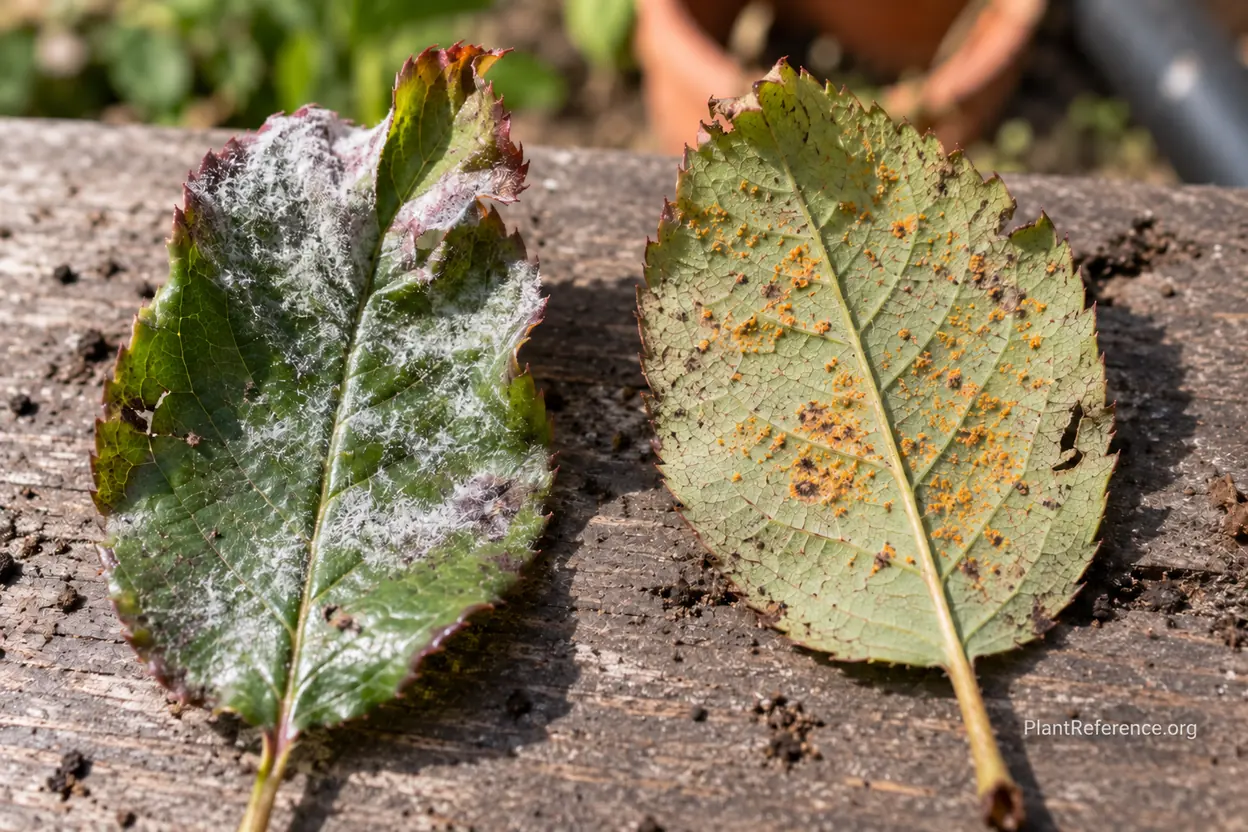
Rust management becomes harder when the lower canopy is inaccessible. Prune for an open structure and inspect leaf undersides weekly during cool wet periods. Orange Spots Under Rose Leaves: Treating Rose Rust provides a focused identification guide. Do not confuse rust spores with spider-mite stippling; mites create pale pinpoints and fine webbing rather than orange powder.
Botrytis Blight and Cane Canker
Botrytis blight attacks petals and buds during cool, damp weather. Tiny red or brown flecks can expand into tan, water-soaked areas; dense flowers may ball, remain closed, or collapse into gray mold. The pathogen exploits aging and injured tissue, so remove spent or infected blooms promptly and keep fallen petals from accumulating in the crown.
Avoid overhead water on flowers and allow enough space for air to move between stems. During extended rain, full-petaled cultivars may suffer more because moisture remains trapped within the bloom. Treatment cannot restore damaged petals. The practical goal is to remove inoculum and protect the next flush.
Canker is a symptom category rather than one single pathogen. Fungi enter injured, winter-damaged, or stressed canes, creating brown, purple, black, or sunken lesions. Tissue beyond a girdling canker wilts and dies because water transport is interrupted. Trace the cane downward until the pith and bark are healthy, then cut below the discolored area with clean bypass pruners.
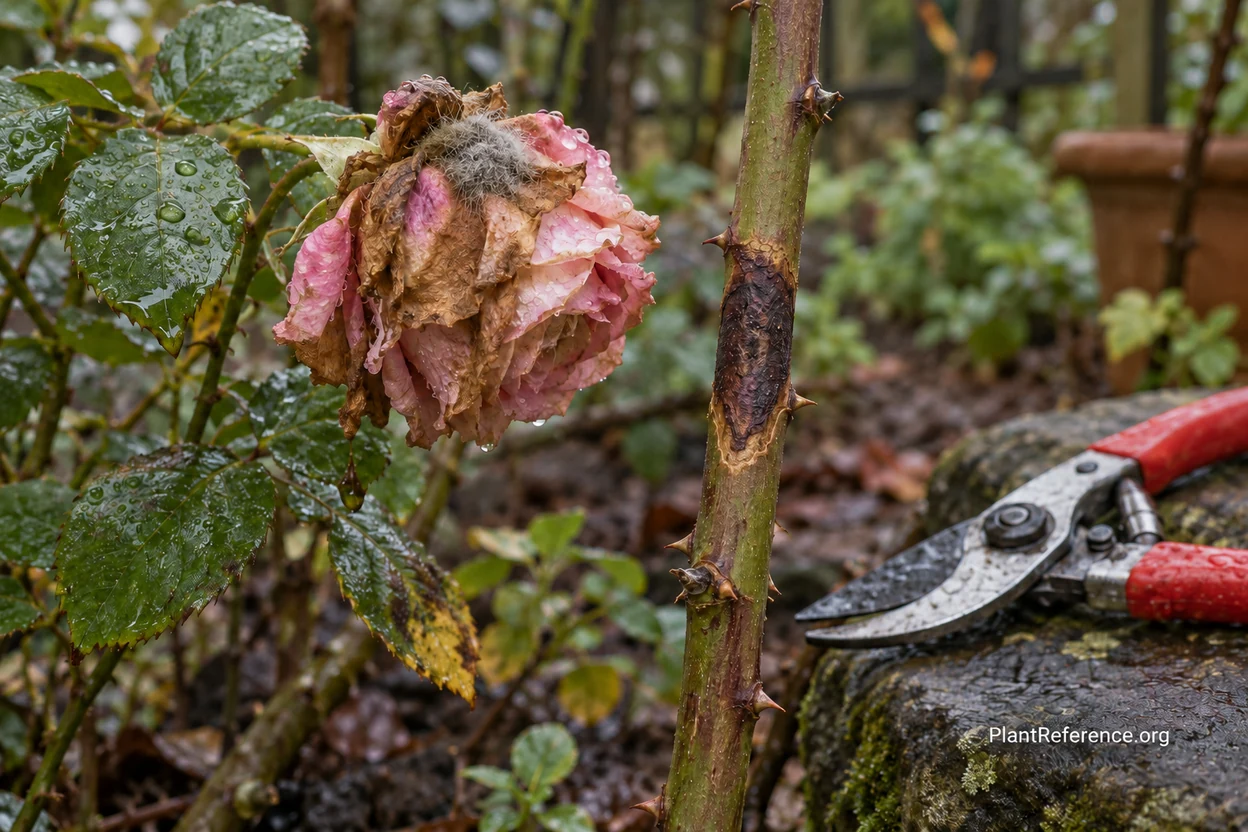
Make the cut in dry weather, bag diseased material, and clean the blade before the next plant. Correct the underlying stress: winter injury, rubbing canes, poor drainage, or repeated drought. How to Prune Roses: When and How to Prune Every Type of Rose explains how purposeful cuts reduce wounds and congestion. Do not coat ordinary cuts with sealer; sound tissue normally compartmentalizes the injury itself.
Rose Rosette Disease
Rose rosette disease is different from the fungal diseases above. It is caused by a virus carried primarily by a tiny eriophyid mite. Symptoms include dense witches'-broom branching, thick succulent shoots, abnormal flowers, excessive soft thorns, and red growth that remains distorted instead of expanding and turning green. A single red shoot is not enough for diagnosis because healthy rose growth often begins red.
Evaluate the symptom cluster and its progression. Herbicide injury can distort multiple shoots at once, frost can blacken tender tips, and normal basal breaks can be unusually vigorous. Rose rosette disease continues producing abnormal architecture and eventually causes decline, often killing the plant within two to four seasons.
There is no cure. A convincingly infected rose must be removed promptly, including its roots, then bagged and disposed of rather than composted. Inspect nearby roses repeatedly because mites may have moved before symptoms became visible. Rose Rosette Disease Symptoms: Identify and Act offers close comparisons of normal red growth, herbicide injury, and witches' brooms.
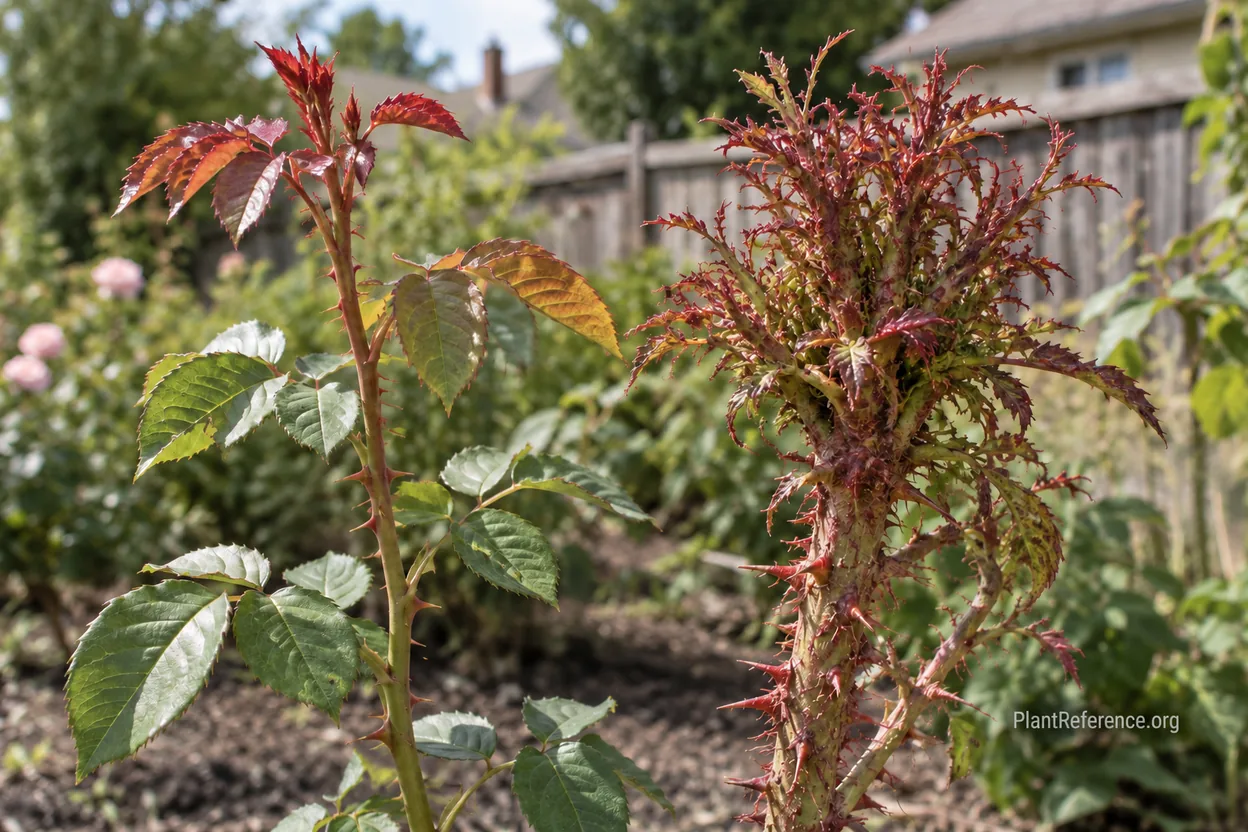
Reduce risk by spacing mature foliage so it does not touch, avoiding leaf blowers around roses, and removing wild 🌿Rosa multiflora (ROH-zuh mul-tih-FLOR-uh) within roughly 300 feet (90 m) where access and local rules allow. The wild species is a major reservoir. Rose rosette can infect disease-resistant landscape roses, including Knock Out selections; resistance to black spot does not imply viral resistance.
Build a Prevention System
Prevention works when several small barriers operate together. Start with a cultivar proven for the local climate, then provide six to eight hours of sun, root-zone drainage, and enough spacing for mature growth. Best Low-Maintenance Roses for Busy Gardeners helps compare plants whose genetics reduce routine intervention.
Water slowly at soil level. A soaker hose or drip line keeps most foliage dry, but it must not keep the root zone saturated. Check soil 2-3 inches (5-8 cm) deep before irrigating. Mulch 2-3 inches (5-8 cm) deep to reduce splash while leaving a bare collar around the canes.
Inspect upper and lower leaf surfaces weekly from spring through fall.
Remove fallen leaves, petals, and pruning debris before they build inoculum.
Thin crossing canes and space plants according to mature width.
Water the root zone early enough that accidental splashes dry quickly.
Stop excessive nitrogen that creates dense, tender, disease-prone growth.
Clean cutting tools after diseased tissue and before moving to another plant.
Record symptoms and weather before applying any treatment.
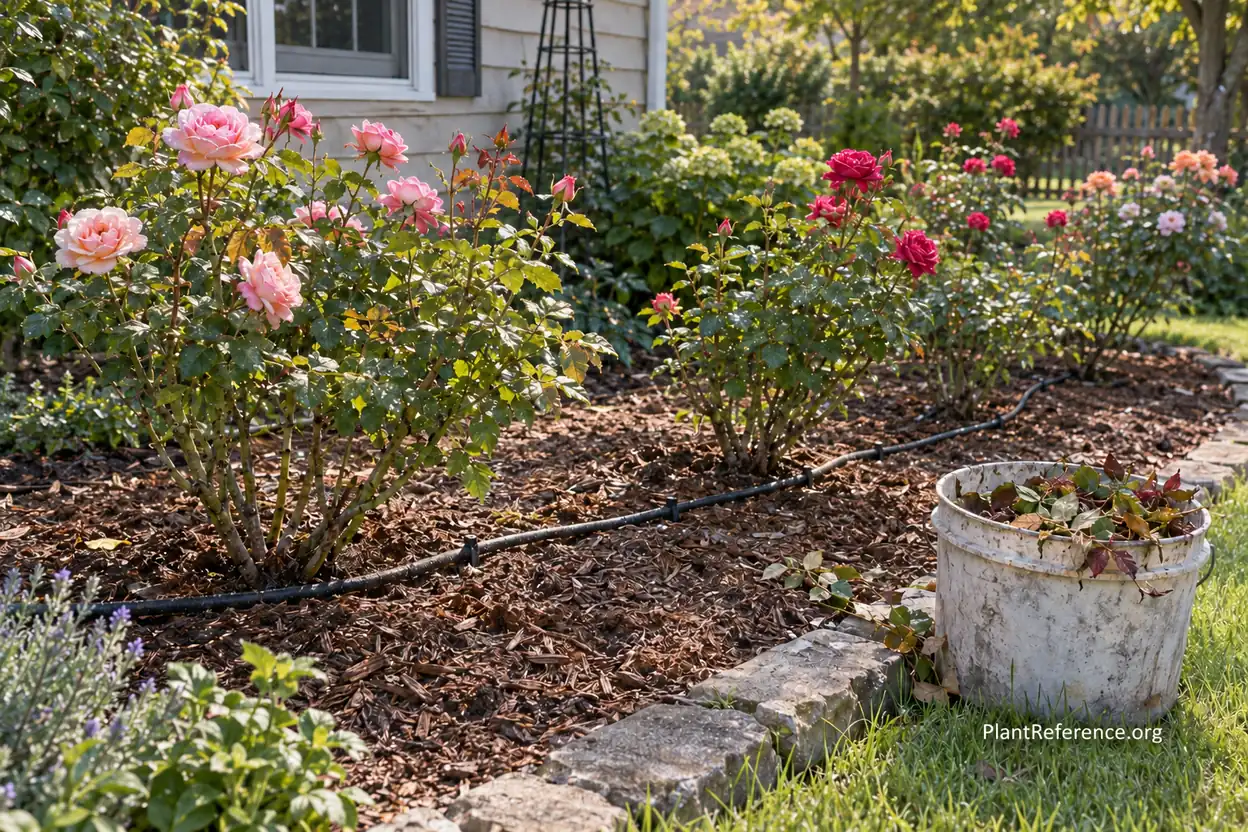
Sanitation is specific, not sterile. You do not need to disinfect soil or remove every ordinary leaf. Focus on infected leaves, mummified flowers, and dead canes that carry pathogens between seasons. Replace badly diseased mulch only when contaminated debris cannot be separated; otherwise add a clean layer after cleanup.
Regional pressure changes the emphasis. Humid southeastern gardens face long black-spot seasons and greater rose-rosette pressure. Cool maritime gardens often see spring and fall mildew, rust, and black spot. Arid gardens have lower fungal pressure but more spider mites and salt or irrigation stress. Growing Roses in the Pacific Northwest: Complete Guide illustrates how local climate changes a national care plan.
Choose Treatments Safely
Use a product only when the disease is identified, the rose is listed on the label, and the target disease appears there. Fungicides work mainly as protectants; they prevent new infection but do not erase existing lesions or rebuild dead tissue. Remove the worst source material, correct culture, then protect healthy growth if disease pressure justifies treatment.
Copper and neem products cover some rose diseases, but formulation, concentration, intervals, temperature limits, and plant sensitivity vary. Oils can burn heat- or drought-stressed foliage, and copper can injure plants or accumulate in soil when overused. Never combine products unless the label explicitly permits it. Test a small portion first and avoid spraying open flowers while pollinators are active.
Decision | Question to answer | If the answer is no |
|---|---|---|
Identification | Do symptoms match one disease across location, pattern, and weather? | Keep observing or seek diagnostic help |
Label match | Are roses and the target disease listed? | Do not use that product |
Timing | Will treatment protect uninfected growth under current conditions? | Use sanitation and cultural correction instead |
Plant condition | Is the rose hydrated and free from heat stress? | Delay oil or other stress-sensitive treatment |
Coverage | Can both leaf surfaces be covered safely? | Improve access and equipment before spraying |
Follow-up | Can the label interval and limits be followed? | Choose a simpler management plan |
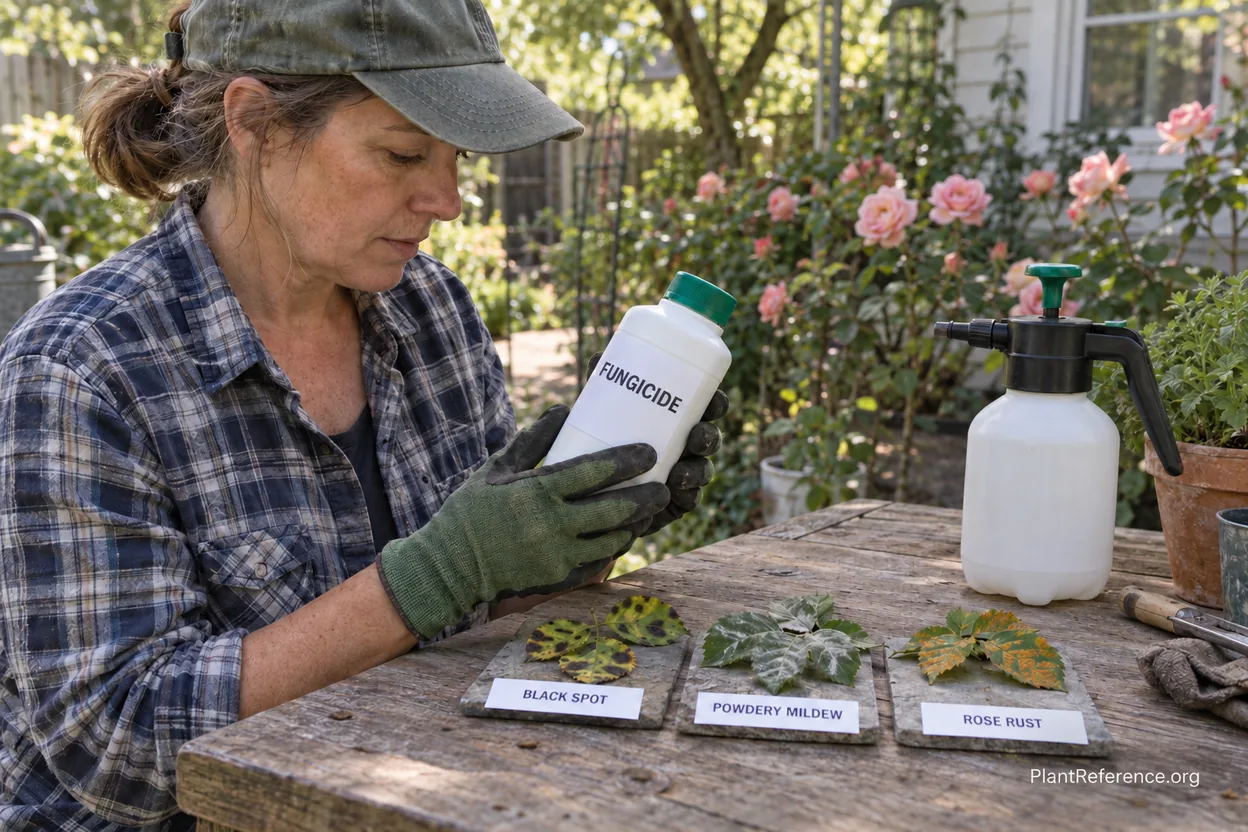
When symptoms remain unclear, a local extension plant clinic can examine a full sample. Include a cane with healthy-to-affected transition, several leaves, flowers if relevant, and photographs of the whole plant. Diagnosis is most reliable before tissue fully decays.
Rose health is not the absence of every spot. A resilient plant maintains enough healthy leaf area to grow, flower, and store energy. Weekly observation, dry foliage, open structure, and prompt sanitation usually accomplish more than a reflexive spray calendar—and they preserve treatment options for the moments when disease pressure truly exceeds the plant's defenses.
Frequently Asked Questions
Reading about plants and recognising them are different skills. These three build the second.
- Daily PlantIdentify the day’s mystery plant from a close-up photograph.
- Keyed OutWork a dichotomous key, lead by lead, to name a hidden specimen.
- Name That PlantName a specimen from botanical clues dealt hardest first.
Free to play, no account needed
Tagged with
Sarah earned her doctorate in plant biology and spent time working in botanical garden education before transitioning to freelance writing and consulting. Now based in Portland, Oregon, she teaches plant identification workshops at local community centers and maintains a modest collection of over 60 houseplants in her small apartment. Sarah specializes in helping beginners understand plant science without the jargon—her approach focuses on practical observation over theory. She's killed her fair share of fiddle leaf figs and finally cracked the code on keeping them alive.