Thuja, Genus, spp., Multiple species,
- Genus
- Multiple species
arborvitaes
Overview
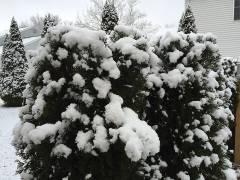
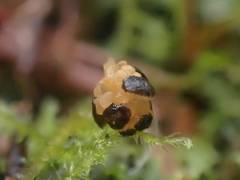
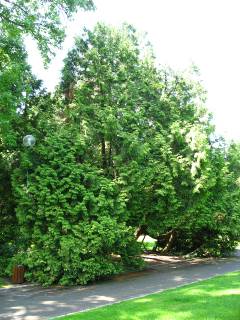
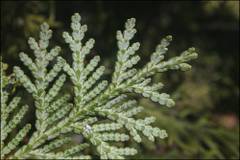
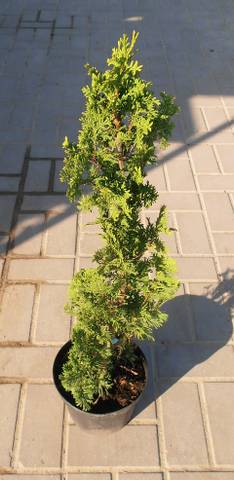
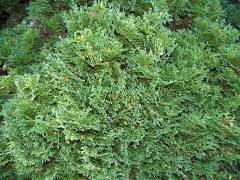
Thuja is a small genus of five species of evergreen coniferous trees and shrubs in the cypress family Cupressaceae, native to North America and East Asia. Plants range from dwarf cultivars near 3 ft (1 m) to forest trees over 200 ft (70 m) tall in T. plicata, the western red cedar, with most garden forms standing 6 to 40 ft (1.8 to 12 m). The foliage is made of small, scale-like leaves pressed flat against the twigs to form soft, fanned sprays, green to yellow-green and often bronzing in cold winters. Crushed foliage is strongly aromatic. The cones are small, 0.3 to 0.5 in (8 to 13 mm), upright, and leathery, opening from green to brown to release winged seeds. T. occidentalis, the eastern arborvitae, and T. plicata are widely planted as hedges, screens, and specimens, with selections such as the narrow Emerald and the tall Green Giant. The foliage and twigs contain thujone, a compound toxic to people and animals if eaten. Limitations include browning of inner foliage in drought, damage from heavy snow and ice, and heavy browsing by deer on T. occidentalis.
Native Range
Thuja is native to two widely separated regions: eastern and western North America, home to T. occidentalis and T. plicata, and East Asia, home to T. standishii, T. koraiensis, and T. sutchuenensis. Plants grow in moist forests, swamp margins, and on rocky slopes, often on limestone or near water. T. plicata forms vast stands in the cool, wet forests of the Pacific Northwest.Suggested Uses
Thuja is planted as hedging, windbreaks, privacy screens, and specimen trees, with dwarf and globe forms used in foundation plantings and containers. The aromatic, rot-resistant wood of T. plicata is used for shingles, posts, and boats. Narrow cultivars suit tight screens along property lines.How to Identify
Appearance
Size & Dimensions
Height3' - 200'
Width/Spread3' - 25'
Bloom Information
Thuja is a conifer and does not flower. Small pollen cones and seed cones form on the same plant, with pollen shed in early spring and seed cones ripening from green to brown by autumn. Wind carries the pollen and the released seeds.
Detailed Descriptions
Foliage Description
green to yellow-green, bronzing in winterGrowing Conditions
Sun Requirements
Requires 4-8 hours of direct sunlight daily
• Full Sun: 6+ hours of direct sunlight
• Partial Shade: 3-6 hours of direct sunlight
• Full Shade: Less than 3 hours of direct sunlight
Care & Maintenance
Care Guide
Thuja grows in full sun to partial shade in moist, fertile, free-draining soil and tolerates a pH from about 6.0 to 8.0, including limestone soils. Plants hold their dense form with steady moisture and turn brown inside and at the tips during prolonged drought. The genus is cold hardy, with T. occidentalis surviving zone 2 winters, though heavy snow and ice can splay or break multi-stemmed plants. Foliage and twigs contain thujone and are toxic to people, dogs, cats, and livestock if eaten. Deer browse T. occidentalis heavily in winter, while T. plicata is less affected.Pruning
Thuja tolerates light to moderate shearing, which is why it is used for formal hedges; trimming in late spring and again in midsummer keeps growth dense. Cuts are kept within the green, leafy zone, as the genus does not resprout from bare old wood. Removing competing leaders early prevents weak, multi-stemmed tops that splay under snow.Container Growing
Suitable for container growing