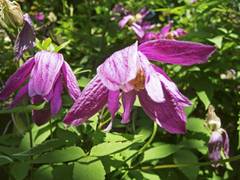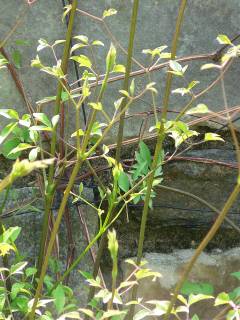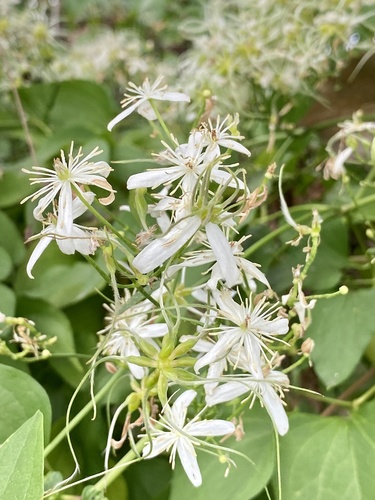
Clematis, Genus, terniflora, Species,
- Genus & species
sweet autumn clematis
East Asia (Japan, Korea, Taiwan, central and eastern China)
Overview
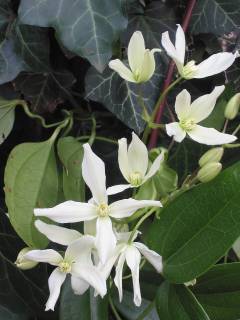
Clematis terniflora is a vigorous deciduous climbing vine reaching 15-30 feet (4.5-9 m) long when supported, with annual stem extension of 6-15 feet (1.8-4.5 m). Stems woody at the base; new growth herbaceous and twining via leaf petioles around supports up to 0.5 inch (1.3 cm) in diameter. Compound leaves with 3-5 leathery, entire-margined, ovate leaflets 1.5-3 inches (4-7.5 cm) long. Foliage holds glossy mid-green color through summer, fading without color change in autumn. Small white flowers 1 inch (2.5 cm) across with four narrow sepals appear in dense panicles August through October, covering the foliage in flower clusters at peak bloom. Flowers carry a strong vanilla-like fragrance detectable from 10-20 feet (3-6 m) away. Silvery feathery seed heads 1.5-2 inches (4-5 cm) wide form after flowering and persist through winter. Hardy in USDA zones 4-9. Listed as invasive in Pennsylvania, Maryland, Virginia, Tennessee, Kentucky, and Georgia under state invasive species programs; spreads by seed into woodland edges and disturbed sites.
Native Range
Native to Japan, Korea, Taiwan, and central and eastern China, where it grows in lowland forest edges, thickets, and stream banks at 0-2,500 feet (0-760 m) elevation. Naturalized throughout the eastern and central United States; categorized as invasive in several Mid-Atlantic and southeastern states.Suggested Uses
Used on fences, trellises, arbors, or as ground cover at 6-10 foot (1.8-3 m) spacing in sites where vigor and seed dispersal are not concerns. Vine cover suits cool foundations of unheated outbuildings. C. terniflora is regulated as invasive in Pennsylvania, Maryland, Virginia, Tennessee, Kentucky, and Georgia under state nursery laws.How to Identify
Appearance
Size & Dimensions
Height15' - 30'
Width/Spread6' - 10'
Bloom Information
Small white flowers in dense panicles appear August through October across most of the range, with peak bloom in September. Bloom lasts 4-6 weeks. Honey bees, native bees, flies, and butterflies forage on the flowers. Seed heads with silvery plumes develop in October and persist into winter; seed dispersal occurs from November through March.
Detailed Descriptions
Foliage Description
Glossy mid-greenGrowing Conditions
Sun Requirements
Requires 4-8 hours of direct sunlight daily
• Full Sun: 6+ hours of direct sunlight
• Partial Shade: 3-6 hours of direct sunlight
• Full Shade: Less than 3 hours of direct sunlight
Care & Maintenance
Care Guide
Water deeply once a week during the first growing season; established plants tolerate 4-6 weeks without rain in zones 6-9. Apply 2 inches (5 cm) of bark mulch over the root zone. Tolerates a wide range of soils and pH from 5.5 to 8.0. Few significant pests or diseases on this species. Stems may be cut to ground level in late fall for cleanup; new growth from the crown reaches 6-15 feet (1.8-4.5 m) by the following autumn. Volunteer seedlings appear within 30-50 feet (9-15 m) of mature plants; in regions where the species is regulated, removal of seedlings prevents naturalization into adjacent habitat.Pruning
Cut stems to within 12 inches (30 cm) of the ground in late winter or early spring; this is a Group 3 (hard prune) clematis that flowers on current-season growth. Annual hard pruning controls size and tangling. Stems left in place from previous seasons accumulate dead growth that becomes brittle and difficult to remove.Pruning Schedule
Prune: February–March
early spring
Container Growing
Minimum container size: 5 gallons