Sorbus, Genus, aria, Species,
- Genus & species
Common whitebeam
Western, central, and southern Europe
Overview
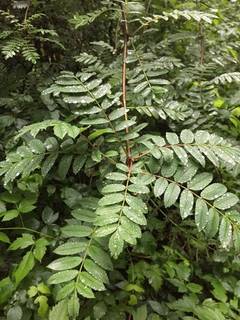
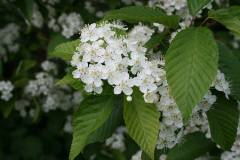
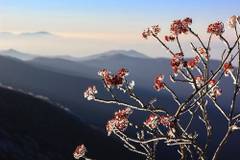
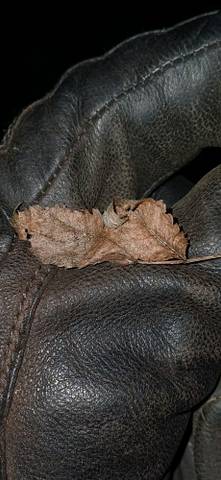
Sorbus aria is a deciduous tree reaching 25-50 feet (8-15 m) tall and 20-30 feet (6-9 m) wide, with a compact rounded to broadly conical crown and smooth grey bark that develops shallow fissures after about 30 years. Leaves are alternate, oval to broadly elliptic, 2.5-5 inches (6-12 cm) long, with 10-14 pairs of straight parallel veins and a sharply double-toothed margin. The upper surface is dull dark green while the underside carries a dense white felt of hairs, so moving air turns the whole crown silver-white. Buds break in April as upright silver-grey shoots before the leaves expand. White flowers 0.4-0.6 inch (10-15 mm) across open in May in flat-topped corymbs 2-3 inches (5-8 cm) wide with a heavy sweet-musky scent. Fruit is a rounded to oval pome 0.4-0.6 inch (10-15 mm) long, ripening from green to scarlet-orange in September. Autumn foliage turns russet and gold over 2-3 weeks in October. The tree grows on chalk and limestone and withstands wind, coastal salt, and urban air, but fireblight kills shoots in warm humid springs, and raw fruit contains parasorbic acid that causes stomach upset if eaten in quantity before frost or cooking breaks it down. Fallen pomes stain paving beneath the crown from late September.
Native Range
Sorbus aria is native to western, central, and southern Europe, from southern England and Wales through France, Germany, and the Alps to northern Spain, Italy, and the Balkans. In Britain its native range is confined to chalk and limestone in the south, chiefly the North and South Downs, the Chilterns, and the Mendips. It grows on thin calcareous soils, cliff ledges, and open scrub, reaching 5,900 feet (1,800 m) in the Alps.Suggested Uses
Grown as a street and avenue tree on chalk and limestone soils, spaced 20-25 feet (6-9 m) apart, and as a garden specimen where a crown of 20-30 feet (6-9 m) can be accommodated. Exposed and coastal shelter planting uses it for wind and salt tolerance. Fruit is taken by thrushes, blackbirds, and waxwings from September onward.How to Identify
Appearance
Size & Dimensions
Height25' - 50'
Width/Spread20' - 30'
Bloom Information
Flowering runs from mid-May to early June, roughly two weeks after leaf emergence. Flat-topped corymbs 2-3 inches (5-8 cm) across carry 20-40 white five-petalled flowers, each 0.4-0.6 inch (10-15 mm) wide with about 20 cream stamens. The flowering period spans 2-3 weeks and draws hoverflies, solitary bees, and pollen beetles. Pomes begin colouring in late August and hold on the tree into October where birds have not stripped them.
Detailed Descriptions
Foliage Description
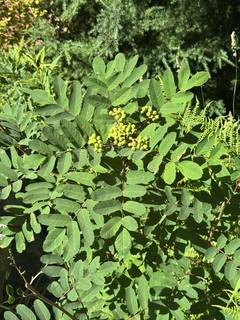
Dark green above, white-felted beneathGrowing Conditions
Sun Requirements
Requires 6-10 hours of direct sunlight daily
• Full Sun: 6+ hours of direct sunlight
• Partial Shade: 3-6 hours of direct sunlight
• Full Shade: Less than 3 hours of direct sunlight
Care & Maintenance
Care Guide
Grows in full sun to part shade on almost any free-draining soil, including thin chalk and limestone at pH 6.0-8.5, and tolerates compacted urban ground. Water demand is low once established, and mature trees come through dry chalk summers without early leaf loss. It is hardy through zones 5-7 and holds up on exposed hilltop and coastal sites carrying salt-laden wind. Fireblight, caused by Erwinia amylovora, kills shoots and whole branches in warm humid springs and is the principal disease of the species. The root system is shallow and wide-spreading, so transplanting is restricted to stock under 10 feet (3 m) tall. Feeding is unnecessary on reasonable ground, and stakes are removed after the second season so the trunk builds taper.Pruning
Cutting is carried out from August to October, when the risk of fireblight infection through wounds is lowest. Formative work over the first 8 years lifts the crown to 6-8 feet (1.8-2.4 m) and removes competing leaders. Dead, damaged, and blighted wood is cut back 12 inches (30 cm) into clean tissue and taken off site. Mature trees hold a naturally compact crown and seldom require reduction.Pruning Schedule
Prune: August–October
summerfall