Solanum, Genus, rostratum, Species,
- Genus & species
buffalobur
Great Plains of central North America (native)
SunFull Sun
Overview
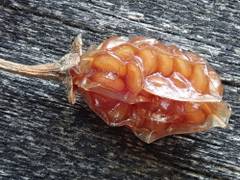
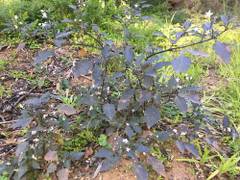
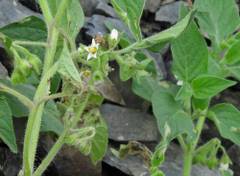
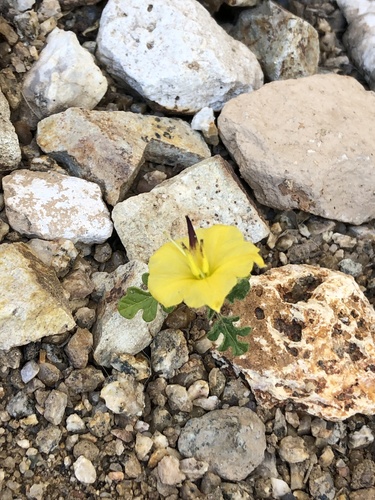
Solanum rostratum is a densely prickly, erect to spreading annual in the nightshade family (Solanaceae) reaching 12–30 inches (30–75 cm) tall with a 12–30 inch (30–75 cm) spread. The entire plant is armed with stout, yellowish, sharp prickles 0.1–0.3 inch (3–8 mm) long on stems, petioles, leaf midribs, and calyx — the heavy armature is immediately diagnostic. Stems are erect to spreading, branching, gray-green, hairy and prickly. Leaves are alternate, deeply pinnately lobed with 5–7 rounded segments, 2–5 inches (5–13 cm) long, gray-green, hairy, with prickles on the midrib and major veins. Flowers are bright yellow, 0.8–1 inch (20–25 mm) across, five-petaled, with 5 stamens — one stamen is conspicuously longer and more curved than the other four (heteranthery), a feature studied in pollination biology. Fruit is a round berry completely enclosed by the spiny, enlarged calyx, forming a burr-like structure 0.4–0.6 inch (10–15 mm) in diameter. A single plant produces 500–2,500 spiny burrs, dispersed by animal fur and foot traffic. Contains solanine; all parts are toxic. Native to the Great Plains but functions as a weed in the Pacific Northwest on dry, disturbed sites.
Native Range
Native to the Great Plains of central North America, from South Dakota to Texas and northern Mexico, occurring in overgrazed rangeland, roadsides, and dry disturbed ground from sea level to approximately 6,000 feet (1,800 m). Adventive and occasionally naturalized in the Pacific Northwest, particularly in dry areas east of the Cascades. The original host plant of the Colorado potato beetle (Leptinotarsa decemlineata) before the beetle shifted to cultivated potato.Suggested Uses
Used in Solanaceae identification as the spiny, yellow-flowered member of the four-species Solanum teaching unit. The heterantherous stamens (one long, four short) are a primary pollination biology teaching feature — division-of-labor between feeding anthers and pollinating anthers. The original host plant of the Colorado potato beetle, studied in agricultural entomology and host-plant shifting. The spiny burr dispersal mechanism is taught in seed dispersal ecology.How to Identify
Appearance
Size & Dimensions
Height1' - 2'6"
Width/Spread1' - 2'6"
Bloom Information
Flowers from June through September. Individual flowers last 1–2 days. Racemes bloom over 4–6 weeks. Buzz-pollinated by bees. The heterantherous stamens (one long, four short) are involved in division-of-labor pollination: the long stamen attracts pollinators with feeding pollen, while the shorter stamens deposit pollen on the bee body. Spiny burrs mature 4–6 weeks after pollination.
Detailed Descriptions
Foliage Description
Gray-green, deeply pinnately lobed with rounded segments; densely covered in stout yellowish prickles on petioles, midribs, and stemsGrowing Conditions
Sun Requirements
Requires 6-12 hours of direct sunlight daily
• Full Sun: 6+ hours of direct sunlight
• Partial Shade: 3-6 hours of direct sunlight
• Full Shade: Less than 3 hours of direct sunlight