Overview
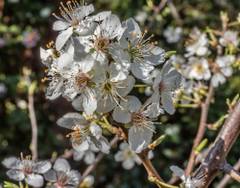
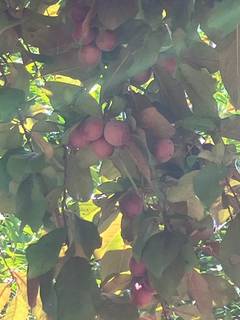
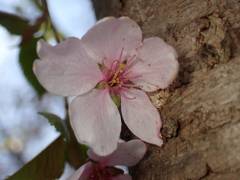
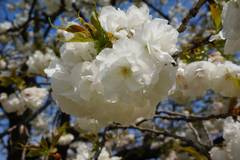
Prunus serrulata 'Kanzan' is a deciduous flowering cherry reaching 25–40 feet (7.5–12 m) tall and 20–30 feet (6–9 m) wide. The crown is narrowly vase-shaped for the first 10–15 years, then broadens into a flat-topped, spreading form as the scaffold limbs arch outward. Flowers are fully double with 20–30 petals, deep rose-pink fading paler toward the margin, 2–2.5 inches (5–6 cm) across, borne in pendulous clusters of 2–5 on stalks 1–1.5 inches (2.5–4 cm) long. The doubled flowers lack functional stamens and pistils, so the tree sets no fruit. Leaves emerge bronze to copper, expand to 3–5 inches (7.5–13 cm) long with doubly serrate margins, mature dark green, and turn yellow to bronze-orange in October. Bark is reddish-brown to mahogany with horizontal lenticels 0.2–0.6 inch (5–15 mm) long. Trees are grafted, and the graft union 1–3 feet (30–90 cm) above ground thickens visibly with age. Landscape lifespan runs 15–25 years, shorter than that of most shade trees, and is cut further by bacterial canker (Pseudomonas syringae), peachtree borer, and the narrow branch unions of the vase-shaped crown, which split under ice and wind loads.
Native Range
Prunus serrulata is native to Japan, the Korean Peninsula, and eastern China, where wild forms grow in hill and mountain woodland to about 5,000 feet (1,500 m). P. serrulata 'Kanzan' arose in Japanese cultivation within the Sato-zakura group of garden cherries selected over several centuries. It reached Europe around 1913 and North America shortly afterward.Suggested Uses
Planted as a street and lawn tree spaced 25–30 feet (7.5–9 m) apart, and used in avenue plantings in public parks. The absence of fruit removes the litter and staining that follow fruiting cherries, while container growing is limited to the first 3–5 years given the eventual root spread. Underplanting with shallow-rooted groundcover is common, since the tree roots occupy the upper 12–18 inches (30–45 cm) of soil.How to Identify
Appearance
Size & Dimensions
Height25' - 40'
Width/Spread20' - 30'
Bloom Information
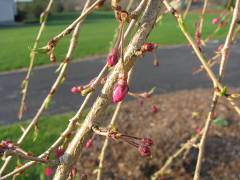
Flowering runs 10–14 days in mid to late April in USDA zone 6, shifting to late March in zone 8 and early May in zone 5. Flowers open with or slightly before the bronze new leaves, so the display is partly veiled by foliage in warm springs. Each flower carries 20–30 petals and spans 2–2.5 inches (5–6 cm). Petal drop covers the ground beneath the canopy over 3–5 days, and no fruit follows because the flowers are functionally sterile.
Detailed Descriptions
Foliage Description
Bronze-copper when new, dark green in summer, yellow to bronze-orange in autumnGrowing Conditions
Sun Requirements
Requires 6-10 hours of direct sunlight daily
• Full Sun: 6+ hours of direct sunlight
• Partial Shade: 3-6 hours of direct sunlight
• Full Shade: Less than 3 hours of direct sunlight
Care & Maintenance
Care Guide
Six or more hours of direct sun daily supports flower bud set; under 4 hours the crown opens and flowering thins. Free-draining soil with a pH of 6.0 to 7.0 suits the root system, which sits in the upper 12–18 inches (30–45 cm) and declines in compacted or waterlogged ground. Watering at 10–15 gallons (38–57 L) weekly through the first two summers, and during droughts longer than three weeks thereafter, sustains growth. The tree is hardy in USDA zones 5–9, with flower buds damaged below about -20°F (-29°C) and open flowers killed by late frosts near 28°F (-2°C). A 2–3 inch (5–7.5 cm) mulch ring held clear of the trunk reduces mower and trimmer wounds, which are the usual entry points for bacterial canker. Japanese beetle, aphids, peachtree borer, and cherry shothole fungus (Blumeriella jaapii) all occur, with borer pressure highest on trees under drought stress.Pruning
Pruning is carried out in summer after flowering, because dormant-season cuts on Prunus bleed sap and open entry points for bacterial canker. Work is confined to dead, crossing, or rubbing branches and to rootstock suckers below the graft union, which appear every year. Removal of more than one quarter of the live canopy in a season pushes watersprout growth along the scaffold limbs. Stubs left proud of the branch collar do not close over and become decay sites.Pruning Schedule
Prune: May–July
late springsummer