© The original uploader was Steve Pastor at English Wikipedia., some rights reserved (CC-BY) · Wikimedia Commons
Polylepis, Genus, spp., Multiple species,
- Genus
- Multiple species
queñua and allies
Overview
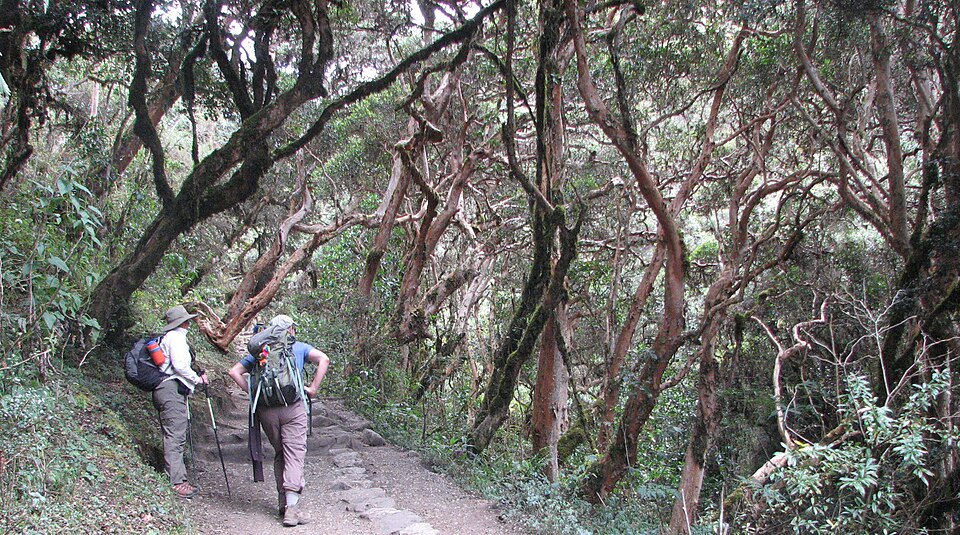
Polylepis is a genus of about 30 species of evergreen shrubs and small trees in the rose family (Rosaceae), native to the high Andes of South America. Plants grow as gnarled, multi-stemmed trees 10-50 ft (3-15 m) tall, often leaning and twisted by wind and cold. The bark peels in many thin, papery, reddish-brown layers that insulate the trunk against freezing nights. Leaves are small, compound, and crowded toward the branch tips, with leathery leaflets 0.2-0.8 in (5-20 mm) long that are often silvery-haired beneath. The small flowers lack showy petals and are wind-pollinated, hanging in short catkin-like clusters and ripening into single-seeded winged fruits. Several species form closed forests above 13,000 ft (4,000 m) and locally near 16,400 ft (5,000 m), elevations beyond the range of most trees. The genus ranges from Venezuela south through the Andes to Argentina and Chile. Growth is slow, and many species are confined to small, fragmented mountain populations under pressure from grazing, fire, and firewood cutting.
Native Range
The genus is restricted to the Andes of South America, from Venezuela and Colombia south through Ecuador, Peru, and Bolivia to Argentina and Chile. Species grow in high montane grassland, on rocky slopes, and in sheltered ravines above the continuous treeline.Suggested Uses
Grown mainly in high-altitude restoration, watershed protection, and specialist alpine collections rather than general gardens. In its native range Polylepis woodland stabilises steep slopes and shelters montane wildlife.How to Identify
Appearance
Size & Dimensions
Height10' - 50'
Width/Spread8' - 25'
Bloom Information
Flowering is inconspicuous and varies with altitude and species, often in the warmer months of the Andean year. The petal-less flowers hang in short clusters and rely on wind for pollination. Single-seeded winged fruits follow and are also wind-dispersed.
Detailed Descriptions
Flower Description
green to yellow-greenFoliage Description
green, silver-haired beneathGrowing Conditions
Sun Requirements
Requires 6-12 hours of direct sunlight daily
• Full Sun: 6+ hours of direct sunlight
• Partial Shade: 3-6 hours of direct sunlight
• Full Shade: Less than 3 hours of direct sunlight
Care & Maintenance
Care Guide
Plants grow in full sun at high altitude, in cold, well-drained rocky or sandy soils, and tolerate frost, intense radiation, and thin mountain air. Growth is slow, and plants are adapted to cold nights rather than to lowland warmth, so they struggle in hot, humid climates. Sharp drainage is needed, as waterlogged ground causes root failure. Watering is moderate, matching the seasonal rainfall of montane habitats. Establishment from seed is slow and erratic, and young plants need shelter from grazing. Few species are grown outside specialist alpine and botanical collections.Pruning
Little pruning is done, as the naturally gnarled form is the plant's main feature and growth is slow. Dead or frost-damaged wood can be removed in spring once new growth shows.Pruning Schedule
early spring