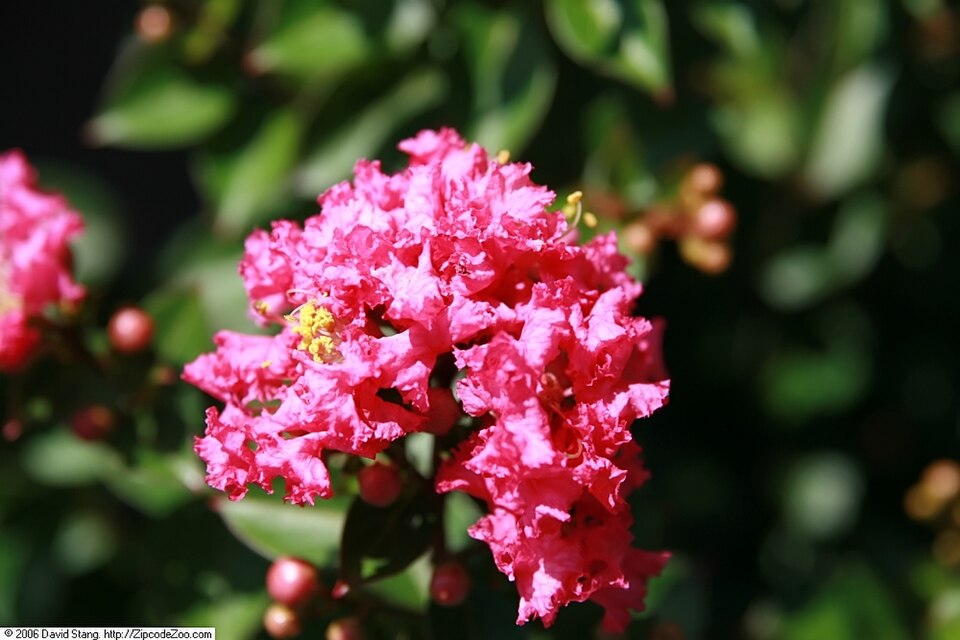
Lagerstroemia, Genus, indica, Species, 'Pocomoke', Cultivar,
- Genus & species
- Cultivar
Pocomoke crape myrtle
East and South Asia (China, Korea, Japan, northern India)
Overview
Lagerstroemia indica 'Pocomoke' is a dwarf deciduous shrub reaching 18-30 inches (45-75 cm) tall and 30-36 inches (75-90 cm) wide with a low spreading mounded habit. Leaves are obovate, 1-2 inches (2.5-5 cm) long, emerging bronze-red and maturing to dark green with red-tinted veins. Pink to deep watermelon-pink flowers, each 0.5-0.75 inches (1.3-2 cm) across, form 4-6 inch (10-15 cm) terminal panicles from July through September. Each panicle holds color for 4-6 weeks; sequential panicles produce continuous bloom across new wood. Foliage turns red, orange, and bronze in fall. Annual growth is 6-12 inches (15-30 cm); plants reach mature size in 4-6 years. Stems and trunk lack the flaking bark of larger L. indica cultivars due to small stem caliper. Cold hardy to -10°F (-23°C); in zones 5-6 stems may die back to ground each winter and regrow from the crown.
Native Range
Lagerstroemia indica is native to China, Korea, Japan, and northern India, where it grows on slopes and in open forest from sea level to 4,000 feet (1,200 m) elevation. The species was introduced to North America in the 1790s and has been widely planted across the southeastern United States. 'Pocomoke' is a hybrid of L. indica and L. fauriei, released by the US National Arboretum in 1998 and named for the Pocomoke River in Maryland.Suggested Uses
Used as a low border specimen, edging plant, or massed groundcover at 30-36 inch (75-90 cm) spacing. Grows in 5-7 gallon (19-26 L) containers, with annual repotting or topdressing. Compact size suits small urban gardens, parking islands, and curb-strip plantings in zones 7-9 where larger L. indica cultivars would outgrow available space.How to Identify
Appearance
Size & Dimensions
Height1'6" - 2'6"
Width/Spread2'6" - 3'
Bloom Information
Bloom begins in late June to early July in zones 7-9 and mid-July in zones 5-6. Continuous flowering extends through September, with individual panicles holding color for 4-6 weeks before fading. Flowers form on current-season wood; bloom continues from successive panicles through frost. Cool wet summers reduce bloom in zones 6-7 by promoting Cercospora leaf spot and slowing panicle development.
Detailed Descriptions
Foliage Description
Bronze-red emerging, maturing to dark green with red-tinted veinsGrowing Conditions
Sun Requirements
Requires 6-12 hours of direct sunlight daily
• Full Sun: 6+ hours of direct sunlight
• Partial Shade: 3-6 hours of direct sunlight
• Full Shade: Less than 3 hours of direct sunlight
Care & Maintenance
Care Guide
Plants establish in 1-2 growing seasons with weekly watering during the first summer. Mature plants tolerate 2-3 weeks without rain and grow in heat above 95°F (35°C). Powdery mildew is the most common foliar disease in humid summers; resistance bred from L. fauriei reduces infection in this hybrid. Aphids may colonize new growth in May-June, producing honeydew and sooty mold. Well-drained soil prevents root rot, which occurs in poorly drained clay. In zones 5-6, stems die back to ground each winter; new growth emerges from the crown after dead canes are removed in early spring.Pruning
Stems are cut to 6-12 inches (15-30 cm) above ground in late winter (February-March) before bud break to maintain compact form and concentrate flowering on strong new wood. In zones 5-6 where winter dieback is typical, stems can be cut to ground level. Removal of the largest 1-2 stems each year on multistem plants in zones 7-9 maintains a balanced framework. Topping above 2 feet (60 cm) produces brittle regrowth and weak flowering.Pruning Schedule
Prune: February–March
winter
Container Growing
Suitable for container growing
Minimum container size: 5 gallons
Toxicity
Non-toxicRelated Lagerstroemia species
 Zuni crape myrtleLagerstroemia indica 'Zuni'
 Tuscarora crape myrtleLagerstroemia indica 'Tuscarora'
 Catawba crape myrtleLagerstroemia indica 'Catawba'
 Bellini grape crape myrtleLagerstroemia indica 'Bellini Grape'
 Natchez crape myrtleLagerstroemia indica 'Natchez'
 Pink Velour crape myrtleLagerstroemia indica 'Pink Velour'