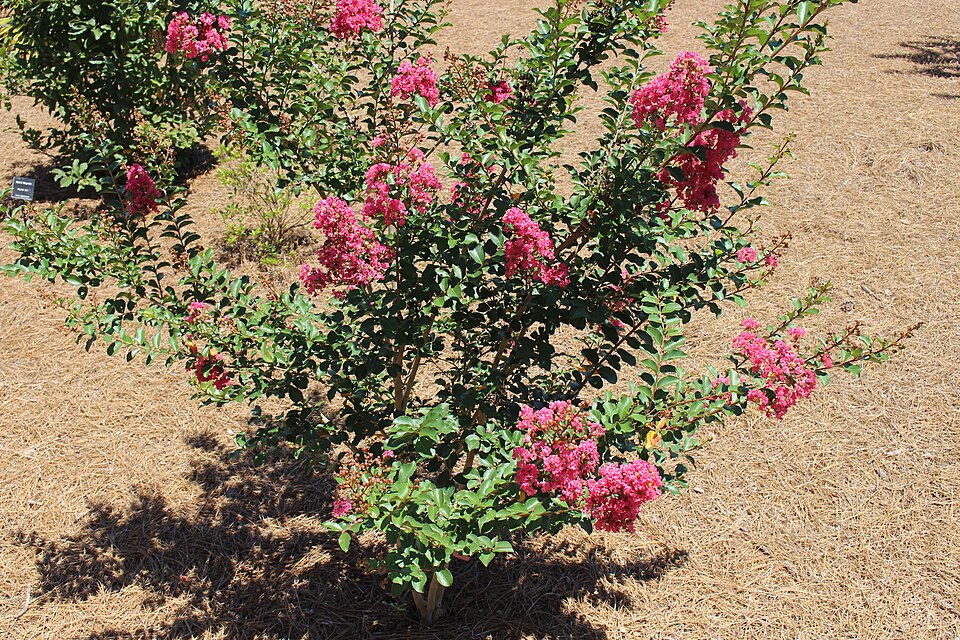
Lagerstroemia, Genus, indica, Species, 'Tuscarora', Cultivar,
- Genus & species
- Cultivar
tuscarora crape myrtle
Hybrid (L. indica × L. fauriei); L. indica native to China, Korea, Japan; L. fauriei native to Japan
Overview
Lagerstroemia indica 'Tuscarora' is a coral-pink crape myrtle, a multi-stemmed deciduous tree reaching 180-300 inches (450-750 cm) tall and 144-240 inches (360-600 cm) wide at 15-20 years. Coral-pink crinkled crepe-paper-textured flowers form panicles 6-12 inches (15-30 cm) and bloom from mid-July through October, totaling approximately 14-16 weeks. An interspecific hybrid of L. indica × L. fauriei from the U.S. National Arboretum breeding program (Egolf, 1981), named for the Tuscarora people. Powdery mildew resistance is higher than pure L. indica cultivars due to L. fauriei parentage; bark exfoliation is more prominent, with mature wood showing smooth mottling in cinnamon, gray, and cream tones. Four-season interest: summer coral-pink panicles; fall orange-red foliage in October-November; winter exfoliating bark; spring bronze new growth. Blooms form on current-season wood. Severe topping ('crape murder') eliminates the natural vase form, removes the bark display, and produces weak watersprout regrowth. Japanese beetles (Popillia japonica) and crape myrtle aphid (Tinocallis kahawaluokalani) are the main pests; aphid honeydew supports sooty mold. Hardy in USDA zones 7-9. Non-toxic. Drought-tolerant once established.
Native Range
Lagerstroemia indica is native to China, Korea, and Japan, occurring in open woodlands and disturbed sites. L. fauriei (the second parent) is native to forested mountainsides on Yakushima Island, Japan. 'Tuscarora' was bred by Donald Egolf at the U.S. National Arboretum in the 1960s and released in 1981.Suggested Uses
Used as a specimen, multi-stemmed street tree, lawn tree, or screening planting in zones 7-9, spaced 144-240 inches (360-600 cm) apart for closed canopy or 240+ inches (600+ cm) for open structure. Drought tolerance and heat tolerance suit it to urban planting strips, parking lot islands, and southern climates. Container culture is rarely successful at landscape scale because the mature canopy exceeds practical pot sizes.How to Identify
Appearance
Size & Dimensions
Height15' - 25'
Width/Spread12' - 20'
Bloom Information
Mid-July through October in zones 7-9 with peak August-September. Each panicle blooms 3-4 weeks; deadheading spent panicles by removing the seed-forming heads produces a second flush in 4-6 weeks for total bloom of 14-16 weeks. Coral-pink color holds without fading in moderate sun; full afternoon sun in zones 9-10 may cause slight color shift toward salmon. Petals drop without staining surfaces below.
Detailed Descriptions
Flower Description
Coral-pink, crepe-paper texture, in paniclesFoliage Description
Dark green; orange-red in fallGrowing Conditions
Sun Requirements
Requires 6-12 hours of direct sunlight daily
• Full Sun: 6+ hours of direct sunlight
• Partial Shade: 3-6 hours of direct sunlight
• Full Shade: Less than 3 hours of direct sunlight
Care & Maintenance
Care Guide
Full sun (6+ hours) supports vigorous growth and full bloom; partial shade produces fewer panicles and increases mildew pressure. Well-drained soil with pH 5.0-6.5 is suited; the species tolerates clay where drainage is adequate. Drought tolerance develops after 2-3 years of regular watering. Japanese beetles (Popillia japonica) skeletonize foliage in July in eastern U.S. populations; crape myrtle aphid (Tinocallis kahawaluokalani) produces sticky honeydew that supports sooty mold, and crape myrtle bark scale (Acanthococcus lagerstroemiae) is an emerging concern in southern states. Powdery mildew is reduced compared to pure L. indica cultivars but not eliminated. Hardy in USDA zones 7-9.Pruning
Pruning is timed to late winter or early spring (February-March) before new growth begins; flowers form on current-season wood, so spring pruning does not eliminate bloom. Removing crossing, inward-growing, and rubbing branches and thinning the interior maintains the multi-stemmed vase form and the bark display on mature wood. Severe topping at 4-6 feet (120-180 cm) destroys the form and produces weak watersprout regrowth that requires staking. Removing seed heads in fall shortens late-bloom dormancy break.Pruning Schedule
Prune: February–March
winterearly spring
Container Growing
Minimum container size: 25 gallons
Toxicity
Non-toxicRelated Lagerstroemia species
 Zuni crape myrtleLagerstroemia indica 'Zuni'
 Catawba crape myrtleLagerstroemia indica 'Catawba'
 Bellini grape crape myrtleLagerstroemia indica 'Bellini Grape'
 Natchez crape myrtleLagerstroemia indica 'Natchez'
 Pocomoke crape myrtleLagerstroemia indica 'Pocomoke'
 Pink Velour crape myrtleLagerstroemia indica 'Pink Velour'