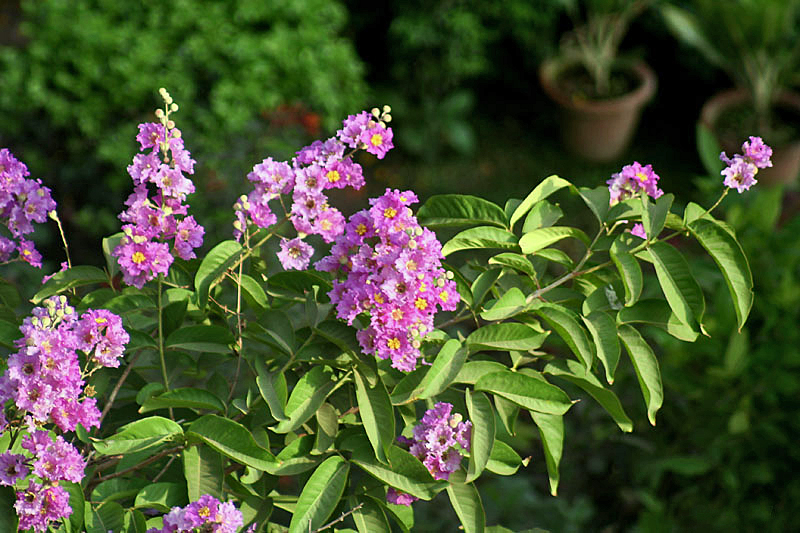
Lagerstroemia, Genus,
- Genus
Crape myrtles
Southern and eastern Asia and northern Australia
Overview
Lagerstroemia is a genus of about 50 species of deciduous shrubs and small trees in the family Lythraceae, native to southern and eastern Asia and northern Australia. Across the genus, plants range from dwarf shrubs 3 feet (0.9 m) tall to trees reaching 30 feet (9 m), with single or multiple upright trunks and a vase-shaped to rounded crown. The bark exfoliates in thin flakes, exposing a mottled surface in tan, cinnamon, and grey. Leaves are simple, oval, and 1 to 4 inches (2.5 to 10 cm) long, emerging bronze and turning yellow, orange, or red before leaf drop. From early summer into autumn the branch tips carry conical panicles 4 to 12 inches (10 to 30 cm) long, packed with flowers whose six crinkled petals open white, pink, red, lavender, or purple. The flowering period extends 8 to 12 weeks in warm climates. Most species are damaged below about 0 F (-18 C) and may die back to the roots in hard winters. Powdery mildew and aphid-related sooty mold affect susceptible species in humid conditions.
Native Range
Lagerstroemia is native to the warm-temperate, subtropical, and tropical regions of the Indian subcontinent, China, Southeast Asia, Japan, and northern Australia. The widely grown L. indica originates in China and Korea, while the larger L. speciosa is native to tropical southern Asia.Suggested Uses
Crape myrtles are grown as specimen and street trees, in shrub borders, and as foundation plantings, with dwarf forms used in containers and low hedges. Larger species are spaced 10 to 20 feet (3 to 6 m) apart as small flowering trees. The summer flowers attract bees and butterflies.How to Identify
Appearance
Size & Dimensions
Height3' - 30'
Width/Spread3' - 20'
Bloom Information
Flowering runs from early summer into autumn, typically June through September, and is heaviest in regions with hot summers. Each panicle blooms over several weeks, and removing spent heads can prompt a second flush. Bloom is sparse or absent in cool-summer climates and in shade.
Detailed Descriptions
Flower Description
white, pink, red, lavender, or purpleFoliage Description
green, turning yellow, orange, or red in autumnGrowing Conditions
Sun Requirements
Requires 6-8 hours of direct sunlight daily
• Full Sun: 6+ hours of direct sunlight
• Partial Shade: 3-6 hours of direct sunlight
• Full Shade: Less than 3 hours of direct sunlight
Care & Maintenance
Care Guide
Crape myrtles grow in full sun on well-drained soil at pH 5.0 to 7.0 and flower poorly with fewer than six hours of direct light. Most species are drought-tolerant once established but flower more freely with summer moisture. Hardiness varies across the genus, with many species root-hardy to USDA zone 6 or 7 and topgrowth damaged by hard freezes. Good air circulation reduces powdery mildew, the most common problem in humid regions, and mildew-resistant species and hybrids are available. Water young plants through the first two summers. Feeding in early spring supports flowering on poor soils.Pruning
Prune Lagerstroemia in late winter to remove crossing, dead, or crowded stems and to shape the crown. Cutting all stems back to thick stubs each year, sometimes called topping, produces weak, whippy regrowth and removes the natural branch structure. Thinning root suckers and inner twigs exposes the trunk bark.Pruning Schedule
Prune: February–March
winterearly spring
Container Growing
Suitable for container growing
Minimum container size: 5 gallons
Toxicity
Non-toxicRelated Lagerstroemia species
 Zuni crape myrtleLagerstroemia indica 'Zuni'
 Tuscarora crape myrtleLagerstroemia indica 'Tuscarora'
 Catawba crape myrtleLagerstroemia indica 'Catawba'
 Bellini grape crape myrtleLagerstroemia indica 'Bellini Grape'
 Natchez crape myrtleLagerstroemia indica 'Natchez'
 Pocomoke crape myrtleLagerstroemia indica 'Pocomoke'