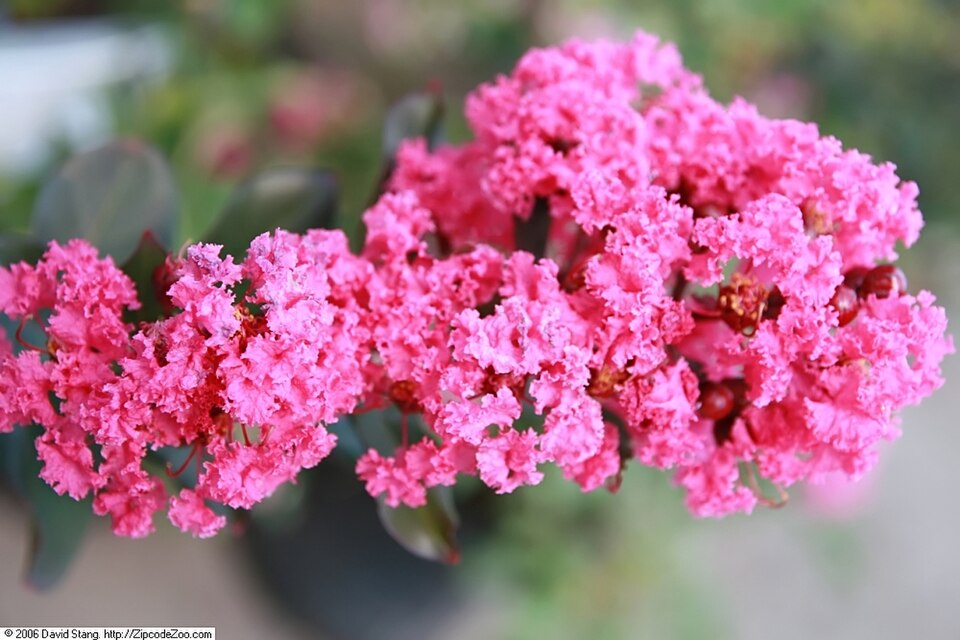
Lagerstroemia, Genus, indica, Species, 'Pink Velour', Cultivar,
- Genus & species
- Cultivar
Pink Velour crape myrtle
Southern China, Korea, Japan, Indian subcontinent
Overview
Lagerstroemia indica 'Pink Velour' is a deciduous large shrub or small tree reaching 8-12 feet (2.4-3.7 m) tall and 6-10 feet (1.8-3 m) wide at maturity. The cultivar produces a more compact form than the species type L. indica (which reaches 15-25 feet/4.6-7.6 m at maturity), with multi-stemmed branching from near the base. New foliage emerges deep burgundy in spring, transitioning to dark green with burgundy undertones through summer. Leaves are obovate to elliptic, 1.5-3 inches (4-7.5 cm) long, opposite to subopposite along the stems. Crinkled, papery six-petaled bright pink flowers 1-1.5 inches (2.5-4 cm) across appear in terminal panicles 6-9 inches (15-23 cm) long from late June through September. Smooth grey-brown bark exfoliates in thin sheets to reveal cinnamon to grey inner bark on stems older than three years. Foliage shifts to red and orange tones in fall before leaf drop. Cold injury occurs at temperatures below 0°F (-18°C), with stem dieback to ground level common in zone 6 and southern zone 5; plants regrow from the root crown in spring but flower 3-4 weeks later than uninjured specimens.
Native Range
The species L. indica is native to southern China, Korea, Japan, and the Indian subcontinent, found in open woodlands, river valleys, and disturbed sites from sea level to 4,000 feet (1,200 m) elevation. Naturalized populations occur throughout the southeastern United States from Virginia to Texas in zones 7-9.Suggested Uses
Planted as a single specimen, in small groves of 3-5 plants, and in foundation plantings at the corners of larger structures in zones 7-9. Used in mixed shrub borders and parking lot island plantings throughout the southeastern United States where summer flowering color extends from late June through September. Grows in containers of at least 15 gallons (57 L) for 4-6 years; container plants are typically over-wintered in protected sites in zones 6-7.How to Identify
Appearance
Size & Dimensions
Height8' - 12'
Width/Spread6' - 10'
Bloom Information
Flowering begins in late June or early July in zones 7-9 and continues through September, with peak display lasting 8-10 weeks. Individual panicles bloom for 3-5 weeks, with new panicles developing on lateral shoots produced after early-summer flowering. Deadheading of spent panicles encourages a secondary flush 3-4 weeks later. Bloom timing shifts 2-3 weeks later in zones 6-7 where stem dieback delays growth resumption.
Detailed Descriptions
Foliage Description
burgundy in spring, dark green with burgundy undertones in summerGrowing Conditions
Sun Requirements
Requires 6-10 hours of direct sunlight daily
• Full Sun: 6+ hours of direct sunlight
• Partial Shade: 3-6 hours of direct sunlight
• Full Shade: Less than 3 hours of direct sunlight
Care & Maintenance
Care Guide
Spacing of 6-10 feet (1.8-3 m) accommodates mature width. Established plants tolerate 3-4 weeks without rain in zones 7-9 and benefit from occasional irrigation during prolonged drought. Powdery mildew develops on susceptible cultivars in humid conditions; 'Pink Velour' carries moderate genetic resistance to powdery mildew, though cosmetic infection can still occur. Cercospora leaf spot causes premature leaf drop in late summer in humid southeastern conditions. Crape myrtle bark scale (Acanthococcus lagerstroemiae) has spread across the southern United States since 2004 and causes black sooty mold on bark and stems, with horticultural oil applications in late winter limiting infestations. Cold injury at temperatures below 0°F (-18°C) can kill stems to the ground, with regrowth from the crown reaching 3-4 feet (90-120 cm) by mid-summer.Pruning
Selective thinning of crossing or interior branches in late winter (February-March in zones 7-9) maintains the natural multi-stemmed form on second- and third-year wood. Severe pollarding cuts that produce knuckle-like callus growths reduce flowering quality and produce a structurally weakened framework over 5-10 years. Removal of basal sucker growth in spring maintains the multi-stemmed form rather than developing a thicket. Deadheading of spent flower panicles in mid-summer encourages a secondary bloom flush.Pruning Schedule
Prune: February–March
winterearly spring
Container Growing
Suitable for container growing
Minimum container size: 15 gallons
Toxicity
Non-toxicRelated Lagerstroemia species
 Zuni crape myrtleLagerstroemia indica 'Zuni'
 Tuscarora crape myrtleLagerstroemia indica 'Tuscarora'
 Catawba crape myrtleLagerstroemia indica 'Catawba'
 Bellini grape crape myrtleLagerstroemia indica 'Bellini Grape'
 Natchez crape myrtleLagerstroemia indica 'Natchez'
 Pocomoke crape myrtleLagerstroemia indica 'Pocomoke'