Persicaria, Genus, longiseta, Species,
- Genus & species
low smartweed
SunFull Sun – Part Shade
WaterHigh
Overview
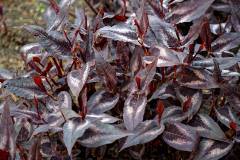
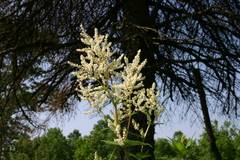
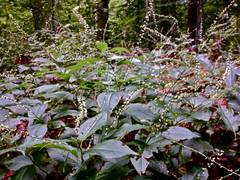
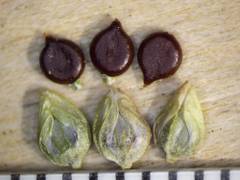
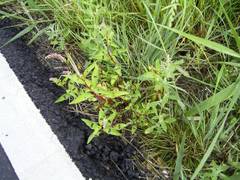
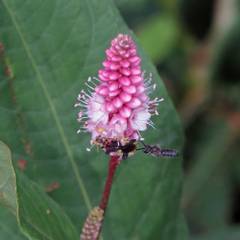
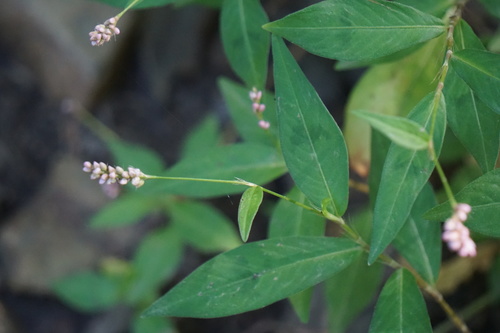
Persicaria longiseta is an annual herb in the knotweed family, growing 8-36 inches (20-90 cm) tall with slender, freely branching stems that are often reddish at the swollen nodes. Each node is wrapped in a papery sheath, or ocrea, fringed with bristles 0.1-0.2 inch (3-5 mm) long, the feature that gives the species its name. The lance-shaped leaves are 1-3 inches (2.5-7.5 cm) long and sometimes carry a dark chevron-shaped blotch. From summer into autumn the stems produce narrow, nodding flower spikes 0.5-1.5 inches (1.5-4 cm) long packed with tiny pink to rose flowers that rarely open fully. Each flower yields a small, shiny, three-sided black achene. The plant favors moist, disturbed ground and turns up along stream banks, ditches, lawns, and field edges. It germinates over a long season and self-seeds heavily, forming dense stands. Persicaria longiseta is regarded as an invasive weed across much of eastern North America, where it competes with native vegetation in wet soils. It dies back completely with the first hard frost.
Native Range
Persicaria longiseta is native to temperate and subtropical East Asia, including China, Japan, Korea, and eastern Russia. It has naturalized widely in eastern North America and parts of Europe.Suggested Uses
It is seldom grown deliberately and is most often managed as a weed of wet ground. In naturalized or wildlife settings the seeds feed ducks, songbirds, and small mammals, and the flowers draw small bees. Where used at all, it suits damp margins and rain-garden edges that can contain its self-seeding.How to Identify
Appearance
Size & Dimensions
Height8" - 3'
Width/Spread1' - 2'
Bloom Information
Detailed Descriptions
Flower Description
pink to roseFoliage Description
greenGrowing Conditions
Sun Requirements
Requires 3-8 hours of direct sunlight daily
• Full Sun: 6+ hours of direct sunlight
• Partial Shade: 3-6 hours of direct sunlight
• Full Shade: Less than 3 hours of direct sunlight
Water & Climate
Water Needs
Care & Maintenance
Care Guide
As a weedy annual it needs no cultivation and grows in sun to part shade on moist, fertile ground. Steady soil moisture and disturbed, open ground favor germination and dense growth. It tolerates periodic flooding and compacted soil but fails in dry, sandy sites. The plant completes its life cycle in one season and relies entirely on seed to return. Pulling plants before seed sets is the practical means of limiting its spread in wet beds. No feeding is required.Pruning
Routine pruning does not apply to this annual. Cutting or pulling the stems before the flower spikes mature prevents seed formation and curbs spread. Cut stems can re-root in wet soil, so removed material is carried away rather than left on damp ground.Toxicity
Non-toxicPlanting Guide
Planting Methods & Timing
Planting Method
direct sow