Passiflora, Genus, edulis, Species,
- Genus & species
passion fruit
Overview
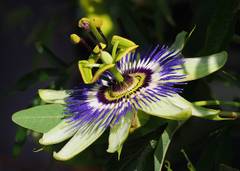
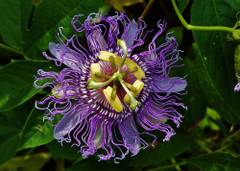
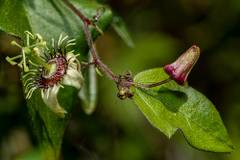
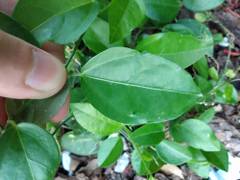
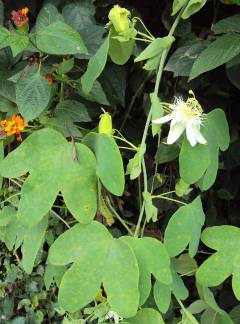
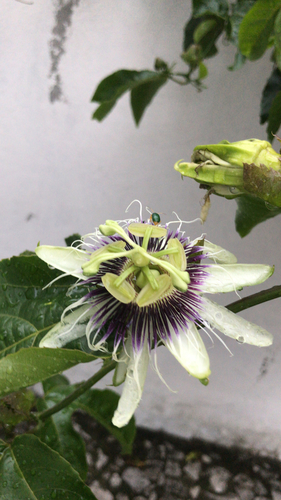
Passiflora edulis is a vigorous, evergreen to semi-evergreen climbing vine in the Passifloraceae family, growing 15–30 feet (4.5–9 m) by attaching to supports with axillary tendrils. Leaves are alternate, deeply three-lobed, 4–6 inches (10–15 cm) across, glossy dark green above, paler beneath, with finely serrated margins. Flowers are solitary, 2–3 inches (5–8 cm) across, complex in structure — five white petals and five white sepals subtend a prominent corona of wavy, banded filaments that are white at the tips, purple at the base. The central structure bears five stamens and three styles on a raised androgynophore. Flowers are fragrant with a sweet, tropical scent. Fruit is a round to ovoid berry, 2–3 inches (5–8 cm) in diameter, with a tough, leathery rind — deep purple in the species type, yellow in the forma flavicarpa. Interior contains a mass of 150–300 seeds, each enclosed in an aromatic, sweet-tart, translucent orange pulp (aril). Fruit drops from the vine when ripe. The vine grows rapidly — 15–20 feet (4.5–6 m) in a single season in warm conditions. In the Pacific Northwest, it is not hardy outdoors — frost kills foliage below 30°F (-1°C) and stems below 25°F (-4°C). Grown as a conservatory plant or in a large container moved outdoors in summer. Self-incompatible (many clones) — a second genetically distinct plant or hand-pollination with a different clone is needed for fruit set. Susceptible to fusarium wilt, brown spot, and fruit fly in warmer climates.
Native Range
Passiflora edulis is native to southern Brazil, Paraguay, and northern Argentina, in subtropical Atlantic Forest habitats at elevations of 1,000–5,000 feet (300–1,500 m). It is now cultivated pantropically for fruit production in Australia, East Africa, Southeast Asia, and Hawaii.Suggested Uses
Grown as a conservatory or greenhouse specimen in the Pacific Northwest, trained on a wall or trellis. Moved outdoors to a warm, south-facing patio in summer. In USDA zones 9b–11, planted permanently outdoors as a fence or arbour cover. The complex flowers and edible fruit make it a dual-purpose ornamental and edible vine. Fruit is consumed fresh, juiced, or used in desserts and cocktails.How to Identify
Appearance
Size & Dimensions
Height15' - 30'
Width/Spread6' - 10'
Bloom Information
Flowers open from late spring through summer, one per node along new growth. Each flower opens for a single day — receptive for approximately 4–6 hours. Flowering continues for 2–4 months on actively growing vines. Fruit develops over 60–80 days after pollination, ripening from green through dark purple. Ripe fruit drops naturally from the vine. In conservatory culture in the Pacific Northwest, flowering occurs from June through September if temperatures and light are adequate.
Detailed Descriptions
Flower Description
White petals with purple-and-white banded coronaFoliage Description
Glossy dark greenGrowing Conditions
Sun Requirements
Requires 6-10 hours of direct sunlight daily
• Full Sun: 6+ hours of direct sunlight
• Partial Shade: 3-6 hours of direct sunlight
• Full Shade: Less than 3 hours of direct sunlight
Care & Maintenance
Care Guide
In the Pacific Northwest, grow in a heated conservatory or large container (minimum 15 gallons / 57 L) that can be moved outdoors in summer. Plant in fertile, well-drained soil or a loam-based potting mix with a pH of 6.0–7.0. Provide a sturdy trellis, wires, or netting — vines are vigorous and heavy. Site in full sun — minimum 6 hours of direct light. Water regularly during the growing season, keeping soil consistently moist but not waterlogged. Feed every 2 weeks from April through September with a high-potassium liquid fertiliser (e.g. tomato feed) to promote flowering and fruiting. Reduce watering and stop feeding in winter. Maintain minimum winter temperature of 50°F (10°C). For fruit set, hand-pollinate by transferring pollen from anthers to stigmas of a different plant using a small brush.Pruning
Prune in late winter (February–March) before new growth begins. Remove dead, weak, and congested growth. Cut back the previous year's lateral shoots to 2–3 buds from the main framework. The vine flowers on current season's growth, so pruning does not sacrifice bloom. In containers, maintain a permanent framework of 2–3 main stems trained along the support, with annual renewal of lateral shoots.Pruning Schedule
Prune: February–March
late spring
Container Growing
Suitable for container growing
Minimum container size: 15 gallons