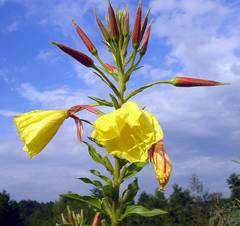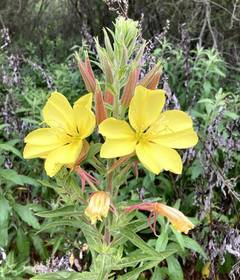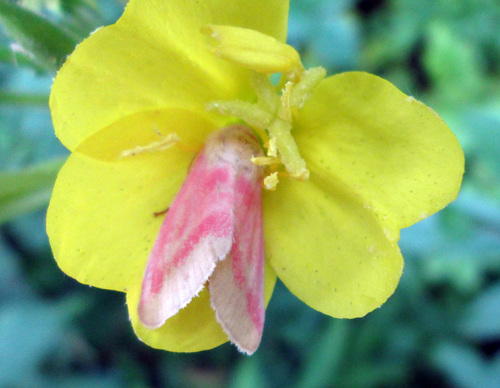
Oenothera, Genus, biennis, Species,
- Genus & species
evening primrose
Eastern and central North America, from Newfoundland to Alberta and south to Florida and Texas; roadsides, waste ground, railroad grades, and open disturbed sites from sea level to approximately 6,000 feet (1,800 m).
Overview
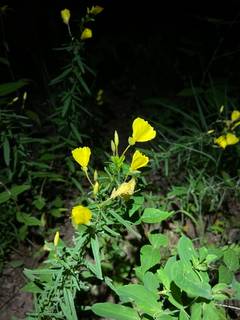
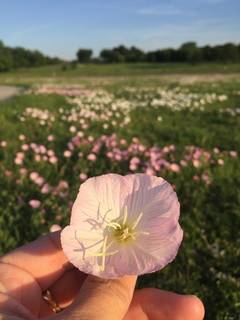
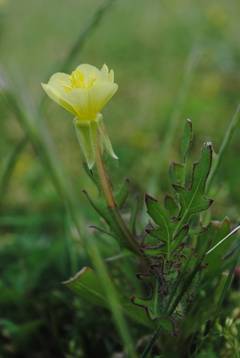
Oenothera biennis is a taprooted biennial reaching 24-72 inches (60-180 cm) tall and 12-24 inches (30-60 cm) wide. First-year plants form a basal rosette of oblanceolate leaves 4-8 inches (10-20 cm) long with a prominent whitish midrib. In the second year, stems bolt erect, stiff, usually unbranched or sparingly branched, hairy, often reddish-tinged, and carry alternate lanceolate leaves 2-6 inches (5-15 cm) long with finely toothed margins. Four-petaled bright yellow flowers 1-2 inches (2.5-5 cm) across open from June through September on a spike-like raceme, with a long slender hypanthium (floral tube) 0.8-1.5 inches (20-38 mm) connecting the inferior ovary at the base to the petals and sepals above. Flowers open at dusk over a period of 1-3 minutes and remain open through the night, wilting by the following morning; each flower lasts a single night. The pale yellow color and sweet evening fragrance signal nocturnal hawk moths (Sphingidae), which are the primary pollinators and whose long tongues match the hypanthium length. Fruit is an elongated capsule 0.8-1.5 inches (20-38 mm) long that splits into four sections and releases numerous tiny seeds. A single plant produces 5,000-100,000 seeds. Seeds are a food source for songbirds, particularly American goldfinches, which work the ripening capsules in late summer and fall. Hardy in USDA zones 3-9 (-40°F / -40°C). Native to eastern and central North America and functions as a weed in the Pacific Northwest on roadsides, waste ground, and disturbed sites.
Native Range
Oenothera biennis is native to eastern and central North America, from Newfoundland to Alberta and south to Florida and Texas, where it grows on roadsides, waste ground, railroad grades, and open disturbed sites from sea level to approximately 6,000 feet (1,800 m). The species has naturalized across the Pacific Northwest and throughout temperate Europe, where it was introduced as a garden plant in the 17th century and has persisted in wildflower and herb gardens.Suggested Uses
The species is used in Onagraceae identification courses for teaching the inferior ovary, the hypanthium tube, and four-petaled flower morphology. Vespertine (evening-opening) flowering and hawk moth pollination are taught in pollination ecology courses with O. biennis as the canonical case. Plants are studied in plant circadian biology and in rapid flower opening mechanics; individual petal unfolding takes 1-3 minutes and can be filmed in real time. Seeds are harvested commercially for evening primrose oil, a source of gamma-linolenic acid used in dietary supplements. The species functions as a native plant operating as a weed outside its core range, an instructive case in biogeography and weed ecology.How to Identify
Appearance
Size & Dimensions
Height2' - 6'
Width/Spread1' - 2'
Bloom Information
Four-petaled bright yellow flowers 1-2 inches (2.5-5 cm) across open at dusk from June through September of the second year, with individual flowers lasting a single night and wilting by the following morning. The spike-like raceme blooms from the base upward over 6-8 weeks, opening 1-5 new flowers each evening. Pollination is primarily by hawk moths (Sphingidae) drawn by the pale yellow color visible at twilight and the sweet fragrance; the hypanthium length matches hawk moth tongue length and excludes shorter-tongued visitors. Flowers are self-compatible and set seed in the absence of pollinators through self-pollination in the closing flower at dawn. Capsules mature 4-6 weeks after pollination.
Detailed Descriptions
Flower Description
Bright yellow four-petaled flowers 1-2 inches (2.5-5 cm) across with a long slender hypanthium (floral tube) 0.8-1.5 inches (20-38 mm) connecting the ovary at the base to the petals and sepals above; flowers open at dusk and wilt by morningFoliage Description
Medium green; first-year basal rosette leaves oblanceolate 4-8 inches (10-20 cm) long with a prominent whitish midrib; second-year stem leaves alternate, lanceolate, 2-6 inches (5-15 cm) long with finely toothed margins; leaf bases often reddish-tingedGrowing Conditions
Sun Requirements
Requires 6-12 hours of direct sunlight daily
• Full Sun: 6+ hours of direct sunlight
• Partial Shade: 3-6 hours of direct sunlight
• Full Shade: Less than 3 hours of direct sunlight