Nepeta, Genus, racemosa, Species,
- Genus & species
Persian catmint
Caucasus, northeastern Turkey, and northern Iran
Overview
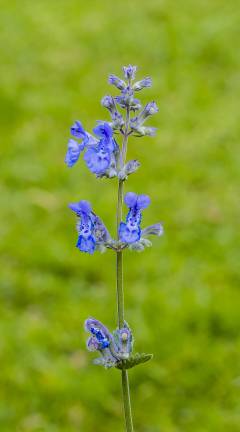
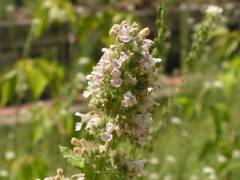
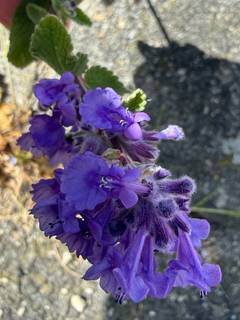
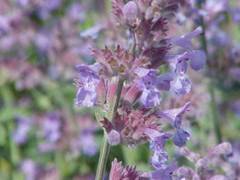
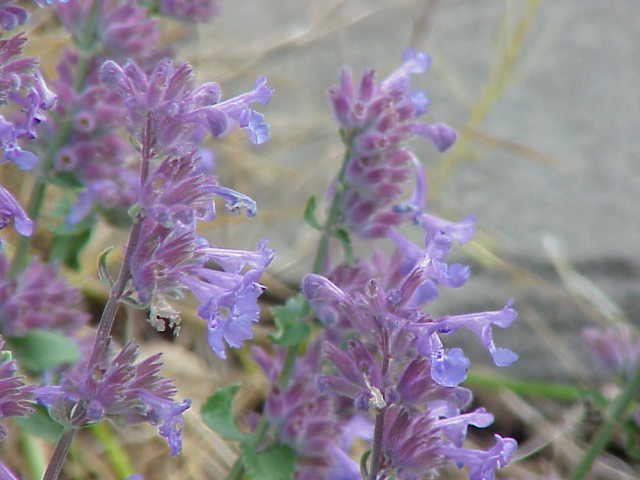
Nepeta racemosa is a herbaceous perennial forming a mound 12-18 inches (30-45 cm) tall and 18-24 inches (45-60 cm) wide from a woody crown. Stems are square in cross-section and carry gray-green ovate to heart-shaped leaves 0.5-1.5 inches (1.5-4 cm) long with scalloped margins and a dense coat of short hairs; crushed foliage releases nepetalactone, the volatile compound that also triggers a response in domestic cats. Flowers are two-lipped, 0.3-0.5 inch (8-12 mm) long, lavender-blue with darker spotting on the lower lip, carried in interrupted whorls along racemes 4-8 inches (10-20 cm) long. First bloom runs May into June; stems cut back after this flush regrow and flower again from July into September. Plants reach mature spread in their second season and self-seed at 10-30 seedlings per plant in open ground. Growth opens at the center after flowering in soils that are rich or hold moisture, leaving a ring of stems around a bare crown until cut back. Foliage dies to the ground below 20F (-7C) and regrows from the crown in early spring.
Native Range
Native to the Caucasus, northeastern Turkey, and northern Iran, growing on rocky slopes, stony meadows, and open scrub at 3,000-8,500 feet (900-2,600 m). Naturalized in scattered locations across Europe and North America following garden escape.Suggested Uses
Planted at 18-24 inch (45-60 cm) spacing along path edges, in gravel gardens, and at the front of borders, and as underplanting among roses at 24 inch (60 cm) spacing. Grows in containers of 3 gallons (11 L) or larger, where restricted moisture holds the habit tighter than in open ground. Self-seeding at 10-30 seedlings per plant and the attention of cats limit its use in formal or heavily trafficked plantings.How to Identify
Appearance
Size & Dimensions
Height1' - 1'6"
Width/Spread1'6" - 2'
Colors
Foliage Colors
Bloom Information
Flowers May into June in zones 3-8, with the first flush lasting 4-6 weeks. Stems sheared to 4-6 inches (10-15 cm) after that flush regrow within 2-3 weeks and flower again from July into September. Total bloom across both flushes runs 12-16 weeks in zones 5-8 and 8-10 weeks in zones 3-4. Flowering starts 2-3 weeks earlier in zones 8-9 and stops by early August under sustained temperatures above 90F (32C).
Detailed Descriptions
Foliage Description
Gray-greenGrowing Conditions
Sun Requirements
Requires 6-8 hours of direct sunlight daily
• Full Sun: 6+ hours of direct sunlight
• Partial Shade: 3-6 hours of direct sunlight
• Full Shade: Less than 3 hours of direct sunlight
Care & Maintenance
Care Guide
Water weekly through the first season, then every 2-3 weeks in the absence of rain; established plants hold through 4-6 weeks of drought with some leaf loss. Lean, sharply drained soil keeps stems upright, while soil high in nitrogen or holding winter moisture causes the clump to split open and the crown to rot. Cutting stems back by half after the first flush restores the mound and brings on the second bloom. Clumps are divided in early spring every 3-4 years as the center thins. Powdery mildew coats leaves in humid weather with still air, and cats rolling on the foliage break stems on plants under two years old. No fertilizer is needed in average soil; a spring topdressing of compost 0.5 inch (12 mm) deep covers the season.Pruning
Stems are sheared to 4-6 inches (10-15 cm) as the first flush of flowers fades in late June, which closes the opening center and brings a second bloom within 3-4 weeks. Old top growth is cut to 2-3 inches (5-8 cm) in late winter before new shoots emerge; growth left standing over winter shelters the crown in zones 3-4. Cutting individual spent stems back to a leaf pair during bloom extends the first flush by 1-2 weeks.Pruning Schedule
Prune: February & June–July
summerwinter
Container Growing
Suitable for container growing
Minimum container size: 3 gallons