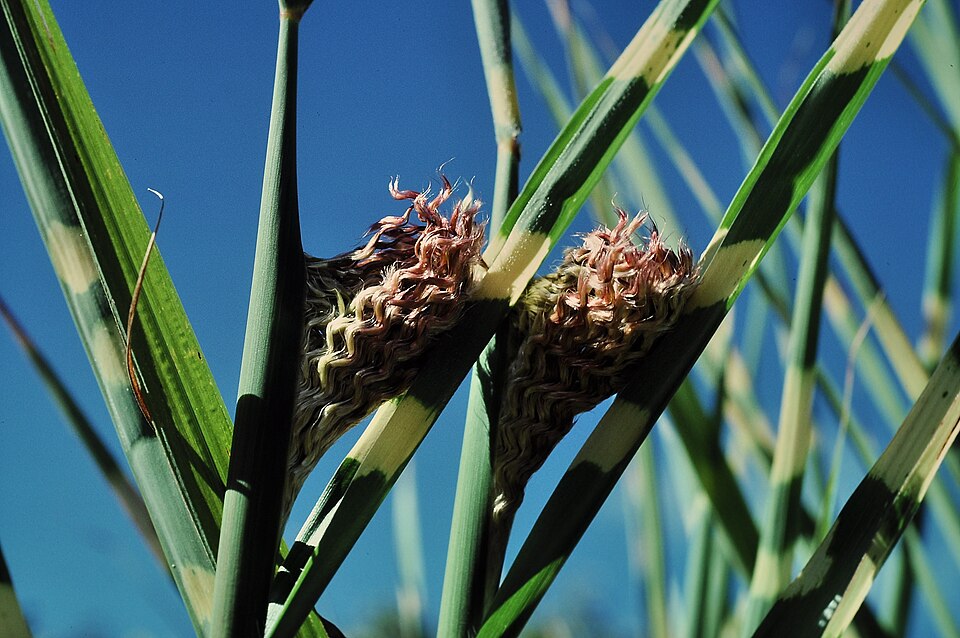
Miscanthus, Genus, sinensis, Species, 'Strictus', Cultivar,
- Genus & species
- Cultivar
porcupine grass
Species native to East Asia (Japan, Korea, China, Taiwan) in mountain grasslands, volcanic slopes, and disturbed open ground at low to moderate elevations; 'Strictus' cultivar is a horticultural selection developed for upright habit and horizontal banding; commercially grown across temperate North America and Europe; species carries invasiveness potential in some North American regions
Overview
Miscanthus sinensis 'Strictus' is porcupine grass — a horizontally banded warm-season ornamental grass cultivar in the family Poaceae growing 60–72 inches (150–180 cm) tall and 48–60 inches (120–150 cm) wide in a stiffly upright clumping habit. The cultivar name 'Strictus' translates as 'upright', referencing the columnar growth form that runs more vertical than the older sibling cultivar 'Zebrinus' which tends to arch and flop in late summer. Green leaf blades carry horizontal golden-yellow bands at regular intervals along the length — the cross-banded leaf pattern runs as the principal ornamental trait. The common name 'porcupine grass' references the stiff spiny-looking upright form that resembles porcupine quills standing erect from the basal mound. Coppery-pink plumes emerge in late fall (October–November) and age to silvery-white through winter; flowering runs inconsistent in northern zones where the growing season may end before the inflorescence matures. The cultivar runs as the first improvement on the older 'Zebrinus' selection (upright versus floppy habit) and runs largely superseded by the newer 'Bandwidth' cultivar that carries wider bands, more reliable habit, and stronger garden performance. The cultivar still reaches the standard nursery channels and runs as a solid performer where established. M. sinensis carries invasiveness potential in some regions of North America; gardeners in invasive-watch areas should consult regional invasive plant lists before planting and consider sterile or non-invasive alternatives such as native Panicum virgatum cultivars. Hardy to USDA zone 5. Deer avoid the foliage. Not known to be toxic to pets or humans.
Native Range
The species Miscanthus sinensis is native to East Asia — Japan, Korea, China, and Taiwan — in mountain grasslands, volcanic slopes, and disturbed open ground at low to moderate elevations. The 'Strictus' cultivar is a horticultural selection developed for upright habit and horizontal banding and is grown commercially across temperate North America and Europe.Suggested Uses
Used as a tall horizontally banded specimen, vertical accent in mixed perennial borders, screening planting along property lines, mass planting for the banded foliage effect, and containers of 10 gallons (38 liters) or more with deep root volume. The cultivar runs as the original upright zebra grass and the principal narrower-banded zebra grass option in the cultivar group. The newer cultivar 'Bandwidth' carries wider bands, more reliable habit, and stronger garden performance and runs as the typical replacement choice for new plantings; 'Strictus' continues to run as a solid performer where established or where 'Bandwidth' is unavailable. M. sinensis carries invasiveness potential in some regions of North America — consult regional invasive plant lists before planting.How to Identify
Appearance
Size & Dimensions
Height5' - 6'
Width/Spread4' - 5'
Bloom Information
Flowering in October and November in the southern half of the cultivation range; flowering runs inconsistent in zones 5–6 where the growing season may end before the inflorescence matures and emerges. Coppery-pink plumes emerge from the upper foliage and age to silvery-white through fall and winter. The plumes hold structural form through winter standing-dormant in dry-climate plantings; in wet climates the plumes may shatter and disperse seed. Plants run wind-pollinated.
Detailed Descriptions
Flower Description
Coppery-pink aging to silvery-white; feathery plumes (inconsistent flowering in northern zones)Foliage Description
Green leaf blades with horizontal golden-yellow bands at regular intervals along the length; stiffly uprightGrowing Conditions
Sun Requirements
Requires 6-12 hours of direct sunlight daily
• Full Sun: 6+ hours of direct sunlight
• Partial Shade: 3-6 hours of direct sunlight
• Full Shade: Less than 3 hours of direct sunlight
Care & Maintenance
Care Guide
Plant in full sun with at least 6 hours of direct light. Average to moist well-drained soil at pH 5.5–7.5 suits the cultivar; the cultivar tolerates a wide range of soil conditions. Cut all foliage to 6 inches (15 cm) above ground in late February or March before new growth emerges; warm-season grasses emerge later in spring than cool-season grasses, and waiting for new growth to start before cutting back avoids damage to emerging shoots. Hardy to USDA zone 5. M. sinensis carries invasiveness potential in some regions of North America — consult regional invasive plant lists before planting and consider deadheading the plumes before seed shatter to reduce self-sowing pressure. The cultivar runs less invasive than the species form due to reduced seed set, but invasive-watch areas may still warrant alternative selection.Pruning
Leave foliage and plumes standing through winter for structural interest and habitat value. Cut all foliage to 6 inches (15 cm) above ground in late February or March before new growth emerges. Optionally deadhead plumes before seed shatter to reduce self-sowing in invasive-watch regions. No other seasonal pruning is needed.Pruning Schedule
Prune: February–March
winter
Container Growing
Suitable for container growing
Minimum container size: 10 gallons
Toxicity
Non-toxicRelated Miscanthus species
 MiscanthusMiscanthus sinensis
 Gracillimus maiden grassMiscanthus sinensis 'Gracillimus'
 Morning light maiden grassMiscanthus sinensis 'Morning Light'
 Silver feather maiden grassMiscanthus sinensis 'Silberfeder'
 Cosmopolitan maiden grassMiscanthus sinensis 'Cosmopolitan'
 Variegated maiden grassMiscanthus sinensis 'Variegatus'