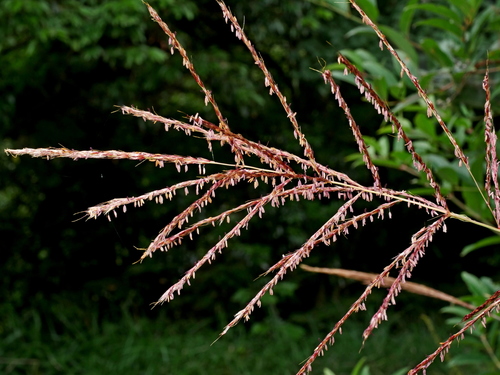
Miscanthus, Genus, spp., Multiple species,
- Genus
- Multiple species
silvergrasses
Overview
Miscanthus is a genus of about 15 species of perennial grasses in the family Poaceae, native to Africa and eastern Asia. Plants form dense clumps of arching, linear leaves and reach 3–12 feet (0.9–3.7 m) tall in flower, depending on species. Leaf blades are 0.3–1.2 inches (8–30 mm) wide and 1.5–3 feet (45–90 cm) long, with a pale or white midrib and rough margins. Feathery flower plumes open above the foliage from late summer into fall, silver to pink or copper, 6–14 inches (15–35 cm) long, fading to tan as seed heads dry and standing through winter. Foliage of most species turns bronze or straw-colored after frost. Growth is warm-season, with active expansion in summer and dormancy in winter. M. sinensis forms tight clumps, while M. sacchariflorus spreads by rhizomes into broad colonies. Several species self-seed and have naturalized outside their native range, and M. sinensis is listed as invasive in parts of the eastern United States.
Native Range
Native to Africa and eastern Asia, including China, Japan, Korea, and far-eastern Russia, with M. sinensis ranging across temperate East Asia. Grows in grasslands, mountain slopes, marsh margins, and disturbed ground from sea level to about 9,000 feet (2,700 m).Suggested Uses
Used as a single specimen, screen, or massed planting in borders and naturalized areas, spaced 3–5 feet (0.9–1.5 m) apart. Stems and seed plumes are cut for fresh and dried arrangements. Rhizomatous and freely seeding species spread near natural areas and are managed accordingly.How to Identify
Appearance
Size & Dimensions
Height3' - 12'
Width/Spread2' - 6'
Bloom Information
Plumes emerge from late summer through fall, generally August to October, with later flowering in short-season climates and earlier bloom in warm regions. Plumes hold their form 8–12 weeks, shifting from silver or pink to tan as seed matures, and dried heads stand through winter. Cool summers delay or reduce flowering in northern gardens.
Detailed Descriptions
Flower Description
silver, pink, to copperFoliage Description
green to blue-green, turning bronze to straw in fallGrowing Conditions
Sun Requirements
Requires 6-10 hours of direct sunlight daily
• Full Sun: 6+ hours of direct sunlight
• Partial Shade: 3-6 hours of direct sunlight
• Full Shade: Less than 3 hours of direct sunlight
Care & Maintenance
Care Guide
Grows in full sun and average, well-drained soil with medium water, tolerating clay, sand, and brief flooding once established. Plants flop in shade or over-rich soil and flower less. Cut clumps to 4–6 inches (10–15 cm) in late winter before new growth begins. Divide every 3–4 years when the clump center dies out. Rust and mealybugs occur occasionally. Self-seeding is heavy in some species and cultivars, and seedlings can establish in nearby open ground.Pruning
Cut the previous season's stems to 4–6 inches (10–15 cm) in late winter or early spring before new shoots emerge. Old foliage left uncut shades emerging growth and slows green-up. Division in spring renews clumps that have died out in the center.Pruning Schedule
Prune: February–March
winterearly spring
Container Growing
Suitable for container growing
Minimum container size: 7 gallons
Toxicity
Non-toxicRelated Miscanthus species
 MiscanthusMiscanthus sinensis
 Gracillimus maiden grassMiscanthus sinensis 'Gracillimus'
 Morning light maiden grassMiscanthus sinensis 'Morning Light'
 Silver feather maiden grassMiscanthus sinensis 'Silberfeder'
 Cosmopolitan maiden grassMiscanthus sinensis 'Cosmopolitan'
 Variegated maiden grassMiscanthus sinensis 'Variegatus'