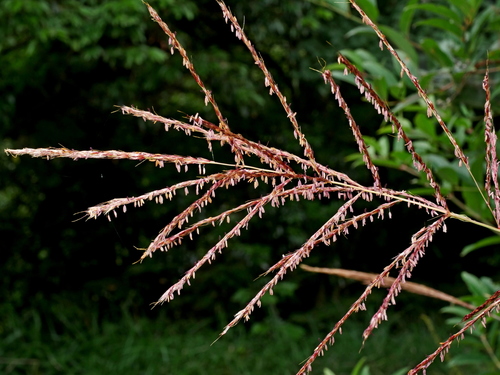
Miscanthus, Genus, sinensis, Species,
- Genus & species
miscanthus
Eastern Asia — China, Japan, Korea, and Taiwan; open grasslands, hillsides, roadsides, and forest margins
Overview
Miscanthus sinensis (miscanthus, Japanese silver grass) is a clumping deciduous ornamental grass growing 48–96 inches (120–240 cm) tall and 36–72 inches (90–180 cm) wide. Silky fan-shaped plumes 8–12 inches (20–30 cm) in silver, pink, or copper-red appear above the foliage from late summer through fall and persist through winter as tan to silver structural elements. Green narrow arching leaves 0.25–0.75 inch (6–18 mm) wide bear a silver-white midrib and turn tan, gold, or orange in fall. Leaf margins contain silica and can lacerate skin on contact. The species belongs to Poaceae. A warm-season grass — new growth does not emerge until soil temperatures rise in late spring (typically May). Cultivars include 'Gracillimus' (maiden grass, narrow leaves, 60–72 inches / 150–180 cm), 'Zebrinus' (zebra grass, horizontal yellow leaf bands), 'Morning Light' (narrow white-margined variegation), and 'Strictus' (porcupine grass, stiff upright habit, horizontal bands). M. sinensis is classified as invasive in parts of the southeastern United States — the species self-seeds readily in warm climates (zones 7–9), while in cooler zones (4–6) seed does not typically mature and the plant remains clump-forming. This invasive potential in warm climates is the principal ecological limitation. Drought-tolerant once established. Non-toxic. Deer-resistant. Hardy in zones 4–9.
Native Range
Native to eastern Asia — China, Japan, Korea, and Taiwan, growing in open grasslands, hillsides, roadsides, and forest margins.Suggested Uses
Used as screens, specimens, in mass plantings, and in containers of at least 10 gallons (38 L), spaced 36–72 inches (90–180 cm). The late-season plumes and persistent winter form supply structure from August through March. M. sinensis is classified as invasive in parts of the southeastern United States. Non-toxic. Deer-resistant. Zones 4–9.How to Identify
Appearance
Size & Dimensions
Height4' - 8'
Width/Spread3' - 6'
Bloom Information
Detailed Descriptions
Flower Description
Silver, pink, or copper-red silky fan-shaped plumes (inflorescences) 8-12 inches (20-30 cm); held above the foliage; late summer through fall; persist through winterFoliage Description
Green; narrow; arching; 0.25-0.75 inch (6-18 mm) wide; silver-white midrib; cultivars: variegated (horizontal bands in Zebrinus/Strictus, white margins in Morning Light); turns tan, gold, or orange in fallGrowing Conditions
Sun Requirements
Requires 6-10 hours of direct sunlight daily
• Full Sun: 6+ hours of direct sunlight
• Partial Shade: 3-6 hours of direct sunlight
• Full Shade: Less than 3 hours of direct sunlight
Care & Maintenance
Care Guide
Grows in full sun with 6–10 hours of direct light. Tolerates loam or clay at pH 5.5–7.5. Drought-tolerant once established. A warm-season grass — new growth does not emerge until soil warms in late spring (typically May). M. sinensis is classified as invasive in parts of the southeastern United States; the species self-seeds in warm climates (zones 7–9). Leaf margins contain silica and can lacerate skin on contact. Non-toxic. Deer-resistant. Suitable for zones 4–9.Pruning
Cut the entire clump to 4–6 inches (10–15 cm) in late winter (February–March) before new growth emerges. Leave the plumes and dried foliage standing through fall and winter. Divide congested clumps every 3–4 years in spring with a sharp spade or saw.Pruning Schedule
Prune: February–March
early spring
Container Growing
Suitable for container growing
Minimum container size: 10 gallons
Toxicity
Non-toxicRelated Miscanthus species
 Gracillimus maiden grassMiscanthus sinensis 'Gracillimus'
 Morning light maiden grassMiscanthus sinensis 'Morning Light'
 Silver feather maiden grassMiscanthus sinensis 'Silberfeder'
 Cosmopolitan maiden grassMiscanthus sinensis 'Cosmopolitan'
 Variegated maiden grassMiscanthus sinensis 'Variegatus'
 Zebra grassMiscanthus sinensis 'Zebrinus'