Image 1 of 10
1 / 10
© Kurt Stueber www.biolib.de, some rights reserved (CC-BY-SA) · Wikimedia Commons
Magnolia, Genus, obovata, Species,
- Genus & species
Japanese bigleaf magnolia
Japan and the southern Kuril Islands
Overview
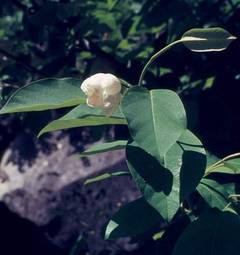
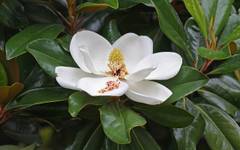
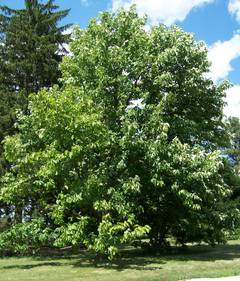
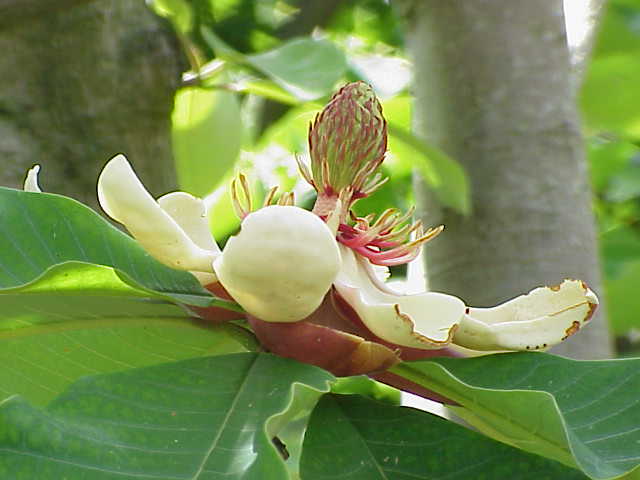
Magnolia obovata is a deciduous tree in the family Magnoliaceae, native to Japan and the southern Kuril Islands. Trees reach 30–80 feet (9–24 m) tall and 25–40 feet (7.5–12 m) wide, with a rounded to broadly pyramidal crown and stout, sparsely branched twigs. Bark is smooth and gray. Leaves are obovate, 8–18 inches (20–45 cm) long and 4–9 inches (10–23 cm) wide, clustered in whorl-like groups at the branch tips, and blue-green with a waxy, glaucous underside. Flowers are cup-shaped, creamy white, 6–8 inches (15–20 cm) across, and fragrant, with 9–12 tepals and a central boss of red-purple stamen filaments; they open in late May to June, after the leaves have emerged. The fruit is a cone-like aggregate of follicles 4–8 inches (10–20 cm) long that ripens to red in autumn and releases red-coated seeds. Plants are hardy in USDA zones 5–8. Large leaves tear in exposed, windy sites, and flowers are held high in the crown, so they are often out of reach on mature trees. Leaf drop in autumn is yellow-brown, and the large leaves decompose slowly.
Native Range
Native to Japan, from Hokkaido to Kyushu, and to the southern Kuril Islands, where it grows in mountain forests and along streams. Grown in temperate gardens and arboreta outside its native range.Suggested Uses
Used as a specimen tree in large gardens, parks, and arboreta, spaced 25–40 feet (7.5–12 m) from buildings and other trees. Flowers and leaves reach their full size in sheltered sites. Mature height of 30–80 feet (9–24 m) limits use in small gardens.How to Identify
Appearance
Size & Dimensions
Height30' - 80'
Width/Spread25' - 40'
Bloom Information
Detailed Descriptions
Flower Description
Creamy white with red-purple stamen filamentsFoliage Description
Blue-green above, glaucous beneathGrowing Conditions
Sun Requirements
Requires 4-8 hours of direct sunlight daily
• Full Sun: 6+ hours of direct sunlight
• Partial Shade: 3-6 hours of direct sunlight
• Full Shade: Less than 3 hours of direct sunlight
Care & Maintenance
Care Guide
Growth is steadiest in full sun to part shade with protection from wind, in deep, moist, well-drained, slightly acidic soil of pH 5.5–6.5 that is high in organic matter. Water is applied at 1–2 inches (2.5–5 cm) per week during the first three growing seasons and during dry periods afterward. Cold hardiness is USDA zones 5–8. A 3–4 inch (8–10 cm) layer of organic mulch conserves soil moisture; mulch is kept 3 inches (8 cm) from the trunk. Shallow, fleshy roots are damaged by soil compaction and by transplanting of older trees.Pruning
Little pruning is required. Dead, crossing, and damaged branches are removed in late summer after flowering, because cuts made in winter heal slowly and bleed on magnolias in spring. Lower branches are removed gradually to raise the canopy when a clear trunk is desired. Cuts larger than 2 inches (5 cm) in diameter heal slowly.Pruning Schedule
Prune: July–August
summer