Lilium, Genus, pardalinum, Species,
- Genus & species
leopard lily
Overview
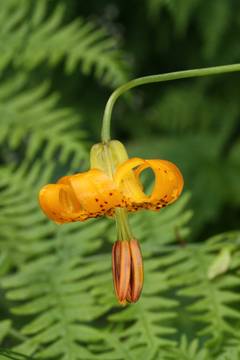
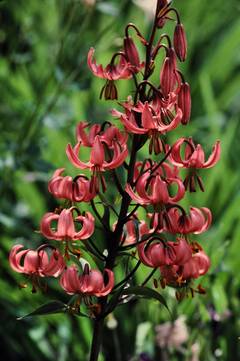
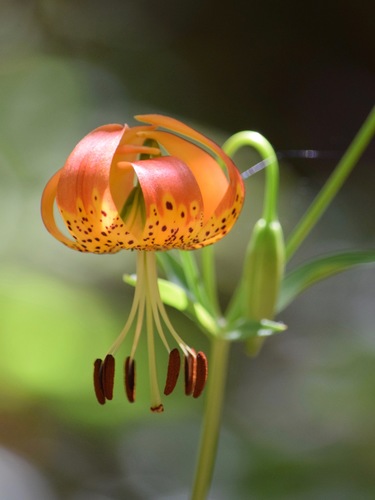
A bulbous perennial with stout, erect stems reaching 3-8 feet (90-240 cm) tall from a horizontally rhizomatous bulb. Leaves linear-lanceolate, 3-7 inches (7.5-18 cm) long, in whorls of 5-12 along the stem, dark green and slightly glossy. Flowers nodding and pendant, in inflorescences of 5-20 (occasionally up to 35), each Turk's-cap shaped with strongly recurved tepals 2-3 inches (5-7.5 cm) long. Tepals orange-red at the tips fading to yellow at the base, marked with maroon to dark purple spots over the inner third. Six prominent stamens project beyond the tepals with rust-orange anthers. Capsules erect, oblong, 1-2 inches (2.5-5 cm) long, ripening late summer. The bulb is a chain of overlapping fleshy scales connected by a creeping rhizome; established colonies extend 1-3 feet (30-90 cm) within 5-7 years. Stems die back to ground level by late autumn. Dormant bulbs withstand winter freezes to -20°F (-29°C) but are damaged in soils that freeze and thaw repeatedly without snow cover.
Native Range
Native to California, southwestern Oregon, and Baja California, Mexico. Found in seasonally wet meadows, streambanks, seeps, and moist conifer forest openings from sea level to 6,000 feet (1,800 m) elevation. Most frequent in the Coast Ranges, Klamath Mountains, and Sierra Nevada foothills.Suggested Uses
Commonly planted in moist woodland gardens, rain gardens, and pondside plantings at 12-24 inch (30-60 cm) spacing. Suitable for containers of at least 5 gallons (19 L) with consistent moisture, though long-term performance in pots is reduced compared to garden settings. Cultural significance to the Karuk, Yurok, and Pomo peoples of California, who used the bulb as a traditional food source.How to Identify
Appearance
Size & Dimensions
Height3' - 8'
Width/Spread1' - 3'
Bloom Information
June through August depending on elevation; coastal and low-elevation populations flower in June, montane populations in July-August. Each stem holds flowers for 2-3 weeks; total bloom period in a stand extends 4-6 weeks. Bloom timing shifts 1-2 weeks earlier in dry years and later in cool wet years.
Detailed Descriptions
Flower Description
orange-red with maroon spots, yellow baseFoliage Description
dark greenGrowing Conditions
Sun Requirements
Requires 4-8 hours of direct sunlight daily
• Full Sun: 6+ hours of direct sunlight
• Partial Shade: 3-6 hours of direct sunlight
• Full Shade: Less than 3 hours of direct sunlight
Care & Maintenance
Care Guide
Plant bulbs 4-6 inches (10-15 cm) deep in autumn, in soil that is consistently moist during the growing season but well-drained in winter. Apply 2-3 inches (5-7.5 cm) of leaf-mold mulch over the planting site to maintain root coolness. Water deeply weekly through the bloom period; reduce water after flowering as plants enter dormancy. Lily mosaic virus and basal rot occur in plants growing in compacted or poorly drained soils. Lily leaf beetle (Lilioceris lilii) defoliates plants in zones 5-8 east of the Cascades and is less frequent in western native populations. Bulbs persist 10-20 years in suitable wet meadow conditions; dryland plantings rarely survive past 3-4 years.Pruning
Cut spent flower stems to 2 inches (5 cm) above the soil after seed has matured in late summer or autumn. Removing flowers before seed-set redirects energy to bulb development and increases flower production the following year by 20-30%. Yellow leaves can be pulled gently when fully senescent; green leaves continue to photosynthesize until they yellow naturally.Pruning Schedule
Prune: September–October
fall
Container Growing
Suitable for container growing
Minimum container size: 5 gallons