Lilium, Genus, nepalense, Species,
- Genus & species
nepal lily
Central and eastern Himalayas (Nepal, Bhutan, northeastern India, southwestern China Yunnan; cool mossy forests and scrub at 6000-11000 feet / 1800-3400 m)
Overview
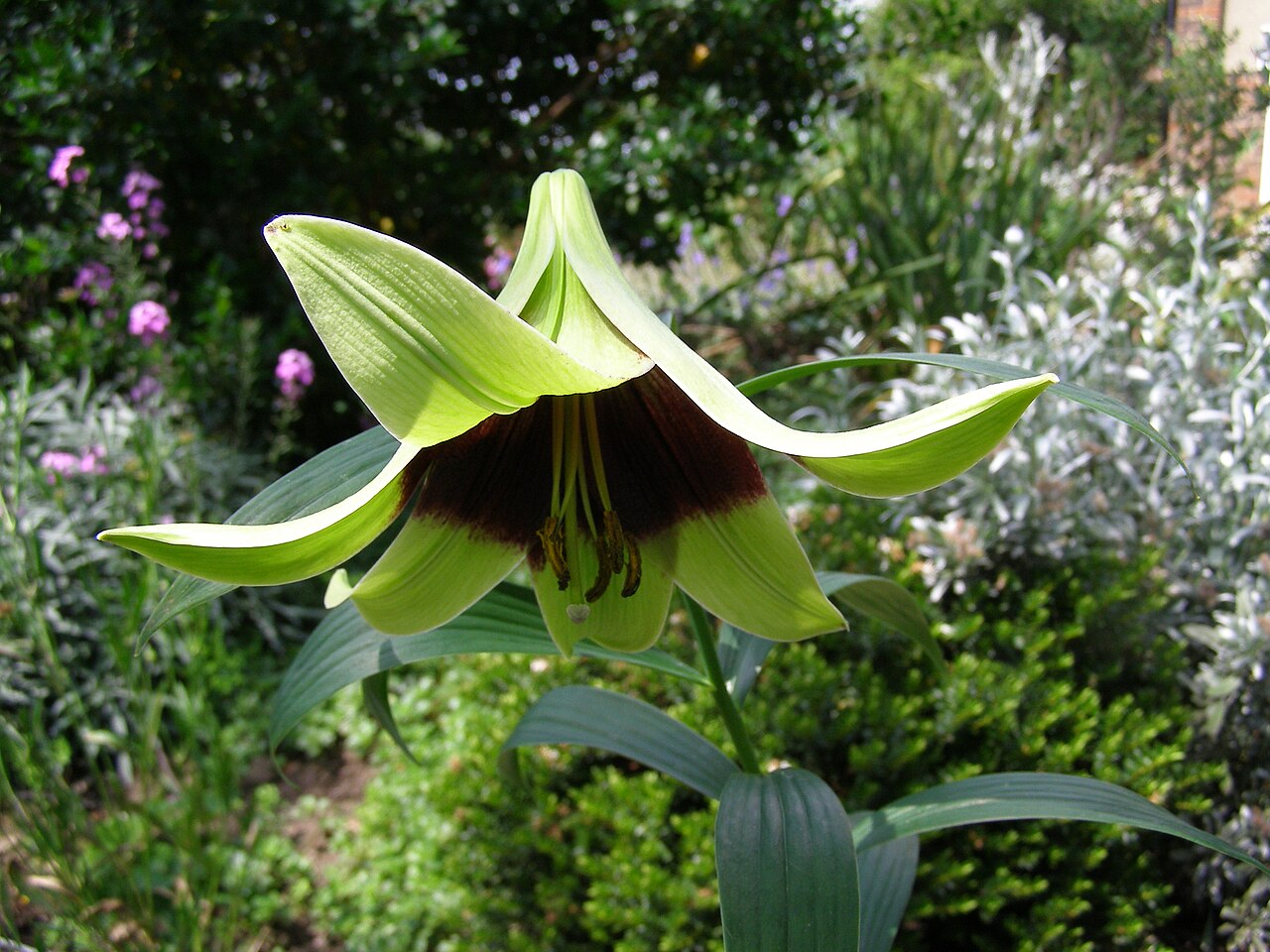
Lilium nepalense is a bulbous herbaceous perennial in the lily family (Liliaceae) reaching 24–36 inches (60–90 cm) tall, growing from a stoloniferous bulb that produces underground runners across the soil profile. This Himalayan species carries pendant funnel-shaped flowers 4–6 inches (10–15 cm) long, colored greenish-yellow to chartreuse on the exterior surface with a deep maroon-purple to burgundy interior throat blotch that extends from the throat outward through the lower third of each petal. The bicolor green-and-maroon pattern separates this species from other lilies in cultivation — no other garden lily carries this exterior-interior color contrast in the same configuration. Each flower stem carries 1–3 flowers from July through August. Scattered lance-shaped leaves run 4–6 inches (10–15 cm) long along the upper portion of the flower stem. The stoloniferous bulb sends underground runners 6–12 inches (15–30 cm) out from the parent bulb and produces new plants at the runner tips, so the bulb itself may migrate underground between seasons rather than holding a fixed position. Foliage dies back through winter dormancy. Cool humid growing conditions are required for reliable performance. Hardy to zone 7 in cool maritime climates.
Native Range
Lilium nepalense is native to the central and eastern Himalayas, where wild populations grow across Nepal, Bhutan, northeastern India (Sikkim and Assam), and southwestern China (Yunnan Province). The species grows in cool mossy forests and scrub habitats at elevations between 6,000 and 11,000 feet (1,800–3,400 m).Suggested Uses
Grown in woodland gardens, cool shaded borders, and sheltered positions in cool maritime climates at 12–18 inch (30–45 cm) spacing. The green-and-maroon bicolor flower pattern differs from every other garden lily in commercial cultivation, which gives the species a specialty-collection role rather than a general border-lily role. The stoloniferous bulb habit means the bulb may migrate underground between seasons, which runs outside the cultural tolerance range for formal plantings that require fixed positions across the years. Cool humid conditions are required for reliable performance across the full growing cycle. Hot-summer climates, dry soils, alkaline soils, and exposed windy positions are all unsuitable given the cultural profile. Hardiness runs limited to zone 7 and above in cool maritime climates only.How to Identify
Appearance
Size & Dimensions
Height2' - 3'
Width/Spread1' - 1'6"
Bloom Information
Pendant funnel-shaped flowers 4–6 inches (10–15 cm) long open from July through August with a 2–3-week bloom duration per stem. The flowers carry greenish-yellow exterior color with a deep maroon-purple interior throat blotch that extends from the throat outward through the lower third of each petal. Each flower stem carries 1–3 flowers over the bloom window.
Detailed Descriptions
Flower Description
Greenish-yellow exterior with deep maroon-purple interior throat blotch; pendant funnel-shaped 4-6 inches longFoliage Description
Medium green lance-shaped 4-6 inches long; scattered along upper stemGrowing Conditions
Sun Requirements
Requires 3-5 hours of direct sunlight daily
• Full Sun: 6+ hours of direct sunlight
• Partial Shade: 3-6 hours of direct sunlight
• Full Shade: Less than 3 hours of direct sunlight
Care & Maintenance
Care Guide
Bulbs are planted 6–8 inches (15–20 cm) deep in autumn in partial shade in cool moist humus-rich acidic well-drained soil at pH 5.0–6.5, tolerating loam and peat. Hardy to zone 7 in cool maritime climates — the species does not tolerate hot humid summers and performance runs unreliable in continental climates with combined cold winters and hot summers. Cool root conditions and ample moisture matter across the growing season, and siting under light shade with moist shaded root run suits the cultural profile. The stoloniferous bulb migrates underground through the soil profile and may emerge in positions other than where originally planted.Pruning
Foliage and flower stems are allowed to die back naturally after bloom ends. Only fully dead stems are removed in late autumn — the dying foliage transfers reserves back to the bulb across the fall dormancy transition and premature cutting weakens the bulb for the following season. The stoloniferous bulbs are not relocated during the growing season because root disturbance during active growth damages the runner system.Container Growing
Suitable for container growing
Minimum container size: 5 gallons