Leptospermum, Genus, laevigatum, Species,
- Genus & species
Coastal tea tree
Overview
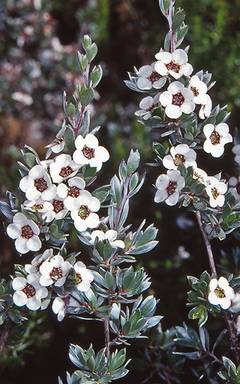
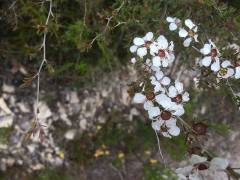
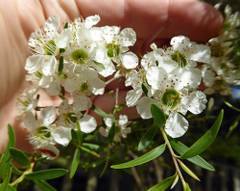
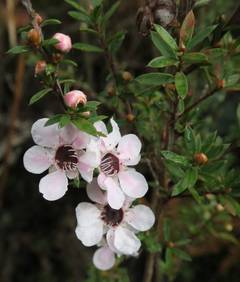
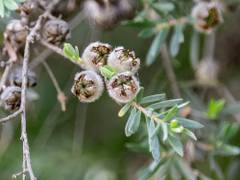
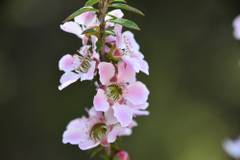
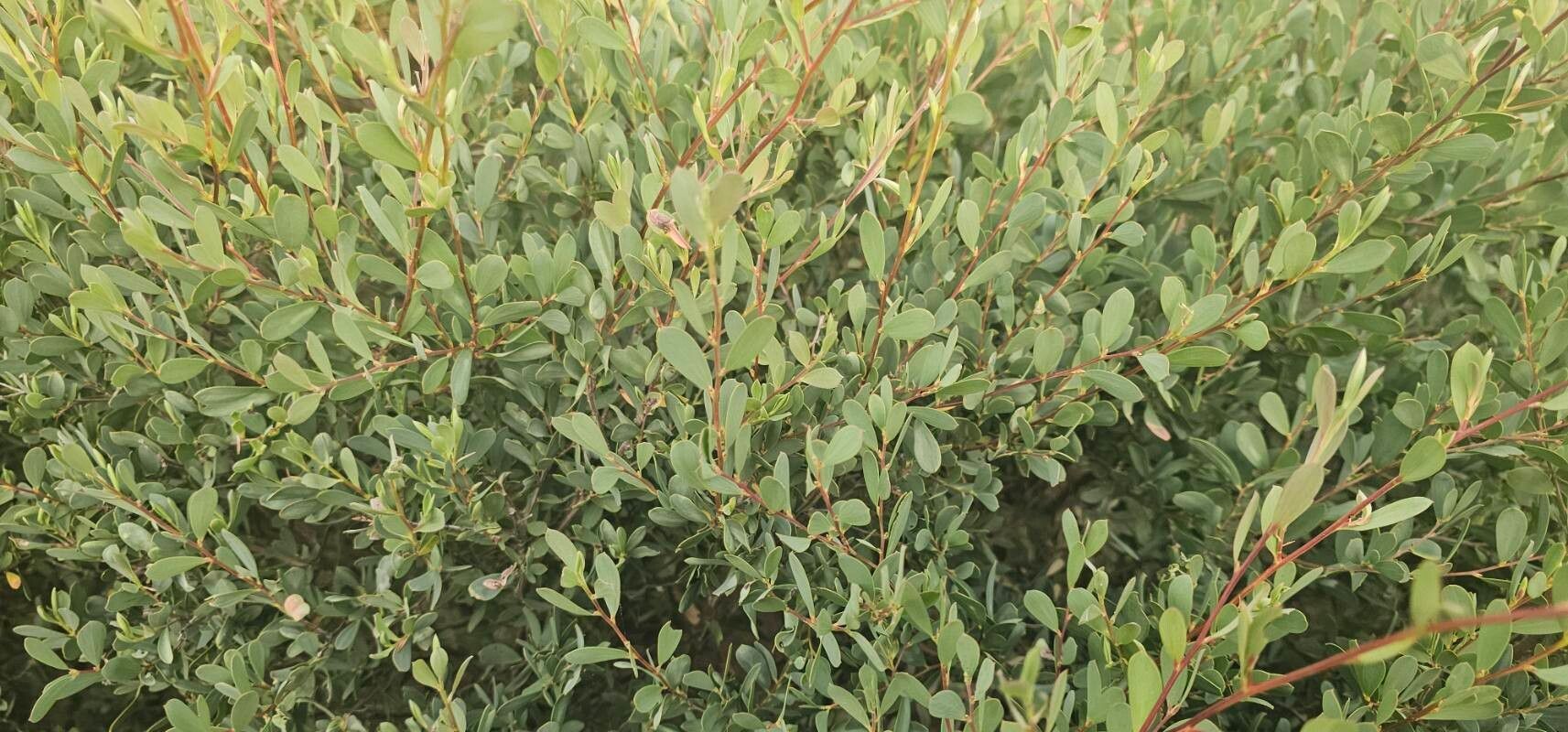
Leptospermum laevigatum is an evergreen shrub to small tree in the Myrtaceae, 6-20 feet (2-6 m) tall and 6-16 feet (2-5 m) wide, with a twisted trunk and branches that lean away from prevailing wind on exposed coastal sites. Bark is grey and fibrous, peeling in long narrow strips to expose paler wood beneath. Leaves are alternate, obovate, 0.6-1.2 inches (1.5-3 cm) long and 0.2-0.3 inches (5-8 mm) wide, grey-green, blunt-tipped with a short abrupt point, and crowded along stiff stems. Flowers are white, five-petalled, 0.6-0.8 inches (15-20 mm) across, carried singly in the leaf axils along the previous season growth from August to November. Woody capsules 0.2-0.3 inches (5-8 mm) wide follow and are held on the branches for several years, releasing seed after fire or branch death. The species roots into pure coastal sand, withstands continuous salt-laden wind and dry periods of 4-6 months, and forms dense thickets on foredunes. Those same traits underlie its status as a declared environmental weed: it has invaded coastal heath and dune systems in South Africa, California, New Zealand and parts of Australia outside its natural range, where it shades out low-growing native vegetation.
Native Range
Leptospermum laevigatum is native to coastal south-eastern Australia, occurring on dunes and sandy headlands from southern Queensland through New South Wales, Victoria and Tasmania to the south-east of South Australia. It grows within the immediate coastal zone, generally within 1.2 miles (2 km) of the shore, on deep siliceous or calcareous sands. Populations established from garden plantings in Western Australia and overseas have naturalised and are managed as weeds.Suggested Uses
Planted within its natural range for dune stabilisation, coastal windbreaks and salt-exposed screens, spaced 6-10 feet (1.8-3 m) apart. Trimmed as an informal hedge to 5-8 feet (1.5-2.4 m) in seaside gardens, and grown in containers of 15 gallons (57 litres) or larger on exposed balconies. Planting is restricted outside the native range in South Africa, California and Western Australia, where the species is listed as an environmental weed.How to Identify
Appearance
Size & Dimensions
Height6' - 20'
Width/Spread6' - 16'
Bloom Information
Flowering runs from August to November across the natural range, peaking over 4-6 weeks in September and October and shifting 2-4 weeks later in Tasmania and southern Victoria. Flowers open singly in the axils of leaves on the previous season growth, so the flush follows the length of each stem. Each flower lasts 5-8 days; the petals drop while the green floral cup stays in place and hardens into the capsule. Flowers are worked by native bees, hoverflies, beetles and honeybees.
Detailed Descriptions
Foliage Description
Grey-greenGrowing Conditions
Sun Requirements
Requires 7-12 hours of direct sunlight daily
• Full Sun: 6+ hours of direct sunlight
• Partial Shade: 3-6 hours of direct sunlight
• Full Shade: Less than 3 hours of direct sunlight
Care & Maintenance
Care Guide
Leptospermum laevigatum grows in full sun with 7-12 hours of direct exposure and becomes open and sparse-flowering in shade. It roots on free-draining sand, sandy loam and gravel across pH 5.0-7.5, including calcareous coastal sand, and fails on heavy soils that hold water through winter. Watering of 2-4 gallons (8-15 litres) weekly for the first summer establishes plants; after 18 months they carry through dry periods of 4-6 months without irrigation. Established plants tolerate 25F (-4C), while young growth burns near 28F (-2C). Fertiliser is not applied on coastal sands, and soil phosphorus above 15 ppm causes leaf yellowing and root damage across this genus. Webbing caterpillars and scale insects cause branch dieback in humid inland plantings, where working life runs 15-20 years against 30-40 years on the coast.Pruning
Pruning is carried out immediately after flowering ends in late spring, since flower buds form on growth made the previous season. Cuts into leafless older wood seldom reshoot, so reduction is confined to stems still carrying foliage, generally the outer 12-18 inches (30-45 cm). Light annual trimming of 4-6 inches (10-15 cm) holds a dense outline in hedged plantings. Untrimmed plants develop an open framework with foliage confined to branch tips by about year 10.Pruning Schedule
Prune: November–December
late springsummer
Container Growing
Suitable for container growing
Minimum container size: 15 gallons