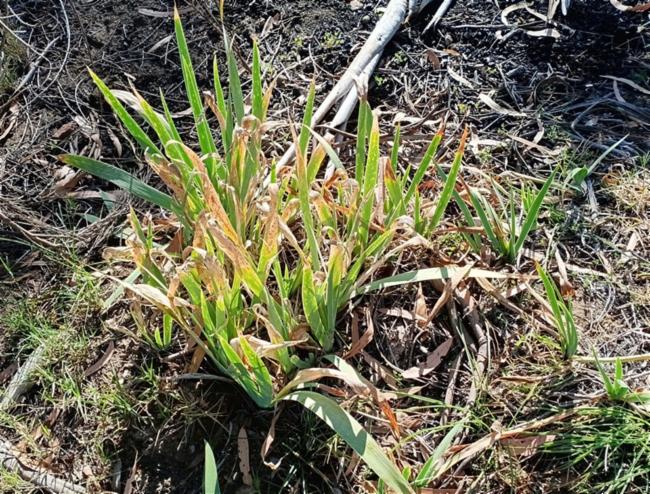
Iris × germanica
bearded iris
Garden origin; parent species from Europe and the Mediterranean
Overview
Iris × germanica is a rhizomatous perennial reaching 2–4 feet (60–120 cm) tall in bloom and spreading 1–2 feet (30–60 cm) wide. It grows from thick, horizontal rhizomes that sit at or just below the soil surface, sending up fans of flat, sword-shaped gray-green leaves 12–24 inches (30–60 cm) long. Branched stalks carry 3–8 flowers 3–5 inches (7.5–13 cm) across in late spring, each with three upright petals called standards and three drooping ones called falls, marked by a fuzzy beard along the center of each fall. Flower color spans purple, blue, white, yellow, bronze, and bicolors across the many named cultivars in this group. The plant tolerates drought and poor soil once established but rots in wet, poorly drained ground. Rhizomes left fully buried or crowded flower poorly and are prone to soft rot. The leaves stand through summer and die back in fall. Rhizomes and leaves contain irritant compounds that are toxic to pets and people if eaten.
Native Range
Iris × germanica is a long-cultivated hybrid complex of garden origin, derived from Iris spp. species native to central and southern Europe and the eastern Mediterranean. It has been grown for centuries and is naturalized in parts of Europe and North America. Its wild parent species grow on dry, rocky slopes and grasslands.Suggested Uses
Planted in perennial borders, cottage gardens, and along paths, spaced 12–18 inches (30–45 cm) apart with rhizomes facing the sun. It is grown in mass for late-spring color and as a cut flower. The upright foliage adds vertical texture to mixed plantings.How to Identify
Appearance
Size & Dimensions
Height2' - 4'
Width/Spread1' - 2'
Reaches mature size in approximately 2 years
Bloom Information
Flowering occurs in late spring, mainly May to June, with each stalk opening several flowers in succession over two to three weeks. Individual flowers last two to four days. Reblooming cultivars within this group flower again in late summer or fall. Bloom is reduced when rhizomes are crowded or shaded.
Detailed Descriptions
Flower Description
purple, blue, white, yellow, and bicolorsFoliage Description
gray-greenGrowing Conditions
Sun Requirements
Requires 6-10 hours of direct sunlight daily
• Full Sun: 6+ hours of direct sunlight
• Partial Shade: 3-6 hours of direct sunlight
• Full Shade: Less than 3 hours of direct sunlight
Care & Maintenance
Care Guide
Full sun and well-drained soil at pH 6.5–7.5 suit Iris × germanica, with at least six hours of direct sun for steady bloom. Rhizomes are planted shallow, with the tops exposed, since deep planting and mulch over the rhizome promote rot. Established plants need little water and tolerate drought, while wet soil and crowding bring on bacterial soft rot. Clumps are lifted and divided every three to four years after flowering to relieve crowding. A low-nitrogen feeding in early spring and again after bloom supports growth without forcing soft, rot-prone tissue.Pruning
Cutting spent flower stalks to the base after bloom prevents seed formation and tidies the clump. Trimming damaged or disease-spotted leaves through the season reduces fungal carryover. Foliage is left to die back in fall, then cut to 4–6 inches (10–15 cm).Pruning Schedule
J
F
M
A
M
J
J
A
S
O
N
D
summerfall
Container Growing
✓ Suitable for container growing
Minimum container size: 2 gallons