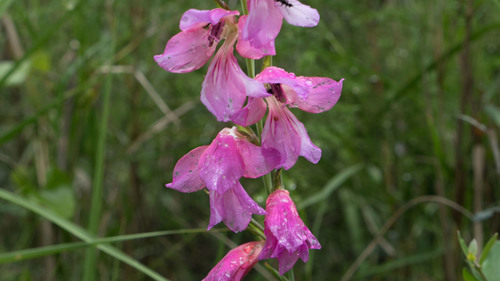
Gladiolus, Genus, spp., Multiple species,
- Genus
- Multiple species
gladioli
Southern Africa, with species in the Mediterranean, Middle East, and tropical Africa
Overview
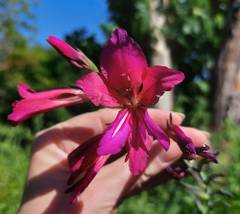
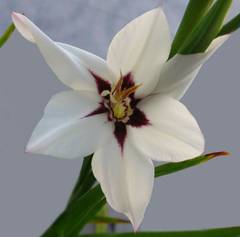
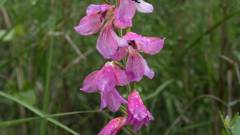
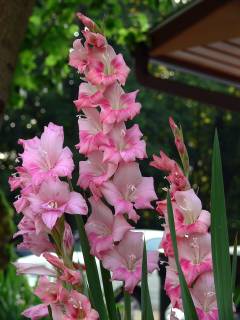
Gladiolus is a genus of about 300 species of cormous perennials in the iris family, Iridaceae, with the great majority native to southern Africa and a smaller number from the Mediterranean, the Middle East, and tropical Africa. Plants grow from a rounded underground corm and produce a fan of stiff, sword-shaped leaves, from which rises a tall, usually one-sided spike 1 to 5 feet (30 to 150 cm) high. The funnel-shaped flowers open in sequence from the base of the spike upward, each with six petal-like segments, and span nearly the whole colour range, including white, yellow, pink, red, orange, purple, green, and bicolours. Wild species range from small, scented kinds to large showy ones, while garden hybrids in the Gladiolus × hortulanus group carry many large, closely set flowers. After flowering the corm renews itself, forming a new corm above the old one along with small cormels. Gladiolus grows on grassland, rocky slopes, and seasonally moist flats, and most species are frost-tender, growing during the wet season and resting when dry. Several species are fragrant, and one, G. communis, has naturalized in parts of Europe and North America. The corms and cut spikes are widely grown for the florist trade.
Native Range
Gladiolus is native mainly to southern Africa, where most species grow in the winter-rainfall Cape region, with additional species in tropical Africa, the Mediterranean, and the Middle East. Plants grow on grassland, rocky slopes, and seasonally moist ground. Garden gladioli are hybrids derived chiefly from South African species.Suggested Uses
Grown in borders, cutting gardens, and rows for the florist trade, where the tall spikes are valued as cut flowers. Shorter species and primulinus types are used in mixed beds and containers. Fragrant wild species suit collectors of South African bulbs.How to Identify
Appearance
Size & Dimensions
Height1' - 5'
Width/Spread6" - 1'
Bloom Information
Garden Gladiolus flowers in summer, roughly June to September, about 60 to 90 days after the corms are planted, with each spike opening over one to two weeks. Wild South African species bloom at various times tied to their wet season. Staggered planting of corms spreads the bloom across the summer.
Detailed Descriptions
Flower Description
white, yellow, pink, red, orange, purple, green, and bicoloursFoliage Description
green to grey-greenGrowing Conditions
Sun Requirements
Requires 6-12 hours of direct sunlight daily
• Full Sun: 6+ hours of direct sunlight
• Partial Shade: 3-6 hours of direct sunlight
• Full Shade: Less than 3 hours of direct sunlight
Care & Maintenance
Care Guide
Gladiolus grows in full sun in fertile, well-drained soil with steady moisture during growth. Corms are planted 4 to 6 inches (10 to 15 cm) deep in spring once the soil warms, and tall hybrids are often staked or supported against wind. In USDA zones 8 and warmer many kinds stay in the ground year-round, while in colder areas the corms are lifted after the foliage yellows in autumn and stored frost-free over winter. Plants need regular water while in leaf and flower but rest dry after the foliage dies down. Thrips are the main pest, scarring leaves and flowers, and corms can rot in cold, wet soil. The hardy species G. communis persists outdoors in milder temperate gardens.Pruning
Spent flower spikes are cut off above the leaves once the last flowers fade, which directs energy back to the corm. The foliage is left until it yellows so the corm can rebuild for the next season. Cut flower stems are taken when the lowest buds begin to open.Container Growing
Suitable for container growing
Minimum container size: 3 gallons