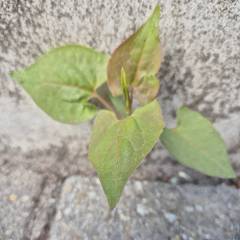
Fallopia, Genus, sachalinensis, Species,
- Genus & species
giant knotweed
East Asia (Sakhalin Island, northern Japan, northeast Asia)
Overview
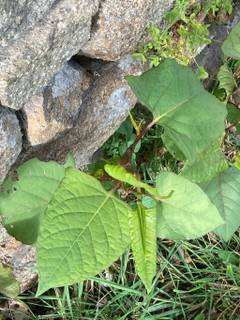
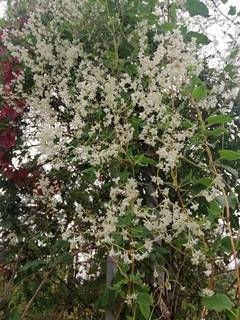
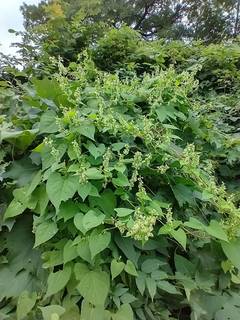
Fallopia sachalinensis (syn. Reynoutria sachalinensis, Polygonum sachalinense) is a massive, rhizomatous, herbaceous perennial in the buckwheat family (Polygonaceae) reaching 6–15 feet (1.8–4.5 m) tall with colonies spreading 6–20 feet (1.8–6 m) wide via aggressive rhizome expansion. The largest of the invasive knotweeds. Stems are erect, hollow, bamboo-like, up to 2 inches (5 cm) in diameter at the base, smooth, green, with swollen nodes. Leaves are the primary distinguishing feature: alternate, very large, broadly ovate, 8–16 inches (20–40 cm) long and 6–12 inches (15–30 cm) wide, with a deeply cordate (heart-shaped) base and scattered hairs on the veins beneath. Flowers are small, greenish-white, borne in short, compact axillary panicles 2–4 inches (5–10 cm) long. The rhizome system is similar in aggressiveness to F. japonica, extending laterally 15–50 feet (4.5–15 m) at depths of 6–10 feet (1.8–3 m). Rhizome fragments as small as 0.5 inch (1 cm) regenerate. Hybridizes readily with F. japonica where both occur, producing the vigorous hybrid F. × bohemica (Bohemian knotweed), which combines the large leaf size of giant knotweed with the aggressive rhizome vigor of Japanese knotweed. Listed as a noxious weed in Washington State and several other states.
Native Range
Native to East Asia, including Sakhalin Island, the Kuril Islands, northern Japan, and parts of northeast China and Korea, occurring in riparian gravels, volcanic slopes, and disturbed ground. Introduced to North America and Europe as an ornamental and fodder plant. Naturalized in the Pacific Northwest, northeastern United States, and parts of northern Europe, primarily in riparian corridors and disturbed sites.Suggested Uses
Used in invasive species identification training alongside F. japonica and F. × bohemica for teaching the knotweed species complex. Studied in hybridization ecology and invasion genetics. A crude extract from F. sachalinensis is marketed as a plant defense elicitor (trade name Milsana/Regalia) for disease suppression in horticulture.How to Identify
Appearance
Size & Dimensions
Height6' - 15'
Width/Spread6' - 20'
Bloom Information
Flowers from August through September. Panicles are shorter and more compact than in F. japonica, 2–4 inches (5–10 cm) long. Plants may produce both male and female flowers; where F. japonica (predominantly female in North America) is present, cross-pollination produces the hybrid F. × bohemica. Pollinated by bees and flies.
Detailed Descriptions
Foliage Description
Dark green, very large, broadly ovate with a deeply cordate (heart-shaped) base, smooth above with scattered hairs on veins beneathGrowing Conditions
Sun Requirements
Requires 4-12 hours of direct sunlight daily
• Full Sun: 6+ hours of direct sunlight
• Partial Shade: 3-6 hours of direct sunlight
• Full Shade: Less than 3 hours of direct sunlight