© Astrid K.S., some rights reserved (CC-BY) · GBIF
Fallopia japonica
Japanese knotweed
Overview
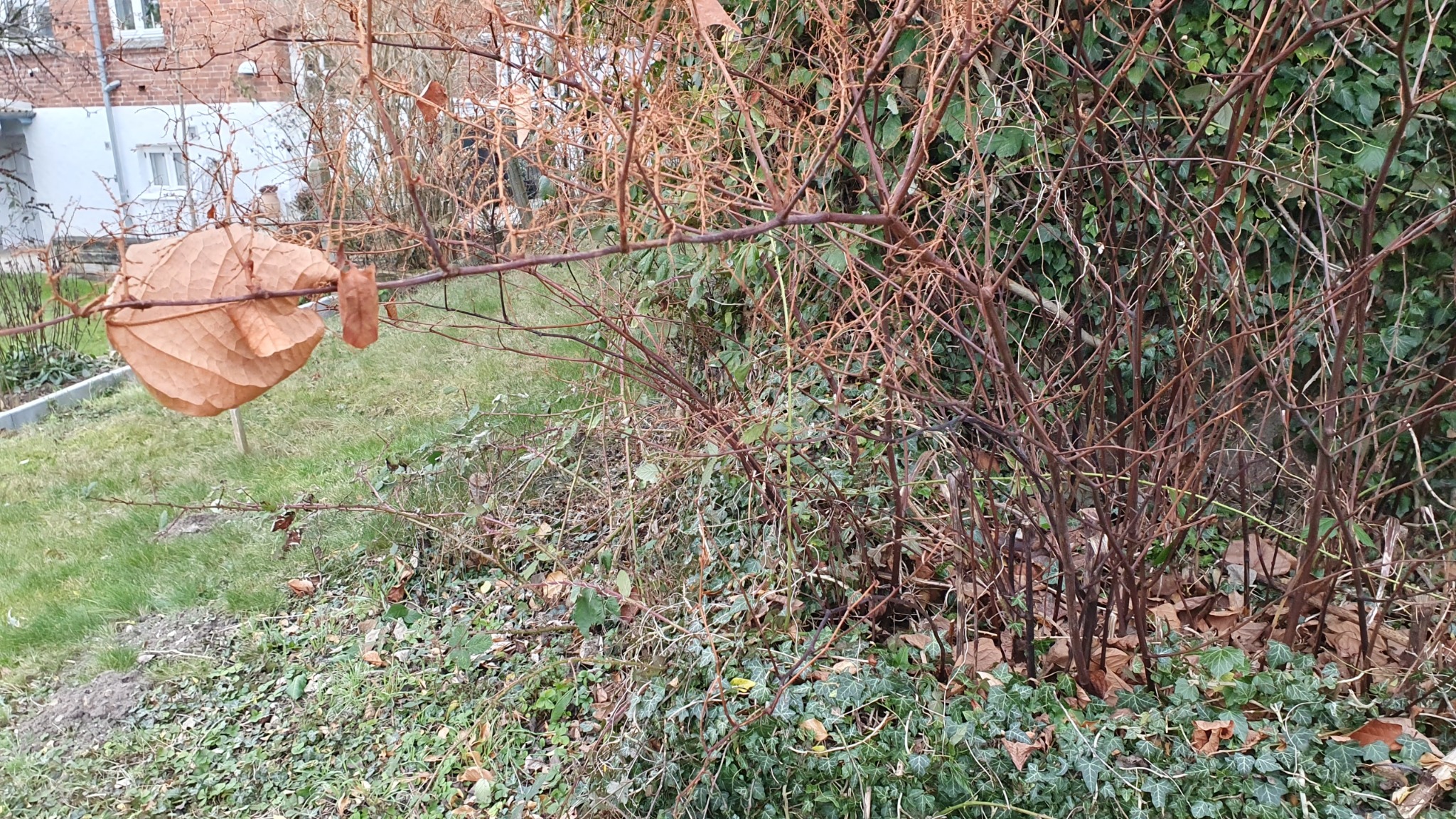
Fallopia japonica (syn. Reynoutria japonica, Polygonum cuspidatum) is a vigorous, rhizomatous herbaceous perennial in the buckwheat family (Polygonaceae) reaching 5-10 feet (1.5-3 m) tall with colonies spreading 6-15 feet (1.8-4.5 m) wide or more via aggressive rhizome expansion. Stems are erect, hollow, smooth, bamboo-like, with swollen nodes and reddish-purple speckles. Stems arise annually from the rhizome crown. Leaves are alternate, broadly ovate to triangular, 3-6 inches (8-15 cm) long, with a flat (truncate) base, smooth on both surfaces. The ochrea (papery sheath at each node, a Polygonaceae character) is present but deciduous. Flowers are small, white to greenish-white, borne in branching axillary panicles 3-5 inches (8-13 cm) long in late summer. Plants in North America are predominantly female, and reproduction is overwhelmingly vegetative. The rhizome system extends laterally 20-65 feet (6-20 m) from the parent colony at depths of 6-10 feet (1.8-3 m). Rhizome fragments as small as 0.5 inch (1 cm) weighing as little as 0.02 ounce (0.7 g) regenerate. Rhizomes penetrate asphalt, concrete foundations, drainage infrastructure, and flood levees. F. japonica is listed as a noxious weed in most U.S. states and Canadian provinces and is included on the IUCN list of 100 worst invasive species worldwide.
Native Range
Fallopia japonica is native to East Asia, including Japan, Korea, and eastern China, where it colonizes volcanic slopes, riparian gravels, and disturbed sites. Introduced to North America and Europe as an ornamental and erosion control plant in the mid-1800s, the species is now naturalized throughout the Pacific Northwest, northeastern United States, and across much of Europe, particularly along waterways, roadsides, and disturbed urban sites.Suggested Uses
Used as a primary case study in invasive species management, restoration ecology, and infrastructure damage assessment training. Studied in rhizome biology, allelopathy, and hybridization dynamics (with F. sachalinensis). Young spring shoots are consumed as a vegetable in Japan and by some foragers in western countries. The compound resveratrol is extracted from the rhizomes for dietary supplement production. F. japonica is a regulated noxious weed in most U.S. states and is not planted horticulturally.How to Identify
Appearance
Size & Dimensions
Height5' - 10'
Width/Spread6' - 15'
Reaches mature size in approximately 3 years
Bloom Information
Flowers appear August through October. Small white flowers are borne in branching axillary panicles 3-5 inches (8-13 cm) long. Plants in North America are predominantly female and rarely produce viable seed. In regions where both sexes or compatible species are present, viable seed results from hybridization with F. sachalinensis, producing the hybrid F. × bohemica. Flowers are pollinated by bees and flies.
Detailed Descriptions
Flower Description
White to greenish-white small flowers in branching axillary panicles 3-5 inches (8-13 cm) longFoliage Description
Dark green, broadly ovate to triangular with a flat (truncate) base, smooth, alternateGrowing Conditions
Sun Requirements
Requires 4-12 hours of direct sunlight daily
• Full Sun: 6+ hours of direct sunlight
• Partial Shade: 3-6 hours of direct sunlight
• Full Shade: Less than 3 hours of direct sunlight