Image 1 of 10
1 / 10
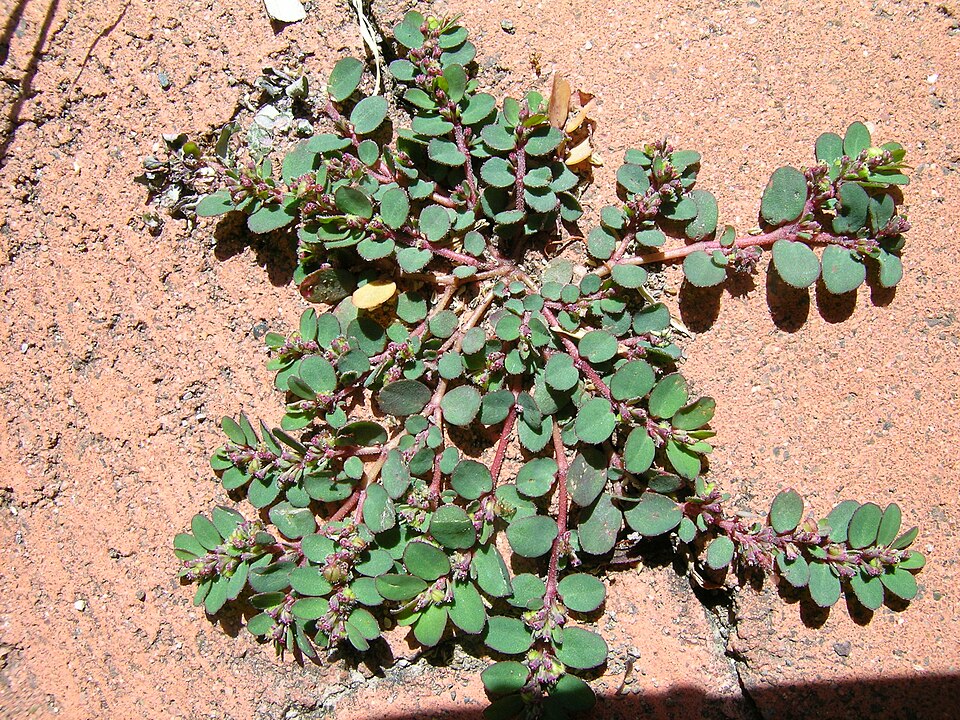
© Harry Rose from South West Rocks, Australia, some rights reserved (CC-BY) · Wikimedia Commons
Euphorbia, Genus, prostrata, Species,
- Genus & species
prostrate sandmat
Tropical and subtropical Americas; widely naturalized
Overview
Euphorbia prostrata is a low, mat-forming annual in the spurge family, native to the warmer Americas and now a widespread weed across the tropics and subtropics. Thin, branching stems radiate flat along the ground from a central taproot, forming mats 4-12 inches (10-30 cm) across and barely 0.5-2 inches (1-5 cm) high. The small oval leaves, 0.1-0.3 inch (3-8 mm) long, sit in opposite pairs, often tinged red, with finely toothed edges. Broken stems release a white, milky sap. The flowers are tiny, gathered in minute cup-like structures (cyathia) with small white-rimmed glands, easy to miss without close inspection. The plant grows quickly in warm weather in full sun on poor, compacted, and disturbed soils, including sidewalk cracks, gravel, and bare gardens. It tolerates drought and heat and completes its life cycle in a few months, self-sowing freely. As an annual, plants die at the season's end. The milky sap can irritate skin and eyes.
Native Range
Native to the warmer parts of the Americas, from the southern United States through Mexico, Central America, and South America, and now naturalized across Africa, Asia, and the Pacific. It grows in disturbed ground, pavement cracks, gardens, fields, and waste places.Suggested Uses
Rarely cultivated; it appears on its own as a pioneer of bare, compacted ground. In some regions the plant is gathered for traditional herbal use. It is generally treated as a lawn and garden weed rather than a garden plant.How to Identify
Appearance
Size & Dimensions
Height1" - 2"
Width/Spread4" - 1'
Bloom Information
Detailed Descriptions
Flower Description
Minute, in tiny cup-like cyathia, inconspicuousFoliage Description
Green, tiny oval, opposite, often red-tingedGrowing Conditions
Sun Requirements
Requires 6-12 hours of direct sunlight daily
• Full Sun: 6+ hours of direct sunlight
• Partial Shade: 3-6 hours of direct sunlight
• Full Shade: Less than 3 hours of direct sunlight
Water & Climate
Water Needs
Drought Tolerance
Drought tolerant when established
Care & Maintenance
Care Guide
Grows in full sun on poor, dry, compacted, or disturbed soil and needs no care to thrive. It tolerates drought, heat, and foot traffic, and grows in pavement cracks and gravel. As a weed, it is more often removed than cultivated; hand-pulling or hoeing before seed sets is the usual control. The milky sap can irritate skin and eyes on contact. As an annual, it dies at season's end but leaves abundant self-sown seed. No fertilizer or watering is required.Pruning
No pruning is needed. Hand-pull or hoe whole plants before seed forms to limit spread. As an annual, it dies back completely at the end of the warm season.Toxicity Warning
Toxic to pets and humansPlanting Guide
Planting Methods & Timing
Planting Method
direct sow
Direct Sow Timing
A spontaneous weed; not usually sown. Seed germinates in warm weather.
Plant Spacing
6 inches