Euphorbia, Genus, hirta, Species,
- Genus & species
asthma plant
Tropics (probably Central America or India)
SunFull Sun
Overview
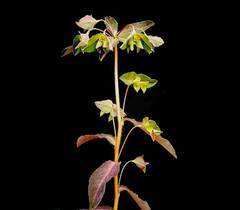
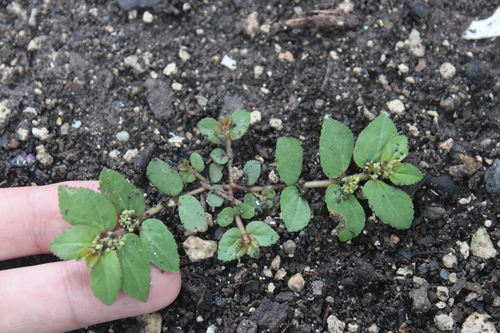
Euphorbia hirta is an annual herb with prostrate to ascending stems 4-24 inches (10-60 cm) long, often reddish and covered in yellowish hairs, that exude a milky white latex when broken. Leaves are opposite, oval to lance-shaped, 0.4-2 inches (1-5 cm) long, with finely toothed margins, a blotch of purple near the center, and hairy surfaces. Tiny flowers are grouped into dense, rounded cyathia clusters 0.2-0.4 inch (5-10 mm) wide in the leaf axils, greenish to pinkish and inconspicuous. These develop into small three-lobed hairy capsules about 0.05 inch (1-1.5 mm) wide that split to fling out seeds. The plant flowers and fruits over most of the warm season and completes its cycle in a few months. It forms a shallow taproot and roots at lower nodes on moist ground. The latex irritates skin and eyes on contact.
Native Range
Of uncertain origin in the tropics, probably native to Central America or India, and now naturalized as a weed throughout the tropics and subtropics worldwide. It grows in disturbed ground, gardens, pavement cracks, roadsides, and waste places, mostly at low elevations.Suggested Uses
Not grown ornamentally; it appears as a weed of gardens, crops, lawns, and paving. It is gathered in some regions for traditional herbal preparations. The plant has no landscape use and is generally removed where it appears.How to Identify
Appearance
Size & Dimensions
Height2" - 8"
Width/Spread4" - 2'
Bloom Information
Flowers and fruits through most of the warm season, year-round in frost-free climates and from late spring to autumn in seasonal ones. The tiny axillary clusters are produced continuously as stems lengthen. There is no single peak; bloom and seed overlap throughout growth.
Detailed Descriptions
Flower Description
greenish to pinkishFoliage Description
green with purple blotchGrowing Conditions
Sun Requirements
Requires 6-12 hours of direct sunlight daily
• Full Sun: 6+ hours of direct sunlight
• Partial Shade: 3-6 hours of direct sunlight
• Full Shade: Less than 3 hours of direct sunlight
Water & Climate
Water Needs
Drought Tolerance
Drought tolerant when established