Euphorbia, Genus, paralias, Species,
- Genus & species
sea spurge
Coastal Europe, the Mediterranean, and North Africa
Overview
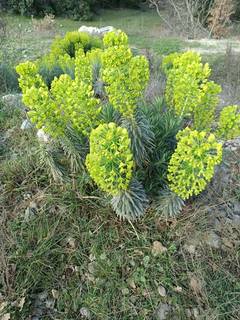
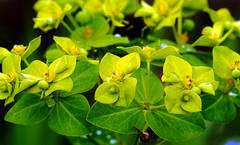
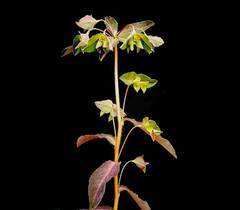
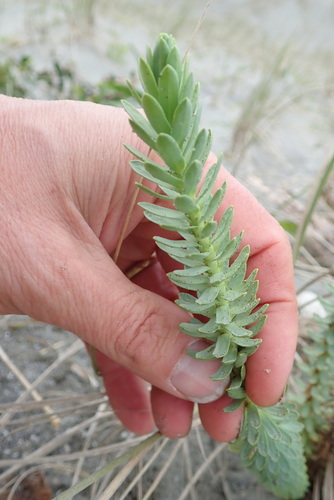
Euphorbia paralias is a perennial growing 8-28 inches (20-70 cm) tall, forming clumps of stout, erect, blue-green stems from a woody base. The fleshy stems are densely covered with overlapping, oval to oblong leaves 0.2-0.8 inch (5-20 mm) long, thick, waxy, and grey-green, arranged in a spiral that gives the stems a scaly look. The flower clusters are yellow-green cyathia grouped in flat-topped terminal heads, each backed by broad paired bracts; flowering runs from midsummer into autumn. Three-lobed capsules follow, 0.1-0.2 inch (3-5 mm) wide, splitting to eject seeds. All parts release a white milky latex when cut. The plant develops deep roots that anchor it in shifting sand, and stems persist through winter in mild coastal climates, regrowing from the base each spring. It grows on mobile and semi-fixed dunes as scattered clumps and tolerates burial by drifting sand, sending up new shoots through accumulated deposits. The latex causes skin and eye irritation on contact.
Native Range
Native to the Atlantic and Mediterranean coasts of Europe, from the British Isles south to North Africa and east through the Mediterranean. Grows on coastal sand dunes, beaches, and shingle close to the sea. It has naturalised on the coasts of southern Australia, New Zealand, and parts of North America, where it spreads across dune systems.Suggested Uses
Grown occasionally in coastal and gravel gardens for its salt and wind tolerance, where its blue-green stems grow in free-draining sand. Its spreading, self-seeding habit and weed status limit planting near natural dune systems. Rarely used in general borders because of the irritant latex and coastal soil requirement.How to Identify
Appearance
Size & Dimensions
Height8" - 2'4"
Width/Spread1' - 2'
Bloom Information
Detailed Descriptions
Foliage Description
grey-green to blue-greenGrowing Conditions
Sun Requirements
Requires 6-12 hours of direct sunlight daily
• Full Sun: 6+ hours of direct sunlight
• Partial Shade: 3-6 hours of direct sunlight
• Full Shade: Less than 3 hours of direct sunlight