Overview
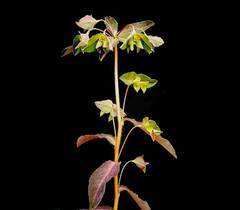
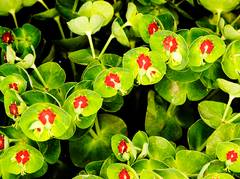
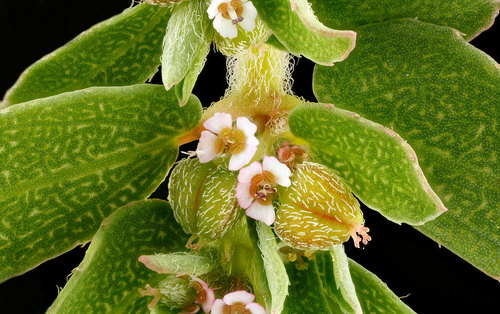
Euphorbia maculata is a low, mat-forming summer annual whose slender, branching stems radiate flat along the ground from a central taproot, spreading 6-20 inches (15-50 cm) wide but rarely more than 1 inch (2.5 cm) high. The small oval leaves are 0.2-0.6 inch (5-15 mm) long, paired along the stems, finely toothed, and usually marked with a reddish to purple blotch near the centre. All parts contain a milky white latex that flows from any broken stem or leaf. Tiny flower-like structures called cyathia appear in the leaf axils from early summer to autumn, each a cup of minute green to pinkish-white parts that is easy to overlook. Small three-lobed seed capsules follow and scatter seed nearby. E. maculata grows in lawns, gardens, pavement cracks, and dry, disturbed ground across much of North America and has spread as a weed worldwide. It roots only at the central crown, so the whole mat lifts with one pull. The latex can irritate skin and eyes.
Native Range
Euphorbia maculata is native to much of North America, from southern Canada through the United States into Mexico. It grows in open, dry, disturbed ground and has naturalised as a weed across Europe, Asia, Australia, and other warm regions.Suggested Uses
Rarely planted on purpose, it appears as a volunteer in lawns, paths, and dry borders, where it is generally controlled. It has minor value as quick ground cover on hot, bare ground and as a nectar source for small insects. In most gardens it is treated as a weed.How to Identify
Appearance
Size & Dimensions
Height1" - 2"
Width/Spread6" - 1'8"
Bloom Information
The minute cyathia are produced from June through October, peaking in the heat of summer. They are wind- and insect-visited but far too small to be showy. Seed capsules ripen within weeks and release seed that germinates in warm soil, often through several overlapping generations in one season.
Detailed Descriptions
Foliage Description
green with reddish blotchGrowing Conditions
Sun Requirements
Requires 6-12 hours of direct sunlight daily
• Full Sun: 6+ hours of direct sunlight
• Partial Shade: 3-6 hours of direct sunlight
• Full Shade: Less than 3 hours of direct sunlight
Water & Climate
Water Needs
Drought Tolerance
Drought tolerant when established