Euphorbia, Genus, nutans, Species,
- Genus & species
nodding spurge
SunFull Sun – Part Shade
Overview
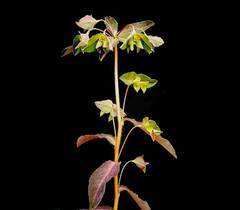
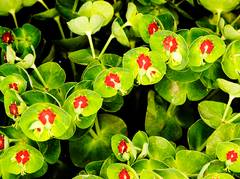
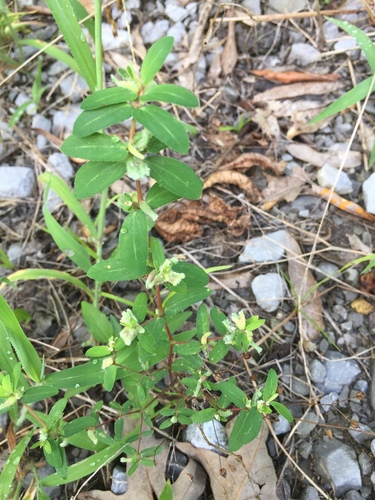
Euphorbia nutans is an erect to ascending summer annual of the spurge family, growing 8-32 inches (20-80 cm) tall from a slender taproot. The branching stems are smooth, often flushed red, and exude a milky white latex when broken. Opposite leaves are oblong to lance-shaped, 0.4-1.5 inches (1-4 cm) long, finely toothed along the margins, and frequently marked with a reddish-purple blotch near the center. Tiny flower clusters called cyathia appear in the leaf axils and branch forks from early summer into autumn, each ringed by small white petal-like appendages. The fruit is a smooth three-lobed capsule that splits to scatter seed. E. nutans colonizes disturbed ground, croplands, gardens, roadsides, and stream banks, completing its life cycle in a single season and self-sowing freely. The milky latex irritates skin and eyes on contact, which limits handling, and the plant is widely treated as an agricultural and garden weed. It germinates in warm soil and grows quickly, flowering within two to three months.
Native Range
Native to North America, widespread across the eastern and central United States and southern Canada, and extending into Mexico. It occupies disturbed soils, fields, gardens, and waste ground, and has naturalized well beyond its original range.Suggested Uses
E. nutans is seldom grown intentionally and is most often encountered as a volunteer in gardens, croplands, and disturbed sites. Its cyathia draw small flies and bees in unmanaged ground. It is typically managed as a weed rather than planted in the landscape.How to Identify
Appearance
Size & Dimensions
Height8" - 2'8"
Width/Spread6" - 1'6"
Bloom Information
The minute cyathia open from early summer through autumn, roughly June to October, each surrounded by four small white appendages that resemble petals. Flowering and seed set overlap, so a single plant carries buds, open cyathia, and ripe capsules at once. Bloom continues until frost ends the season.
Detailed Descriptions
Foliage Description
green, often blotched reddish-purpleGrowing Conditions
Sun Requirements
Requires 6-12 hours of direct sunlight daily
• Full Sun: 6+ hours of direct sunlight
• Partial Shade: 3-6 hours of direct sunlight
• Full Shade: Less than 3 hours of direct sunlight
Water & Climate
Water Needs
Drought Tolerance
Drought tolerant when established
Care & Maintenance
Care Guide
As a warm-season annual, it germinates once soil warms in late spring and needs no cultivation to establish. It grows in full sun on most soils, from sand to clay, and tolerates dry, compacted, and nutrient-poor ground. Moderate moisture speeds growth, though the plant withstands drought once rooted. Where it is unwanted, shallow cultivation or hand-pulling before seed set reduces spread. No fertilizing is needed. Each plant produces abundant seed, so removing plants before capsules ripen is the main control measure.Pruning
No pruning is needed for this annual. Where control is wanted, plants are pulled or cut at the soil line before the capsules ripen and scatter seed. Cut stems release milky latex that irritates skin and eyes.Toxicity Warning
Toxic to pets and humansPlanting Guide
Planting Methods & Timing
Planting Method
direct sow
Direct Sow Timing
late spring after soil warms
Days to Maturity
60–90 days
Plant Spacing
12 inches