Euonymus, Genus, alatus, Species,
- Genus & species
burning bush
Northeastern Asia (China, Japan, Korea, Manchuria, Russian Far East; woodland edges, thickets, open forests)
Overview
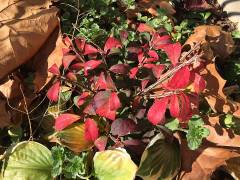
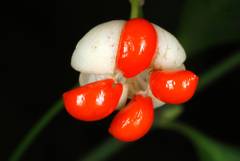
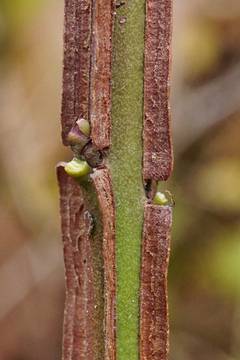
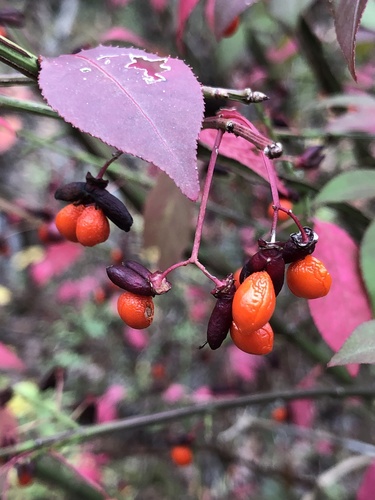
Euonymus alatus is a spreading vase-shaped to rounded deciduous shrub in the staff-tree family (Celastraceae) reaching 10–15 feet (3–4.5 m) tall with a spread of 10–15 feet (3–4.5 m). The species separates from most other deciduous shrubs by the prominent corky wing-like ridges (alae) running along the stems — wings are 0.1–0.2 inch (3–5 mm) wide and extend the length of each branch, which gives the twigs a squared or flanged cross-section visible year-round. Leaves are elliptic 1–3 inches (2.5–8 cm) long, medium green through summer, turning vivid fluorescent scarlet-red to crimson-red in fall; fall color ranks among the highest-intensity reliable displays in cultivated shrubs and develops even in partial-shade positions where many red-fall-color species read muted. Flowers are inconspicuous greenish-yellow 0.25 inch (6 mm) in May and are not the ornamental feature. Small red-purple capsules split in fall to reveal orange-red seeds. Growth rate is slow to moderate. The species has been documented as invasive in parts of eastern North America through bird-dispersed seed escape into natural areas. Hardy to zone 4.
Native Range
Euonymus alatus is native to northeastern Asia (China, Japan, Korea, Manchuria, Russian Far East), where it occurs in woodland edges, thickets, and open forests.Suggested Uses
Grown as a specimen, hedge, or mass planting at 8–10 foot (2.4–3 m) spacing. Vivid fluorescent scarlet-red fall foliage is the primary ornamental feature and carries 3–4 weeks of color before leaf drop. Corky winged stems add winter structural interest after the foliage falls. The shrub functions as an informal hedge or screen at mature size. The species has been documented as invasive in parts of eastern North America through bird-dispersed seed escape; gardeners in those regions have alternatives such as Fothergilla gardenii and Itea virginica, which carry similar fall-color value without the invasive behavior. Sites within regions where the species is known to naturalize or is regulated are not suitable given the documented seed-dispersal pattern.How to Identify
Appearance
Size & Dimensions
Height10' - 15'
Width/Spread10' - 15'
Bloom Information
Inconspicuous greenish-yellow flowers 0.25 inch (6 mm) across open in small axillary clusters in May. The flowers are not the ornamental feature of the species. Small red-purple capsules 0.3 inch (8 mm) across split open in fall to reveal orange-red seeds carried by birds, which contributes to the species invasive-spread pattern in eastern North America.
Detailed Descriptions
Foliage Description
Medium green summer; vivid fluorescent scarlet-red to crimson-red fall; elliptic 1-3 inches longGrowing Conditions
Sun Requirements
Requires 4-10 hours of direct sunlight daily
• Full Sun: 6+ hours of direct sunlight
• Partial Shade: 3-6 hours of direct sunlight
• Full Shade: Less than 3 hours of direct sunlight
Care & Maintenance
Care Guide
Grows in full sun to partial shade in well-drained soil at pH 5.5–7.5, tolerating loam, clay, and sand. Fall color develops most intensely under full sun but remains reliable even in partial-shade positions, which separates this species from many red-fall-color shrubs that require full sun for color development. Hardy to zone 4. Tolerates a wide range of soil and moisture conditions once established. Growth is slow to moderate. The species has been documented as invasive in parts of eastern North America through bird-dispersed seed escape into woodlands and natural areas; gardeners in affected regions often substitute native alternatives with similar fall-color value, such as Fothergilla gardenii or Itea virginica, which carry the red-to-orange fall display without the documented naturalization behavior.Pruning
Light pruning is done in late winter to early spring to shape the plant. The species tolerates hard pruning and regenerates from basal wood without difficulty. The natural vase-shaped to rounded form develops without intervention. Basal suckers are removed if the grower wants a single-stemmed specimen rather than a multi-stemmed shrub.Pruning Schedule
Prune: February–March
winterearly spring