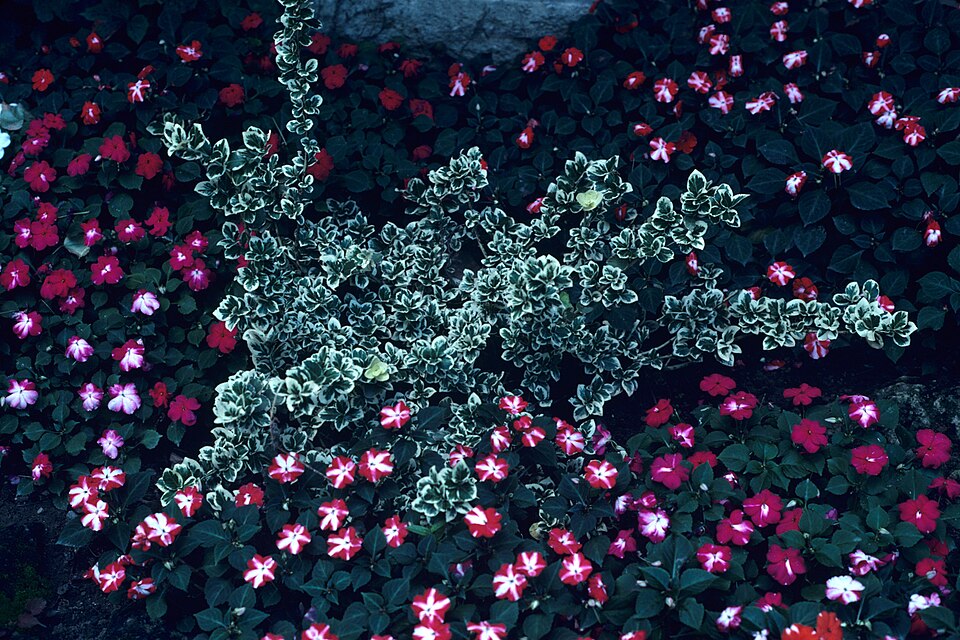
Euonymus, Genus, fortunei, Species, 'Emerald Gaiety', Cultivar,
- Genus & species
- Cultivar
emerald gaiety euonymus
China, Korea, Japan, and the Philippines; woodland understory and rocky slopes
Overview
Euonymus fortunei 'Emerald Gaiety' is a spreading evergreen shrub or self-clinging vine growing 3–4 feet (90–120 cm) tall and 4–6 feet (1.2–1.8 m) wide as a shrub, or climbing 10–15 feet (3–4.6 m) on vertical surfaces via aerial rootlets. Opposite ovate leaves 1–1.75 inches (2.5–4.5 cm) have dark green centers with bright white to cream margins; the white margins acquire a pink to rosy-pink tinge in cold weather from fall through late winter. Inconspicuous greenish-white 4-petaled flowers 0.2 inch (5 mm) appear in small axillary cymes in June–July for about 4 weeks. The species belongs to Celastraceae; fortunei honors Robert Fortune, the 19th-century Scottish plant collector. Native to China, Korea, Japan, and the Philippines in woodland understory and rocky slopes. E. fortunei is classified as invasive in many eastern US states from Massachusetts to Kentucky — runners and bird-dispersed seeds allow spread into native forest understory. This invasive potential is the principal ecological limitation. Euonymus scale (Unaspis euonymi) is a serious pest that can cause severe defoliation. Powdery mildew also occurs. All-green reversion shoots appear periodically and should be removed to maintain variegation. All plant parts contain cardiac glycosides and are toxic to people and pets. Drought-tolerant once established. Hardy in zones 5–9.
Native Range
Species native to China, Korea, Japan, and the Philippines, in woodland understory and rocky slopes. 'Emerald Gaiety' was selected in cultivation.Suggested Uses
Used as an evergreen groundcover, low border edging, or self-clinging vine on masonry walls and fences, and in containers of at least 5 gallons (19 L), spaced 3–5 feet (90–150 cm). E. fortunei is classified as invasive in many eastern US states; in-ground planting near natural woodland is the principal siting restriction. All parts toxic. Zones 5–9.How to Identify
Appearance
Size & Dimensions
Height3' - 4'
Width/Spread4' - 6'
Bloom Information
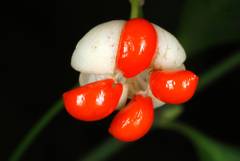
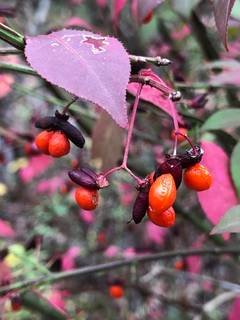
Summer (June–July) over about 4 weeks. Tiny greenish-white 4-petaled flowers 0.2 inch (5 mm) in small axillary cymes. Not showy. Occasional orange-red capsules with white arils follow in fall.
Detailed Descriptions
Flower Description
Greenish-white; tiny; 4-petaled; 0.2 inch (5 mm); in small axillary cymes; June-July; not showy; occasional orange-red capsules with white arils in fallFoliage Description
Dark green centers with bright white to cream margins; opposite; ovate; 1-1.75 inches (2.5-4.5 cm); margins acquire a pink to rosy-pink tinge in cold weather (fall through late winter); evergreen year-roundGrowing Conditions
Sun Requirements
Tolerates up to 8 hours of direct sunlight daily
• Full Sun: 6+ hours of direct sunlight
• Partial Shade: 3-6 hours of direct sunlight
• Full Shade: Less than 3 hours of direct sunlight
Care & Maintenance
Care Guide
Grows in full sun to full shade with 0–8 hours of direct light — tolerant of a wide light range. Soil pH 5.5–7.5 in well-drained loam, clay, or sand. Drought-tolerant once established. E. fortunei is classified as invasive in many eastern US states from Massachusetts to Kentucky. Euonymus scale (Unaspis euonymi) is a serious defoliating pest; horticultural oil applied in the dormant season and at crawler emergence can suppress populations. Powdery mildew also occurs in humid stagnant conditions. All-green reversion shoots appear periodically and should be removed promptly. All parts contain cardiac glycosides and are toxic to people and pets. Suitable for zones 5–9.Pruning
Prune in early spring (March–April) to shape and control spread. Tolerates hard pruning into older wood. Remove all-green reversion shoots promptly at any time to maintain the white-margined variegation. Stems escaping the planting bed can be cut back during the growing season.Pruning Schedule
Prune: March–April
early spring
Container Growing
Suitable for container growing
Minimum container size: 5 gallons