Eriogonum, Genus, inflatum, Species,
- Genus & species
desert trumpet
Southwestern United States and northern Mexico
Overview
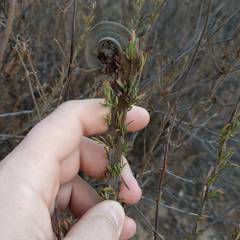
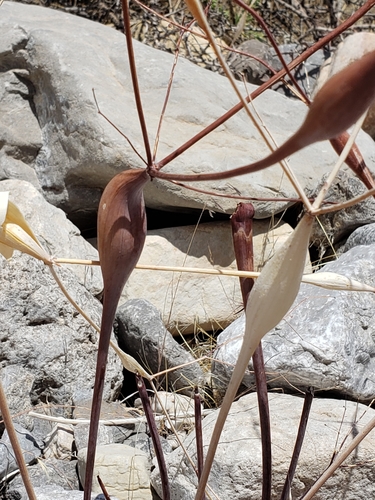
Eriogonum inflatum, the desert trumpet, is a desert perennial in the Polygonaceae set apart by the swollen, hollow stem that gives it its name. From a basal rosette of rounded, grey-green leaves 0.5-1.5 inches (1-4 cm) long, smooth blue-green stems rise 8-40 inches (20-100 cm) tall and balloon outward just below the upper branch points into a trumpet-like swelling. The wiry upper branches fork repeatedly and carry tiny yellow flowers, each only about 0.1 inch (2-3 mm) across, in small clusters from spring through summer. The basal leaves often wither early, leaving the green, photosynthetic stems to carry the plant through the dry season. It grows in open desert, on sandy and gravelly flats, washes, and rocky slopes across the southwestern deserts. Plants are small in dry years and taller after wet winters. The inflated stems are filled with air rather than serving any storage role, and the plant carries little leafy cover, reading more as a sculptural skeleton than a leafy perennial.
Native Range
Native to the southwestern United States and northern Mexico, across the Mojave, Sonoran, and Great Basin deserts from California and Nevada to Utah, Arizona, and into Baja California and Sonora. It grows in open desert scrub, on sandy or gravelly flats, washes, and rocky slopes, mostly at low to middle elevations.Suggested Uses
Used in desert, rock, and gravel gardens, xeriscapes, and native plantings, and as a curiosity for its inflated stems, spaced 10-18 inches (25-45 cm) apart. It suits hot, dry, low-water sites and containers with sharp drainage. The sparse foliage and short life make it poorly suited to lush borders or moist ground.How to Identify
Appearance
Size & Dimensions
Height8" - 3'4"
Width/Spread8" - 1'6"
Bloom Information
Tiny yellow flowers open over a long season, mainly March through June and sometimes again after summer rain. They are carried in small clusters at the tips of the wiry, forking upper branches. The flowers are minute, so the plant is noticed more for its inflated stem than its bloom.
Detailed Descriptions
Foliage Description
grey-greenGrowing Conditions
Sun Requirements
Requires 6-12 hours of direct sunlight daily
• Full Sun: 6+ hours of direct sunlight
• Partial Shade: 3-6 hours of direct sunlight
• Full Shade: Less than 3 hours of direct sunlight
Care & Maintenance
Care Guide
Grows in full sun in dry, fast-draining sandy, gravelly, or rocky soil over a pH range of about 6.5-8.5. Water needs are very low; established plants depend on seasonal rainfall and rot in wet or poorly drained ground. It tolerates intense heat, drought, and poor soil, and self-sows where conditions suit. Container plants need a gritty mineral mix and sparing water. In cultivation it is short-lived and is renewed from seed sown in autumn or spring.Pruning
Needs no pruning. Dead stems and spent flower stalks can be removed once dry to tidy the plant. The hollow stems are brittle and snap easily, so handling is kept to a minimum.Container Growing
Suitable for container growing
Minimum container size: 2 gallons