Eriogonum, Genus, compositum, Species,
- Genus & species
arrowleaf buckwheat
Overview
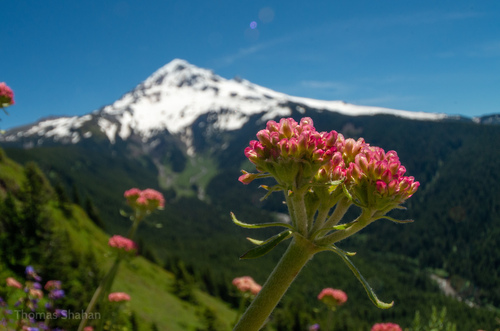
A clump-forming evergreen subshrub-perennial reaching 8-24 inches (20-60 cm) tall during flowering and 12-24 inches (30-60 cm) wide, growing from a stout woody taproot and branching basal crown. Foliage forms a basal rosette of broadly arrow-shaped (sagittate) leaves 1-4 inches (2.5-10 cm) long, gray-green above and densely white-woolly beneath, on petioles roughly equal to the blade length. Leafless flowering stems (scapes) carry compact, branched, umbel-like inflorescences 2-5 inches (5-13 cm) wide with cream to pale-yellow flowers 0.1 inch (3 mm) across; flowers age to rust-red as they dry and persist on the stem into autumn. Plants flower May through July across the species' range. Foliage remains semi-evergreen in mild zones (8-9) and dies back partially in colder zones (5-7) where it regrows from the rootstock in spring. Roots withstand temperatures to -25°F (-32°C). Plants do not transplant from established stands; the long taproot does not recover from disturbance.
Native Range
Native to the inland Pacific Northwest from south-central Washington through eastern Oregon to northwestern California and western Idaho. Found on dry rocky slopes, basalt cliffs, sagebrush steppe, and ponderosa pine openings at 500-7,000 feet (150-2,150 m).Suggested Uses
Planted in dryland gravel gardens, native rock gardens, and steppe-style perennial plantings within zones 5-9 at 18-24 inch (45-60 cm) spacing. Pairs with Penstemon, Astragalus, and bunchgrasses in xeric plantings. Container culture is sustained 2-4 years in pots of at least 3 gallons (11 L) with pure mineral substrate and no summer fertilizer.How to Identify
Appearance
Size & Dimensions
Height8" - 2'
Width/Spread1' - 2'
Bloom Information
May through July across the species' range, with peak flowering in June. Lower-elevation populations bloom in May; higher-elevation stands continue into early August. Each flower lasts 5-7 days; total bloom per stand 6-8 weeks. Dried flower clusters persist on the stem September into November and remain on the dormant plant.
Detailed Descriptions
Flower Description
Cream to pale-yellow ageing to rustFoliage Description
Gray-green above, white-woolly beneathGrowing Conditions
Sun Requirements
Requires 6-12 hours of direct sunlight daily
• Full Sun: 6+ hours of direct sunlight
• Partial Shade: 3-6 hours of direct sunlight
• Full Shade: Less than 3 hours of direct sunlight
Care & Maintenance
Care Guide
Plants benefit from supplemental water for the first growing season after planting; established plants require no irrigation in zones 5-8 with annual rainfall above 12 inches (30 cm). Crown rot develops on irrigated heavy clay or in containers without sharp drainage and is the primary cause of plant loss in cultivation. Aphids cluster on flower stems and are managed by predator activity within 1-2 weeks. Stands persist 7-12 years on dry, well-drained sites; inland summer rain shortens lifespan to 3-5 years on rich loam. Mature plants are damaged by transplanting because the taproot does not recover from disturbance.Pruning
Spent inflorescences can be removed at the base in late autumn after the dried flower clusters have persisted through autumn; alternately, stems are left in place over winter and trimmed in February. Foliage receives no cutting, as the basal rosette carries multi-year photosynthetic tissue and partial defoliation slows recovery for two seasons.Pruning Schedule
Prune: February
winter
Container Growing
Suitable for container growing
Minimum container size: 3 gallons