Eriogonum, Genus, wrightii, Species,
- Genus & species
Wright's buckwheat
Southwestern United States and northern Mexico
Overview
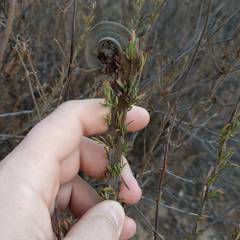
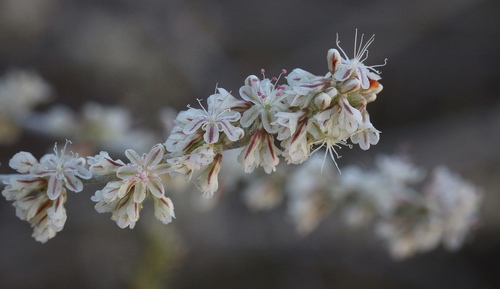
Eriogonum wrightii is a woody-based subshrub reaching 6-24 inches (15-60 cm) tall and 12-36 inches (30-90 cm) wide, forming a low mound of branched gray stems. Leaves are oblong to elliptic, 0.25-0.75 inch (6-19 mm) long, gray-green above and densely white-woolly beneath, clustered along the stems and at branch tips. Tiny white to pink flowers, each about 0.1 inch (2-3 mm) across, are carried in interrupted spike-like clusters from summer into fall, aging to rust-brown as seeds mature. The plant is anchored by a woody taproot and develops a tangled, semi-evergreen framework that persists through winter in mild climates. Growth is slow to moderate, with plants reaching full size in 2-3 years. Foliage and stems are densely hairy, an adaptation to arid heat and high light. In prolonged drought the oldest leaves drop, leaving bare lower stems. Flowering is reduced in shade or in soils that hold moisture through winter, conditions that also shorten the plant's lifespan.
Native Range
Native to the southwestern United States from California east to Texas and north to Nevada and Utah, and south into northern Mexico. Grows on dry slopes, rocky ridges, desert scrub, and pinyon-juniper woodland at 1,500-9,000 feet (450-2,700 m) elevation.Suggested Uses
Planted in rock gardens, dry slopes, and native and pollinator gardens in arid and semi-arid regions, spaced 18-36 inches (45-90 cm) apart. The flowers draw native bees and butterflies. Suited to unirrigated and low-water landscapes; grows poorly in lawns or beds with regular summer water.How to Identify
Appearance
Size & Dimensions
Height6" - 2'
Width/Spread1' - 3'
Colors
Bloom Information
Flowers from June through October across most of its range, with peak bloom in late summer. Bloom timing shifts earlier at low desert elevations and later at higher elevations. Individual clusters remain in flower for several weeks before fading to rust-brown seedheads that persist into winter.
Detailed Descriptions
Flower Description
white to pinkFoliage Description
gray-greenGrowing Conditions
Sun Requirements
Requires 6-12 hours of direct sunlight daily
• Full Sun: 6+ hours of direct sunlight
• Partial Shade: 3-6 hours of direct sunlight
• Full Shade: Less than 3 hours of direct sunlight
Care & Maintenance
Care Guide
Grows in full sun and sharp-draining soils, tolerating rocky, sandy, and gravelly substrates of low fertility. Water deeply but infrequently during the first year to establish the taproot, then reduce to occasional irrigation, as established plants survive on rainfall in arid regions. Excess water and poorly drained soil cause root rot and stem dieback. Flowering declines in shade and in enriched garden soils. Serious pests are uncommon, though aphids may gather on flower stalks. Lifespan is typically 5-10 years, shorter in heavy soils or under summer irrigation.Pruning
Shear lightly after flowering to remove spent seedheads and hold a compact form. Cut back leggy or winter-damaged stems in early spring before new growth begins; the woody base resprouts readily. Cutting into old bare wood produces little regrowth.Pruning Schedule
Prune: March & October
early springfall
Container Growing
Suitable for container growing
Minimum container size: 3 gallons