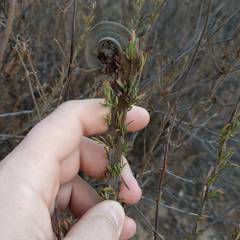
Eriogonum, Genus, umbellatum, Species,
- Genus & species
Sulfur buckwheat
Overview
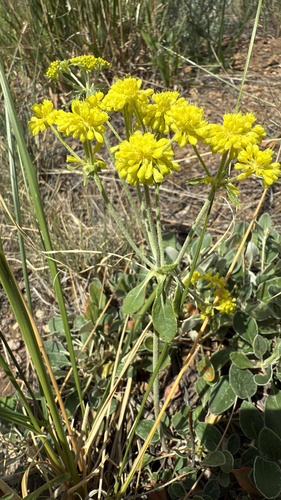
Eriogonum umbellatum is a perennial subshrub forming low mats or mounds, reaching 4-24 inches (10-60 cm) tall in flower depending on variety and spreading 12-36 inches (30-90 cm) wide. Branches are woody at the base with terminal rosettes of evergreen leaves. Leaves are ovate to elliptic, 0.4-1.2 inches (1-3 cm) long, with green upper surfaces and densely white-woolly undersides. Erect leafless flowering stems hold compound umbels 4-16 inches (10-40 cm) above the foliage; a single involucre of leafy bracts subtends the umbel where rays branch. Individual flowers are sulfur-yellow at peak bloom, fading to orange or rust as they age, 0.1-0.2 inches (3-5 mm) across. Bloom occurs from June through August. Achenes are 3-angled, 0.1 inch (3 mm) long. Plants persist 10-20 years on well-drained sites; lifespan is shorter on heavy or irrigated soils. Foliage darkens to bronze or burgundy in autumn and remains on the plant through winter. The species includes more than 40 recognized varieties differing in height, leaf shape, and flower color depth.
Native Range
Native to western North America from southern British Columbia and Alberta south through California, Arizona, and New Mexico, and east to western Colorado and Wyoming. Found on rocky slopes, ridges, sagebrush steppe, montane meadows, and subalpine ridges at 1,000-12,000 feet (300-3,650 m) elevation, with varieties occupying distinct habitats.Suggested Uses
Used in rock gardens, gravel gardens, and dryland meadow plantings at 18-30 inch (45-75 cm) spacing. Suited to xeriscape designs, scree beds, and pollinator restoration; flowers attract native solitary bees, small butterflies, and Mormon metalmark caterpillars. Performs poorly in mixed perennial borders with regular irrigation.How to Identify
Appearance
Size & Dimensions
Height4" - 2'
Width/Spread1' - 3'
Bloom Information
Flowers open from June through August across most of the range; peak bloom occurs in early July at mid-elevations and in late July to August at subalpine sites. Individual umbels remain in bloom 3-4 weeks; total floral display lasts 5-7 weeks per plant. Flowers fade from sulfur-yellow through orange to rust-brown as they age and persist on the plant through September. Higher-elevation varieties bloom 2-3 weeks later than valley populations.
Detailed Descriptions
Flower Description
sulfur-yellow, aging orange to rust-brownFoliage Description
green with white-woolly undersides; bronze to burgundy in fall and winterGrowing Conditions
Sun Requirements
Requires 6-12 hours of direct sunlight daily
• Full Sun: 6+ hours of direct sunlight
• Partial Shade: 3-6 hours of direct sunlight
• Full Shade: Less than 3 hours of direct sunlight
Care & Maintenance
Care Guide
Water deeply weekly during the first growing season; established plants tolerate 6-8 weeks without rain in regions receiving at least 10 inches (25 cm) of annual precipitation. Plants in irrigated borders or clay soils develop crown rot and decline within 2-3 years. Aphids may colonize flower stems in early summer; populations typically remain below 30 individuals per stem. Plants self-sow modestly on bare gravel, producing 5-15 seedlings per parent annually. Fertilizer is not required; supplemental nitrogen produces lax stems and reduced flowering. Replace plants when crowns die out, typically after 10-20 years.Pruning
Spent flowering stems are cut to the basal foliage in late summer once seed dispersal is complete. The persistent burgundy or bronze foliage remains intact through winter; dead leaves break off as new growth resumes in late April. Cuts into the woody crown can kill the plant; pruning is typically limited to the leafy zone above the woody base.Pruning Schedule
Prune: August–September
summerfall
Container Growing
Suitable for container growing
Minimum container size: 5 gallons