Delphinium, Genus, trolliifolium, Species,
- Genus & species
streambank larkspur
Pacific Northwest from southwestern Washington to northwestern California
Overview
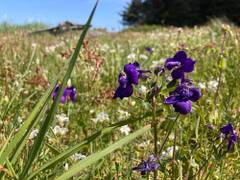
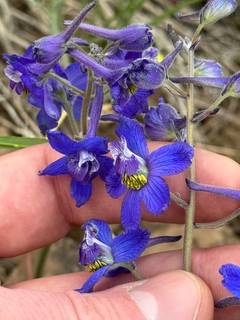
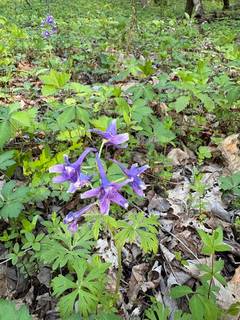
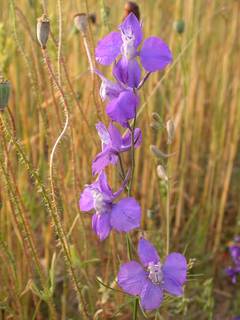
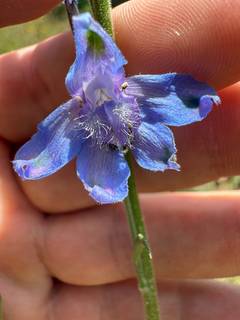
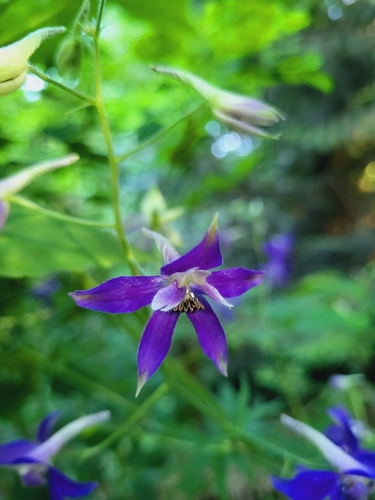
A tall herbaceous perennial reaching 3-6 feet (90-180 cm) tall and 18-36 inches (45-90 cm) wide, growing from a fibrous-fleshy rootstock. Leaves few but large, palmately divided into 5-7 broad, irregularly cut lobes resembling those of Trollius; blade up to 8 inches (20 cm) wide, deep green, mostly clustered near the stem base. Open racemes carry 5-25 widely spaced flowers; flowers deep blue-purple, 0.75-1.25 inches (1.9-3.2 cm) across, with a slender 0.5-0.75 inch (13-19 mm) spur. Plants flower April through June and remain in full leaf longer than other western larkspurs, retaining green basal foliage well into August in moist sites before going dormant. All parts contain norditerpenoid alkaloids and are toxic to livestock and humans on ingestion. Stems may topple during storms because of the open inflorescence and tall stature; surrounding vegetation typically supports stems along streambanks. Plants do not flower in deep shade and decline within 2-3 years on dry, exposed sites.
Native Range
Native to a narrow region of the Pacific Northwest, from southwestern Washington through western Oregon to northwestern California. Found along streambanks, in moist deciduous forests, and on shaded slopes in oak and Douglas-fir woodlands at 200-3,000 feet (60-900 m) elevation.Suggested Uses
Planted in moist-shade gardens, streamside borders, and shaded woodland edges within zones 6-9 at 24-30 inch (60-75 cm) spacing. Used as a tall vertical accent in mixed perennial groupings where soil moisture remains adequate through July. Container culture is rarely successful because of the deep, fibrous rootstock.How to Identify
Appearance
Size & Dimensions
Height3' - 6'
Width/Spread1'6" - 3'
Bloom Information
April through June across the species' range, with peak flowering in May. Cool, moist springs extend flowering by 2-3 weeks; warm, dry springs compress bloom into a 3-week window. Individual flowers last 6-9 days. Secondary flushes are not produced.
Detailed Descriptions
Foliage Description
Deep greenGrowing Conditions
Sun Requirements
Requires 3-6 hours of direct sunlight daily
• Full Sun: 6+ hours of direct sunlight
• Partial Shade: 3-6 hours of direct sunlight
• Full Shade: Less than 3 hours of direct sunlight
Care & Maintenance
Care Guide
Soil moisture during growth is the primary requirement; plants on consistently moist sites remain in active growth into August, while those on drier sites senesce by July. A 2-3 inch (5-7.5 cm) layer of leaf duff applied annually retains summer moisture. Slugs damage new growth in April and May along the coast. Crown rot develops on poorly drained sites that stay saturated below freezing. All parts contain norditerpenoid alkaloids; ingestion poses cardiac and respiratory risks to livestock and humans, and skin contact with cut stems can cause numbness in some individuals.Pruning
Spent flower stems are cut at the base after seed dispersal in July. Foliage is left to senesce naturally and pulls free at the rootstock once dormant. Mid-summer cutting bleeds sap from stems and slows recovery; partial removal is delayed until dormancy when possible.Pruning Schedule
Prune: July
summer
Container Growing
Minimum container size: 3 gallons