Delphinium, Genus, menziesii, Species,
- Genus & species
Menzies' larkspur
Pacific coast of western North America
Overview
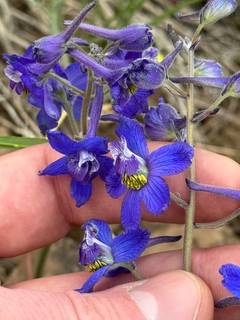
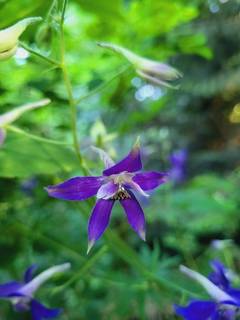
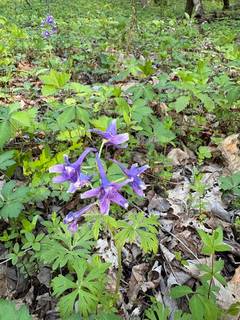
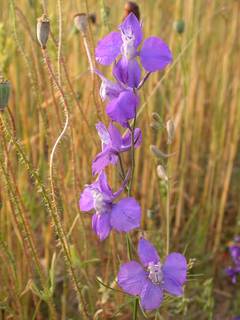
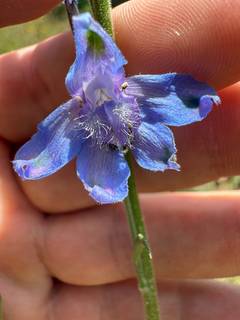
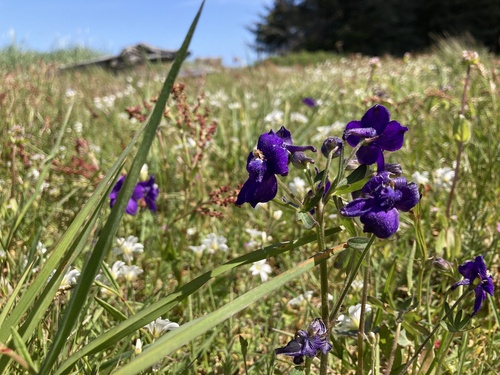
A clump-forming herbaceous perennial reaching 6-20 inches (15-50 cm) tall and 4-8 inches (10-20 cm) wide, arising annually from a short tuberous rootstock. Basal and lower stem leaves deeply palmately divided into 5-7 narrow lobes, each lobe further cut into linear segments 0.1-0.2 inch (3-5 mm) wide; foliage withers as flowering ends. Flowering stems carry 5-15 flowers in an open raceme; individual flowers deep blue-purple, 0.75-1.25 inches (1.9-3.2 cm) across, with five sepals (the upper extended into a 0.5-0.75 inch (13-19 mm) spur) and four smaller petals — the upper two whitish and prominent. Flowering occurs April through June depending on elevation. Plants enter summer dormancy by July, with foliage dying back to the rootstock; new growth resumes the following spring. Seedlings reach flowering size in 3-4 years from spring sowing. All parts contain diterpenoid alkaloids; livestock losses occur regularly across western rangelands where the species grows. Plants are short-lived in garden cultivation outside their native climate, with most stands declining within 3-5 years on irrigated soils.
Native Range
Native to western North America from coastal British Columbia south through Washington and Oregon to northern California, with inland populations east to western Idaho. Found in open coniferous woodlands, oak savanna, coastal bluffs, and grassy slopes from sea level to 7,500 feet (2,300 m).Suggested Uses
Planted in dry meadow plantings, native woodland gardens, and unirrigated borders within its hardiness range, at 8-12 inch (20-30 cm) spacing. Stands occupy cracks between rocks and along path edges where summer drought is reliable. Container culture is rarely successful beyond 2-3 years because crown rot follows even moderate summer watering.How to Identify
Appearance
Size & Dimensions
Height6" - 1'8"
Width/Spread4" - 8"
Bloom Information
April through June at low elevations, with peak flowering in May. Higher-elevation populations may bloom into early July. Total bloom period per stand lasts 3-5 weeks; individual flowers persist 5-7 days. Cool, wet springs extend bloom by 1-2 weeks.
Detailed Descriptions
Flower Description
Deep blue-purple with whitish upper petalsFoliage Description
Mid-greenGrowing Conditions
Sun Requirements
Requires 5-9 hours of direct sunlight daily
• Full Sun: 6+ hours of direct sunlight
• Partial Shade: 3-6 hours of direct sunlight
• Full Shade: Less than 3 hours of direct sunlight
Care & Maintenance
Care Guide
Plants benefit from supplemental water during the first growing season after planting; established plants need no irrigation once foliage senesces in early summer. Crown rot develops in summer-irrigated beds and is the primary cause of stand decline in cultivation. Slugs damage emerging foliage in March and April in coastal climates. Seeds require 6-10 weeks of cold stratification at 32-40°F (0-4°C) before germination and are commonly autumn-sown for natural stratification. All parts contain diterpenoid alkaloids; ingestion can be lethal to cattle, horses, sheep, and humans, with no reliable treatment for severe poisoning. Most stands decline by year 3-5 in non-native climates and are maintained by replacement seeding rather than long-lived plants.Pruning
Spent flower stems can be removed once seed disperses if self-seeding is not desired. Withering foliage is left in place after summer dormancy as it pulls free with light tugging in autumn. Cutting back during active growth slows recovery, as wounds on stems and leaves bleed sap that does not seal quickly in dry summers.Pruning Schedule
Prune: July–August
summer
Container Growing
Minimum container size: 1 gallons