Dahlia, Genus, 'Bishop of Llandaff', Cultivar,
- Genus
- Cultivar
dahlia 'Bishop of Llandaff'
Garden origin, raised in Wales and introduced in 1924
Overview
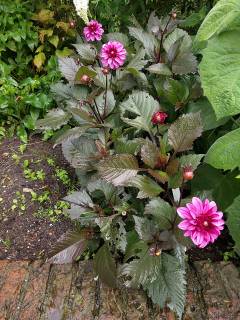
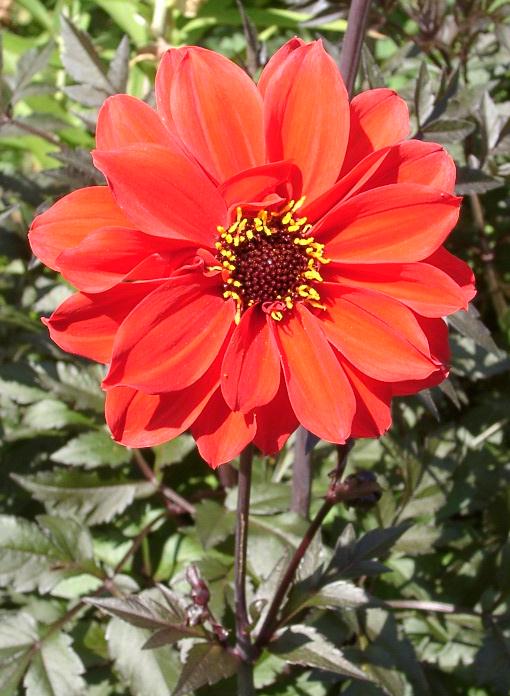
Dahlia 'Bishop of Llandaff' is a tuberous perennial reaching 36-42 inches (90-110 cm) tall and 18-24 inches (45-60 cm) wide in one season from a clump of tubers. Foliage is dark bronze-purple rather than the mid-green of most dahlia cultivars, with leaves pinnately divided into narrow pointed segments 1-2 inches (2.5-5 cm) long. Flowers are semi-double, 3-4 inches (8-10 cm) across, in scarlet-red, with one or two rows of ray florets around an open central disc of yellow and near-black florets. The open centre leaves the disc florets reachable by bees, unlike the fully double flowers of decorative and ball dahlia types. Flowering runs from July until the first frost, with 20 to 40 flowers open at once on an established plant. Stems are hollow and brittle and snap in wind above 25 mph (40 km/h) without support. Foliage colour shifts toward bronze-green under less than 6 hours of direct sun and in summers below 68F (20C). Tubers are killed at 28F (-2C) in the ground and are lifted in zones 3-7 for storage at 40-50F (4-10C). Raised in Wales and introduced in 1924, the cultivar is propagated from basal cuttings or tuber division rather than seed, since seedlings vary in flower form and foliage colour.
Native Range
Dahlia 'Bishop of Llandaff' is of garden origin, raised in Cardiff in Wales and introduced in 1924. It has no wild distribution. The genus Dahlia is native to the highlands of Mexico and Central America, where the wild species grow on rocky slopes and in pine-oak woodland at 5,000-9,000 feet (1,500-2,700 m).Suggested Uses
Planted in mixed borders and cutting gardens at 18-24 inch (45-60 cm) spacing, with stakes set at planting time. Grown in containers of 10 gallons (38 L) or larger, where plants hold at 30-36 inches (75-90 cm) and take daily watering in summer. The open flower centre carries bees and hoverflies from July through October, unlike fully double dahlia types. Cut stems hold 4-6 days in water after the stem end is dipped in near-boiling water for 10 seconds.How to Identify
Appearance
Size & Dimensions
Height3' - 3'6"
Width/Spread1'6" - 2'
Bloom Information
Flowers open from early July in zones 8-10 and from late July in zones 4-7, continuing until the first frost, which ends the season at 28F (-2C). An individual flower lasts 7-10 days on the plant and 4-6 days cut. An established plant carries 20 to 40 open flowers at peak in August and September. Flower production stops within 3-4 weeks where spent heads are left to set seed.
Detailed Descriptions
Flower Description
scarlet-red with a yellow and black central discFoliage Description
dark bronze-purpleGrowing Conditions
Sun Requirements
Requires 6-12 hours of direct sunlight daily
• Full Sun: 6+ hours of direct sunlight
• Partial Shade: 3-6 hours of direct sunlight
• Full Shade: Less than 3 hours of direct sunlight
Care & Maintenance
Care Guide
Tubers are planted 4-6 inches (10-15 cm) deep after the last frost, once soil reaches 60F (15C), and shoots appear in 2-4 weeks. Plants take 1-2 inches (25-50 mm) of water weekly from bud formation onward, applied at the soil rather than over the foliage to limit powdery mildew. A low-nitrogen feed high in potassium goes on every 2 weeks from July, since nitrogen-rich feed produces foliage in place of buds and soft stems. Stakes 4 feet (1.2 m) tall are set at planting, as the hollow stems snap in wind above 25 mph (40 km/h). Earwigs shred the ray florets overnight and slugs strip young shoots in May and June, and both feed after dark. Tubers are lifted after the foliage blackens in the first frost in zones 3-7, dried for 1-2 weeks, and stored in barely moist material at 40-50F (4-10C), while tubers left in ground below 28F (-2C) collapse and rot.Pruning
The growing tip is pinched out above the third or fourth pair of leaves in June, which produces four to six flowering stems in place of one and delays first bloom by 10-14 days. Spent flowers are cut back to the first pair of leaves at intervals of 5-7 days from July onward. Faded heads close to a pointed cone and are told apart from unopened buds, which stay round. Top growth is cut to 4-6 inches (10-15 cm) above the tuber after the first frost blackens the foliage.Pruning Schedule
Prune: June–September
summerfall
Container Growing
Suitable for container growing
Minimum container size: 10 gallons