Paeonia lactiflora 'Coral Charm'
Coral Charm Peony
Hybrid origin (Wisconsin, USA, 1960s); species native to central and eastern Asia
Overview
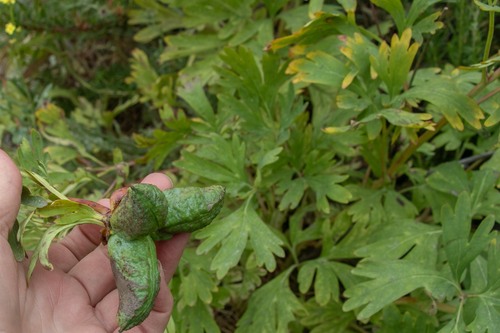
Paeonia lactiflora 'Coral Charm' is a clump-forming herbaceous perennial reaching 30-36 inches (75-90 cm) tall and 30-36 inches (75-90 cm) wide at maturity. Stems are sturdy and thick, holding flowers upright in unstaked plantings. Compound leaves are large, divided into 9 leaflets, each 3-4 inches (7.5-10 cm) long, dark green and glossy through summer; fall color develops as bronze-red in October. Semi-double flowers 7-9 inches (18-23 cm) across open coral-pink and fade through peach to cream-yellow over 7-10 days, producing a multicolor display as flowers age out of phase. Each flower has 12-18 petals around a central boss of yellow stamens. Bloom occurs in late May through mid-June in zones 4-7, lasting 10-14 days at peak in cool spring conditions. Plants live 25-50 years in the same site without division. Mature size requires 3-4 years from a bare-root division. The cultivar was bred by Samuel Wissing of Wisconsin and registered with the American Peony Society in 1964; received the American Peony Society Gold Medal in 2002. Botrytis blight causes black streaks on stems and brown spots on leaves in cool wet springs; affected stems are cut and discarded.
Native Range
The species Paeonia lactiflora is native to central and eastern Asia from Mongolia and Siberia south to northern China, Korea, and Tibet, growing in meadows and open woodlands at 1,500-7,000 feet (450-2,135 m) elevation. 'Coral Charm' is a hybrid cultivar developed in Wisconsin, USA in the 1960s; parentage involves P. lactiflora and additional Asian peony species.Suggested Uses
Used in perennial borders, cottage gardens, and as cut flowers spaced 30-36 inches (75-90 cm) apart. The strong stems and large flowers tolerate cutting; one bud per stem with 6-8 inches (15-20 cm) of stem yields cut flowers that hold 5-7 days in water. Combined with late-spring perennials such as Iris germanica and Aquilegia spp. cultivars in mixed plantings.How to Identify
Appearance
Size & Dimensions
Height2'6" - 3'
Width/Spread2'6" - 3'
Reaches mature size in approximately 4 years
Colors
Bloom Information
Late May through mid-June in zones 4-7, with peak bloom 10-14 days. In zones 8-9, bloom begins in early to mid-May and ends by early June. Individual flowers last 7-10 days, transitioning from coral-pink to peach to cream-yellow during that period. Plants do not rebloom in summer; the entire bloom event lasts 2-3 weeks.
Detailed Descriptions
Flower Description
Coral-pink fading to peach and cream-yellowFoliage Description
Dark green; bronze-red in fallGrowing Conditions
Sun Requirements
Requires 6-8 hours of direct sunlight daily
• Full Sun: 6+ hours of direct sunlight
• Partial Shade: 3-6 hours of direct sunlight
• Full Shade: Less than 3 hours of direct sunlight
Care & Maintenance
Care Guide
Water deeply once weekly during the first growing season with 3-5 gallons (11-19 L) per session in the absence of rain. Established plants tolerate 3-4 weeks without rain but show wilting and leaf scorch during prolonged drought. Plant the crown 1-2 inches (2.5-5 cm) below soil surface in zones 4-7 and at soil level in zones 8-9; deeper planting reduces flowering. Botrytis blight (caused by Botrytis paeoniae and B. cinerea) develops in cool wet springs, with black streaks on stems and brown spots on leaves; affected material should be cut and discarded rather than composted. Annual fall cleanup removes all dead foliage to reduce overwintering disease spores. Plants do not require fertilization in fertile soils; in poor soils, a balanced 10-10-10 fertilizer in early spring at 1/4 cup (60 mL) per plant supports flowering.Pruning
Cut stems to 1-2 inches (2.5-5 cm) above ground level in late fall after the first hard frost, removing all foliage to reduce botrytis spore overwintering. Deadhead spent flowers to direct energy to root growth; allowing seedheads to develop reduces flowering the following year. Established plants do not transplant well; clumps left in place perform reliably for 25-50 years without division. If division is required, dig in early September with 3-5 eyes per division.Pruning Schedule
J
F
M
A
M
J
J
A
S
O
N
D
fall